Joyful

I have been very lucky in my career choice. At age seventeen, I got my first art job. I had about one hundred kids every day in a summer art program. By August, I knew I would love being an art teacher. And now, fifty-nine years later, I am still doing art classes for children… and I can’t think of a happier thing to do.

Children are natural artists and do not need Pinterest directives to be creative. The teacher is merely the catalyst for introducing new topics and challenges, materials and tools. The world as seen through young people’s fresh eyes is filled with delight.

To celebrate Youth Art Month, I’ve put together a small sampling of artwork from the kids I have worked with in schools and libraries throughout my home state of Wisconsin this past year. May their happy, vibrant and unique creations bring a bit of joy to your eyes and heart. We could all use some of that now. (Click here or the picture below for viewing the artwork.)


0

Rooster

We don’t have any roosters at our house, but we might as well have. We have a morning sentinel who moist vociferously greets the dawn each day. Our rooster is in the guise of a cat.

Stripe, a handsome dilute tabby, was a feral cat until we took him in one night a year ago when the temperature was -23 degrees. He is now an extraordinarily loving indoor cat who has adjusted quickly to the indoor life…except in the pre-dawn hours.

Stripe seems to think that the sun will not rise without his help. About a half-hour before sunrise, he starts yowling and running from window to window, checking for progress. These actions are punctuated by him jumping on me to make sure I know he is on the job. I do know, and tell him I think the situation is under control, the sun will rise.

My assurances don’t help, and he continues caterwauling and running around. Being a night person, I am not delighted to have a thirteen-pound alarm clock each morning. I learned ages ago that dawn takes care of itself and that sunsets are more my style.

However, I’m fairly certain that Stripe’s behavior is one of the hard-wired ones like chasing mice or grooming. I’m happy he is inside and safe from cars on our busy road, predators and the neighbor’s dog. So my best option seems to be pulling the covers over my head and trying to get back to sleep. Failing this, I can always just stay in bed and write a blog.

After we are up and about, it doesn’t take Stripe long to figure out he needs to take his mid-morning nap. He jumps up on our freshly made bed, curls up and falls asleep instantly. It’s hard work getting the sun over the horizon every morning.

Stripe

0

Lions

The saying, “March comes in like a lion but goes out like a lamb” does not ring true in my state of Wisconsin. Having lived here a lifetime, I know the first part is correct. However, March most often ends roaring out like a lion as well.  The few lambs that might be about would be camouflaged by the snowbanks. So March is the perfect time to talk about lions, Panthera leo, the namesake of our blustery weather.

Even though lions are called “The King of the Beasts”, they are not the largest of the big cats. Tigers get that honor. The heaviest recorded lion was 826 pounds. Average weights are 400 pounds for males and 290 pounds for lionesses.

Lions live on plains and grasslands in southern and Eastern Africa, with Tanzania having the largest lion population. All lions are threatened by habitat loss and their numbers are decreasing. Their conservation status is listed as vulnerable.

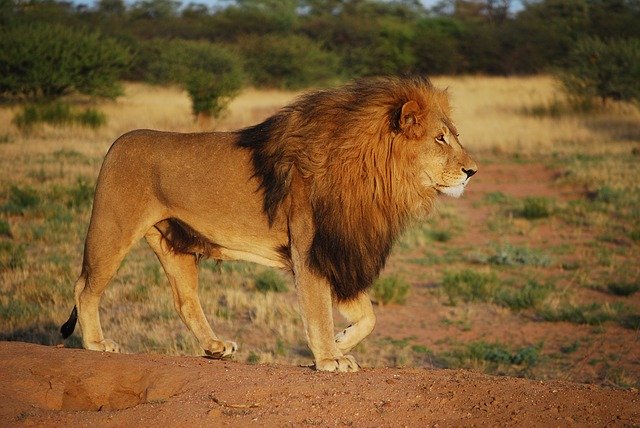
Lions differ significantly from other cats in four ways: they live in groups, have no spots or stripes, have tasseled tails and are dimorphic. Dimorphism means “two forms”. Lions are sexually dimorphic as the male and female differ noticeably in appearance. Hence, even a kindergartener can tell which lion is dad.

The darker a lion’s mane, the older he is. Lionesses prefer guys with the darker, longer manes.

A pride of lions consists mostly of females, offspring and a few males. The males defend the group and the females do 90% of the hunting, although the males always eat first. The women’s rights movement has not yet reached lion land.

Only the big cats can roar, and the lion’s roar is mighty. It can be heard from five miles away.

Don’t race a lion. They can reach speeds of fifty miles per hour for a short while. Don’t try to out-leap them, either. A lion can leap thirty-six feet.

Lions eat an average of about 18 pounds of meat a day. That’s the equivalent of a person eating seventy hamburgers at a sitting.

The lion’s bite is thirty times stronger than that of a house-cat. However, the jaguar’s bite is much stronger.

And, finally, in true cat fashion, lions are sleepyheads. As many as twenty-two hours a day are spent slumbering. So if you are inclined to take a nap, don’t feel guilty. Just think, “I’m resting up for the hunt.”
0
Bang!

I will never tire of teaching. The joy of sharing the world’s wonders with children and hearing their thoughts and questions never diminishes.

A few weeks ago, I had one of those perfect teaching moments. I was explaining basic solar system facts to 25 third graders, all great kids. One boy in particular was giving extremely knowledgeable answers to my “tough, hard, brain-breaking” questions. When it was time for the kids to ask me questions, his hand shot up and he asked, “Did the Big Bang” make a noise? You said sound does not travel without air.”

“That’s a terrific question,” I replied, “and I will have to do some research and get back to you with the answer.”

So if you ever wanted to know if the Big Bang actually went “Bang”, here are the results of my search.

A professor at Washington State University, James Crawford, devoted years on reconstructing the sound of the Big Bang. He has concluded that the sound was a robot-like hum that could not be heard by the human ear. This is because the newborn universe was plasma, not gas, and the pressure waves it produced were Ion Acoustic Waves which are inaudible to the human ear.

However, 379,000 or so years later, the universe had cooled down enough for “electrons and protons/neutrons to bind together to form atoms. Then, potentially, sound waves that could be heard by the human ear could start to propagate through clouds of gas. Unfortunately, there were no humans around then to hear that sound.

While doing this research, I came up with a delightful bit of information. James Crawford’s groundbreaking research began when an eleven-year-old at one of his science presentations asked him, “Did the Big Bang make a noise?”

0

Alert!

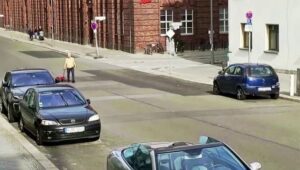
A monumental traffic jam was reported in Berlin recently causing warnings to be sent out on Google Maps. Drivers were given other routes to avoid the massive 99 car tie-up.

At the exact time the jam was noted, the actual street under notice was almost void of traffic. How could this be possible?

Credit one extremely creative artist and prankster named Simon Weckert. He states, “What I am interested in generally is the connection between technology and society and the impact of how it shapes us…I have a feeling right now that technology is not adapting to us, it’s the other way around.”

So Mr.Weckert set out to put humans back in charge. He created a Google hack by putting 99 cell phones, all with location apps on, in a little red wagon. Then he slowly walked down a street that had very sparse traffic, a street that was not coincidentally the one where Google’s Berlin offices are located.

His plan worked brilliantly. After a short while, the bright red warning line appeared on Google maps and his faux traffic nightmare was noted as reality.

Google responded with humor. “We’ve launched the ability to distinguish between cars and motorcycles…though we haven’t quite cracked traveling by wagon…We appreciate seeing creative uses for Google maps like this as it helps us make maps work better over time.”

I have two thoughts on this art happening. First, there is hope that a human still can occasionally outwit a computer. And second, the Google employees in Berlin should occasionally look out their windows.

0