Redheads

I saw two big redheads standing in a field beside the highway this week. At up to five feet tall with a flaming red streak on their foreheads, Sandhill Cranes stand out like exclamation points on the landscape.

The Sandhills are one of only two crane species in North America and they number about 530,000. In contrast, the Whopping Crane is extremely rare with a total population of both wild and captive birds numbering around 600.

Wisconsin is Sandhill country. These impressive birds return from their Florida vacations as early as the end of February or the first weeks of March. Pairs, which mate for life, stake out a territory in a marsh. Having sex in a cold, wet marsh wouldn’t appear to be a turn on, but the cranes go at it with gusto. They preen mud into their feathers and engage in unison calling and dancing, which consists of bowing, jumping, running, stick and grass tossing and wing flapping. The Sandhills can jump 20 feet high in the exuberance of a mating dance.

Their nests are built from large clumps of vegetation and are in low, wet places or even floating in the wetlands. Mom usually lays two eggs. Within 24 hours of hatching, the young, who are called colts, can walk, swim and find food. Their shape resembles “eggs on legs”. By day two, the baby Sandhills, who are all highly aggressive, start fighting. They play for keeps: frequently, only one survives. Real life is not a Disney movie.

The remaining family spends the summer together in farmers’ fields eating their favorite food, grain. But like most survivors, they are not fussy eaters……berries, seeds, insects, crayfish, worms, clams, reptiles, amphibians and even small birds and mammals are all on their menus.

When Sandhills take to the air,  they always fly with their necks extended and their legs trailing behind, like giant arrows transversing the sky.

Click on this link to view these magnificent birds.

sh


0

Remains

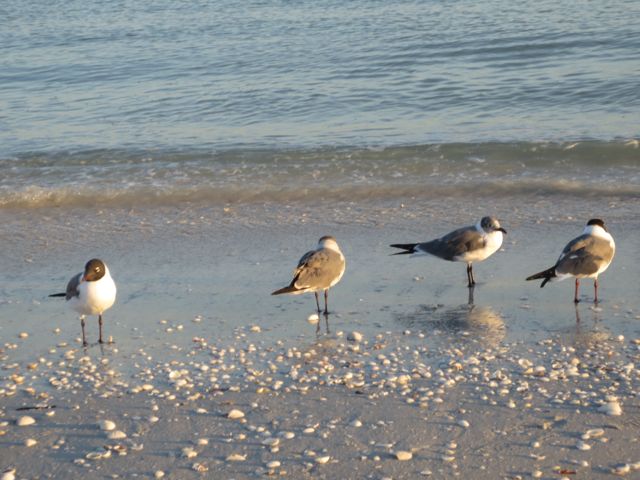
The hour before sunset on an ocean beach exudes calm. The wave-jumpers, sand castle builders, sun seekers, shell collectors and volleyball players all have departed. Shore birds do swoop down to catch a last fish and the sandpipers run around like over-wound wind up toys. Otherwise, the peace is palpable.

The remains of the day are everywhere. Complex sand castles and shell gardens await  the ravages of high tide. The day’s deposits of shells, sponges and seaweed are scattered on the beach like hundreds of still lifes. I attempt to capture these vignettes with my camera. A poor photographer at best, I don’t know how to deal with the rapidly lengthening shadows and diminishing light. I click and hope for the best.

As our part of the planet spins into darkness, the sun puts on a spectacular show. My vision-impaired Aunt used to ask me, “Do you think we will have a good one tonight?” Her tired eyes could still see brilliant sunsets. I wish she could have seen this one.

Click here for 40 seconds of tranquility.

Note: The long, curly things on the beach are whelk egg cases. Filmed at Sanibel Island, Florida.

birds

0

Puddles

“There’s a big one, go get it!” the mom gently suggested to her little boy. He was about four years old and was wearing shiny, new rubber rain boots. He headed for a big puddle and splish splashed through it, a huge grin on his face.

“How do they work?” his mom asked.

I spotted this duo as I was leaving a school at the end of the day. They were checking out all the puddles in the school parking lot while waiting for an older sibling. What an excellent pursuit!

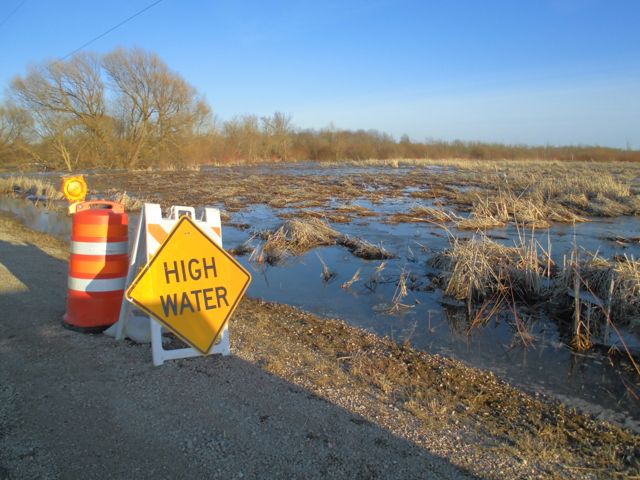
Springtime is puddle time. This year promises to have a bumper crop. When I looked out my kitchen window the other day, Lake Dennis had appeared in the field across the road. Our good neighbor, Dennis, owns the field and gets an ephemeral lake each spring in a low spot. One year the gigantic puddle lasted so long that it acquired a resident pair of ducks. This year it could host a flock.

We have puddles as well. The plow guy created a story high mountain of snow at the end of our downward sloping driveway. Now that the temperatures finally are inching above freezing, I asked my husband if we might possibly need a few sandbags, a dike or an ark. The ark idea was quickly dismissed as our resident cats (mostly toms) would never peacefully go two by two up the ramp.

My husband choose a different solution. He emulated the Netherlands and has dug little canals to contain and control the direction of the melt. This system is not yet perfect, but the water has been diverted from running into the garage.

E.E. Cummings described the springtime world as “mud-luscious” and “puddle-wonderful”. We should all go out and stomp around a bit. By August we may be in the clutches of drought with puddles merely memories.

CIMG0318 


0

Introverts

I recently heard a fascinating program on NPR on the virtues of introverts. Bravo! Introverts, for obvious reasons, are loathe to sing their own praises.

People who need periods of solitude, the speaker noted, are often society’s creators and innovators. This view of how things work flies in the face of the current cherished myths on creative thinking. At the moment, group work enjoys a godlike reverence in schools and businesses. We are expected to get our most creative inspirations as a loyal member of a brainstorming team. The best way to kill your grade or your job would be to say, “Let me go to a quiet place and think about that.”

I can report from personal experience that I have never conceived one creative thought as part of a committee given the task of “coming up with ideas.” And I am delighted that research into brainstorming now backs up the frequent futility of these groupthink exercises.

My best ideas strike when I’m alone, without pressure and free to let my mind wander. A long road trip or plane flight is often the incubator. Perhaps the motion puts thoughts in motion.

I love people and believe in contributing to joint efforts. But a distinction must be recognized between coming up with ideas and implementing them. My husband and I frequently collaborate. I conceive the idea for a graphic design and he provides the technical expertise to turn the idea into a reality. We bring our best, but totally different, skills to the table. I also work every week with excellent teachers and librarians. I come with ideas and programs: my peers tailor those ideas for their young people.

I would like to give Dr. Seuss the last word on introverts. He said,”You can get help from teachers, but you are going to have to learn a lot by yourself, sitting alone in a room.”

pbag

0

Tessellations

I must begin by stating that I still love lizards. Nevertheless, 65 lizards recently almost drove me crazy.

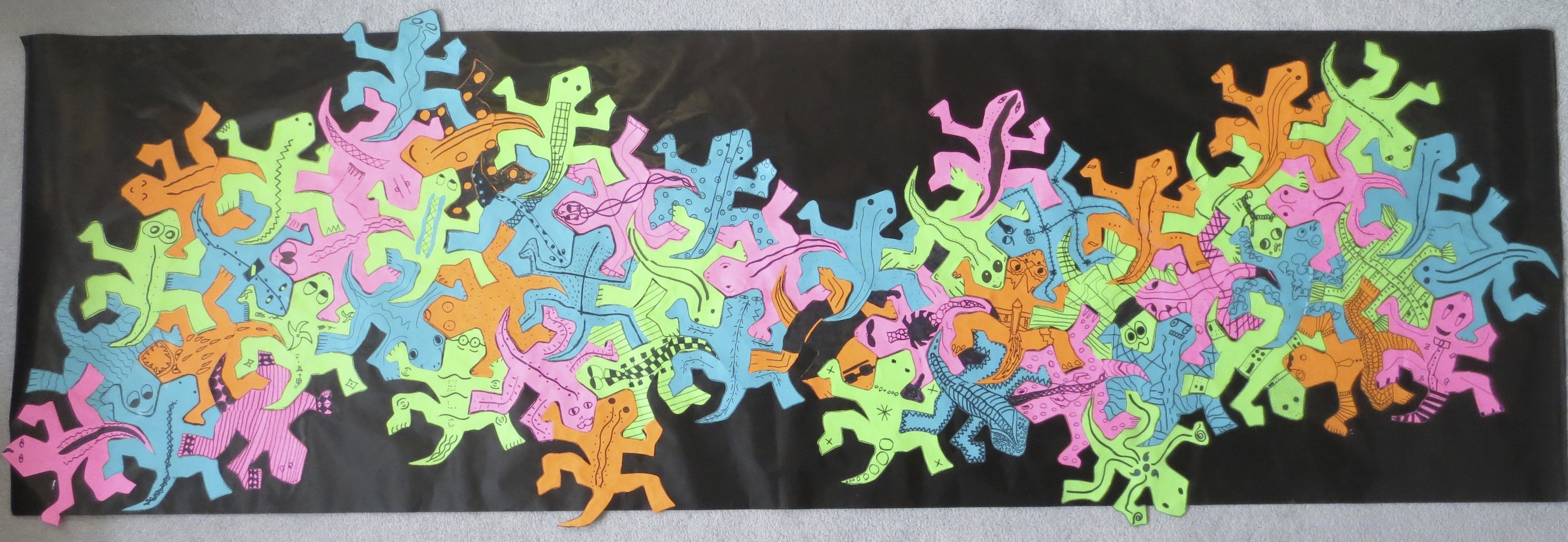
One of my favorite schools asked me to do one of my favorite programs, All About Lizards, for their sixth grade classes. Natural science, and lizards in particular, are not hot topics in our schools at the moment. I was excited about the booking. Then an idea popped into my head. I always conclude my science programs with a short art project. What if I told the students about the Dutch artist M.C. Escher and his wonderful lizard tessellations? Then we could construct a lizard tessellation.

Small alarm bells did go off in my head as math skills are not my forte. To be on the safe side, I decided to show a short video on the math involved in making a tessellation. Then I gave each student a pattern of a lizard to creatively decorate and  carefully cut out. Time did not allow us to make our own patterns.

All was going well until someone handed me the fourth lizard. It did not fit neatly as a puzzle piece into its other lizard friends. I had that old familiar sinking feeling: math is something that works for other people but not for me. In fact, math hates me. I felt a nightmare gearing up.

I took all the lizards home to decipher what went wrong and consult my resident math guy. Within an hour, two of us were going crazy. Several more hours later we solved the problem. The pattern I found on the computer was incorrect, 1/4 inch off and not a true tessellation. Surgery was performed with scissors and Scotch tape on 65 lizards. The post operative lizards were glued into place and all cooperated.

All’s well that ends well. I now have a perfect pattern and the kids have a mural up at their school.

tessellation3

0