Crabby

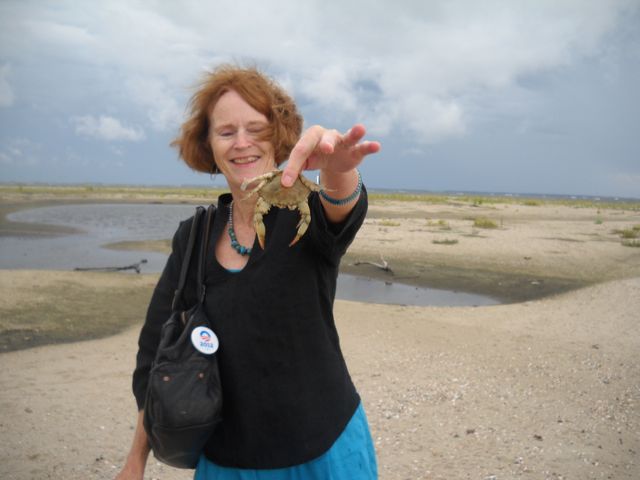
Our first animal rescue was not a cat. This fact probably comes as a surprise to those who know us. Our first rescue was a crustacean, a grapefruit size hermit crab.

All rescue animals come with sad stories, and his was no exception. This gigantic crab plus his shell home and small terrarium was dropped off at the creative arts kindergarten where I worked. His pincers were strong enough to snap off a tot’s misplaced fingers. A note suggested that crab would be an interesting pet for our school. We knew otherwise.

None of the school’s staff volunteered to take him home, but one person offered to dispose of him.  That’s when I raised my hand and left with a crab in the back seat of my car.

A pet rock would have had a more scintillating personality than our crab. For months and months, we never saw him move. In fact, the only proof of life was a small amount of missing food and water each morning.

But then one day I was cleaning his terrarium and decided to put Crabby on the laundry room floor so I could thoroughly scour his tank. A few moments later, I heard a strange thumping, clunking sound. Our “comatose” crab was scooting down the hall to the living room banging his shell against the baseboard he was following. I was simultaneously stunned and heartbroken. His message was clear; would I or any other creature sprint about if confined to a small, uninteresting environment? From  that day for the rest of his life, Hermit Crab had play time every day. Clunk, clunk, clunk became a familiar sound as he explored the entire house via the baseboards.
crabby 1

Another “crabby” friend.


0
Gallery

I am the curator of a delightful gallery of art. The artists are my students ages 4 to 13 who attend a number of different schools.

Thanks to digicams and computers, I am able to enjoy and share their art for years to come. The original art goes home with the artists. My fervent hope is that the artwork will survive the trip home and be treasured. I am extremely versed in saying, “DO NOT PUT YOUR ART IN YOUR BACKPACK!”

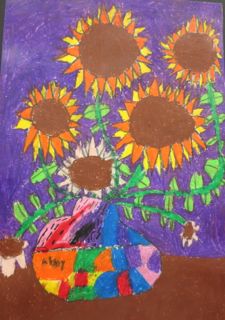
A short video highlighting our year’s efforts follows. Since I teach art by discussing famous artists, art works and art movements with the students, our gallery will likely induce a feeling of deja vu. Van Gogh’s sunflowers, Renoir’s Girl with a Watering Can, Kandinsky’s geometric abstractions, Rembrandt and Katz’s portraits, Thiebaud’s pop art sweets, Belle Epoque posters and more were all on our art menu this year.

I may not be able to hang the kids’ art on my walls at home, but my screen savers are a rotating exhibition of their lovely creations. We hope our virtual gallery brings you joy as well. All artists, no matter how young, want their art to be seen and appreciated. Feel free to share.

Click here to view Gallery 2013

Gallery 20131

0

Sprung

This past winter was harsh, but now we are being rewarded for our endurance. Spring has announced her arrival with unparalleled exuberance making the cold and snow distant memories.

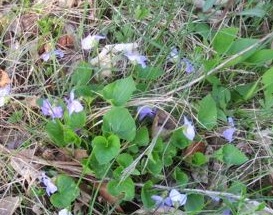
We decided to celebrate with a beach walk from our house to the nature preserve on a nearby bluff. As we climbed the bluff and stepped into the forest, wood violets were poking their petals above the leaf litter. These petite blooms are our state flower and one of Spring’s earliest harbingers.

IMG_0742sm

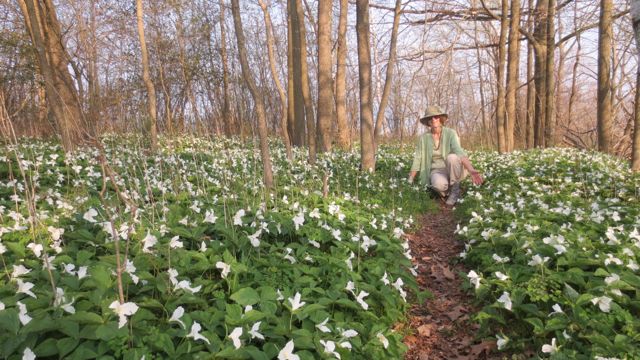
Following an old deer trail up the side of a steep hill, we emerged into a snowy glen. But this “snow” was trilliums, thousands of them mocking the real snow that only last month covered this same patch of forest.

The Chicago Botanical Garden describes trilliums eloquently:

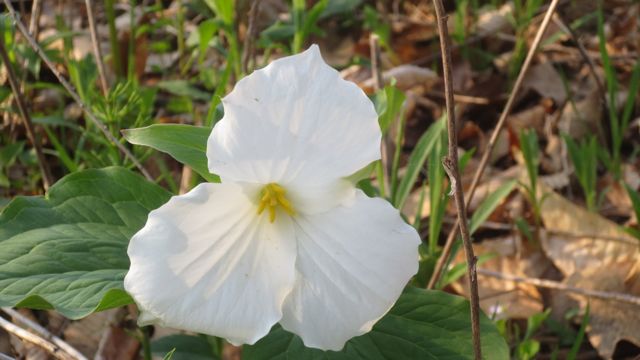
In the constellation of singular spring flowers, there are a few stars that shine more brightly than the rest. Perhaps the fairest of them all is the great white trillium, Trillium Grandiflorum… also known as wake-robin, snow trillium or trinity flower, it is easily recognizable by its waxy white flower with three petals and three sepals blooming atop a single stalk arising from a whorl of three deep green leaves.

We will be back next weekend to check the trilliums’ progress; the petals fade to a delicate pale rose color before the show ends.

IMG_0732

IMG_0741

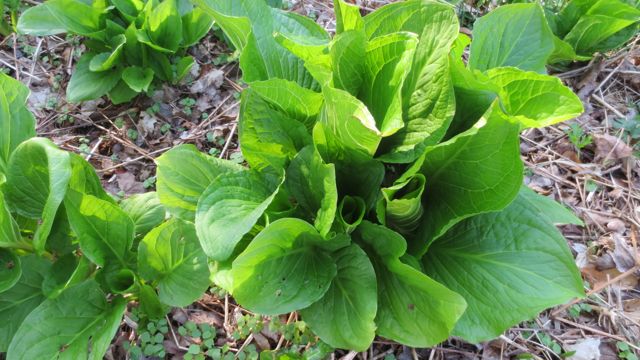
Going from the truly sublime to the delightfully nutty, skunk cabbage lined the roadside on our walk home. This remarkable plant is an early bloomer as the buds within the plant create enough heat to melt the snow around it. Buds can reach 70 degrees even in freezing weather.

Skunks do not dine on skunk cabbage. The name comes from the plant’s skunky smell which attracts pollinators. Large predators steer clear as the giant leaves contain calcium oxalate crystals which create a burning sensation in the mouth.

When not disturbed, a skunk cabbage plant can live a long time. Some researchers believe the largest ones could be hundreds of years old.

IMG_0743

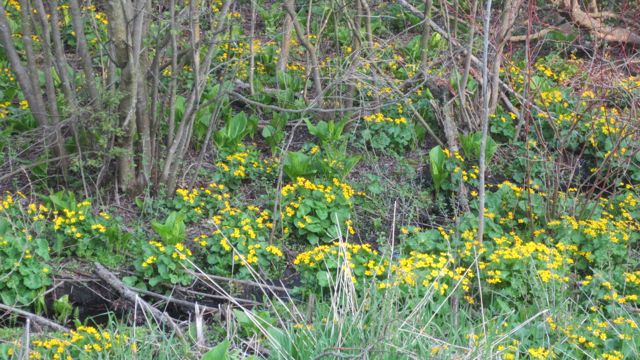
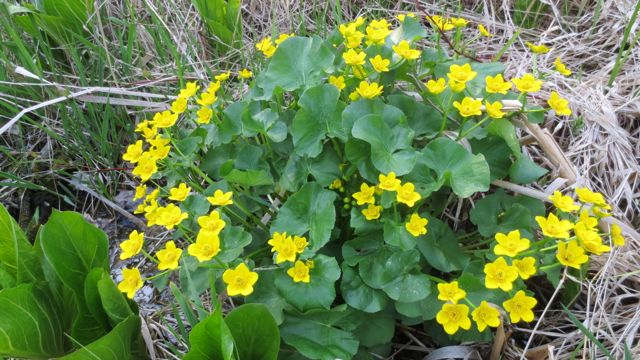
Mixed in with the skunk cabbage in low lying wet places, marsh marigolds were also heralding Spring. Mounds of these sunny yellow flowers light up the forest floor. Marsh marigolds are in the buttercup family and are referred to in our locale as cowslips.

IMG_0747

IMG_0745

Nature loves spirals, and Spring’s spirals, ferns, were everywhere on our walk. As the days grow longer, the spirals will slowly unfurl into huge green plumes. Then we will know that Spring has completely unsprung.

IMG_0749

0

Mars

Don’t plan any vacations to Venus. Despite being named after the goddess of beauty, Venus is far from a beauty spot. With 800 degree plus temperatures, sulphuric acid clouds, a crushing carbon dioxide atmosphere and hurricane force winds, this planet can make hell look desirable.

I always thought that our other neighbor, Mars, had vacation potential, but I have learned otherwise. Mars only looks promising because Venus is a complete nightmare.

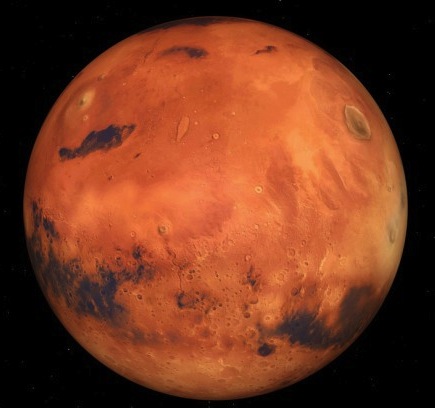
For unknown reasons, Earth had the Great Oxygenation Event and turned lush, while Mars had the Great Desiccation Event and became arid. More graphically, one turned green, the other red.

Visitors to Mars would find a pinkish atmosphere composed mainly of carbon dioxide and air pressure one-hundredth that of Earth. Winds are sufficient to stir huge dust storms which can envelope the planet for months. Days are about a half hour longer than ours, but months occur in a matter of hours. Mar’s two small moons, Phobos and Deimos, are fast orbiters.

Sightseers on Mars should be prepared for cold weather in all seasons. The average annual global temperature is 40 below zero (Earth’s is 59 degrees Fahrenheit).

Lovers of the extreme are perfect candidates for a sojourn on Mars. A Martian mountain, Olympus Mons, is the highest in the solar system. Just imagine the Alps on top of the Himalayas on top of the Rockies.

Mars also has a giant canyon that makes the Grand Canyon look like a hole in the backyard dug by a kid with a Tonka bulldozer. Valles Marineris (Valley of the Mariners) runs along the Martian equator and is 2,500 miles long, 125 miles wide and 4 miles deep. Be forewarned: no donkeys are available to carry tourists to the valley floor.

Thrill seekers are eager to sign up for future missions to Mars. Most of us, however, should heed the words of advice from John Grotzinger, the chief biologist on the Mar’s Curiosity mission. “You look at enough pictures from Mars, and you really start to appreciate the Earth.”

But you can go to Mars; at least your name and your poem can. NASA is sponsoring a Mars Haiku contest. The three winning poems and the names of all who submit poems will head for Mars on the upcoming MAVEN mission. Here is a link to the details.

mars

0

Duckie

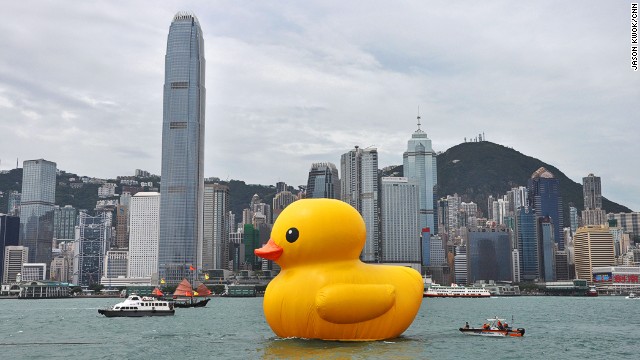
Rubber Duckie WAS the one last week. This particular 54 foot tall rubber duck sailed into Hong Kong harbor to the cheers of hundreds.

rubber-duck-in-hong-kong

Designed by Dutch artist Flortentijn Hofman in 2007, duckie has visited 13 cities in 9 countries. He is rumored to be heading to the U.S.A. as well.

I was not surprised that the duck’s creator was a Dutchman. The Netherlands always ranks high in listings of countries with the happiest people in the world. Rubber Duckies will do that to you.

Mr. Hofman states, “My sculptures cause an uproar, astonishment and put a smile on your face. They give people a break from their daily routines. Passers-by stop in front of them and enter into conversation with other spectators. People are making contact with each other again.”

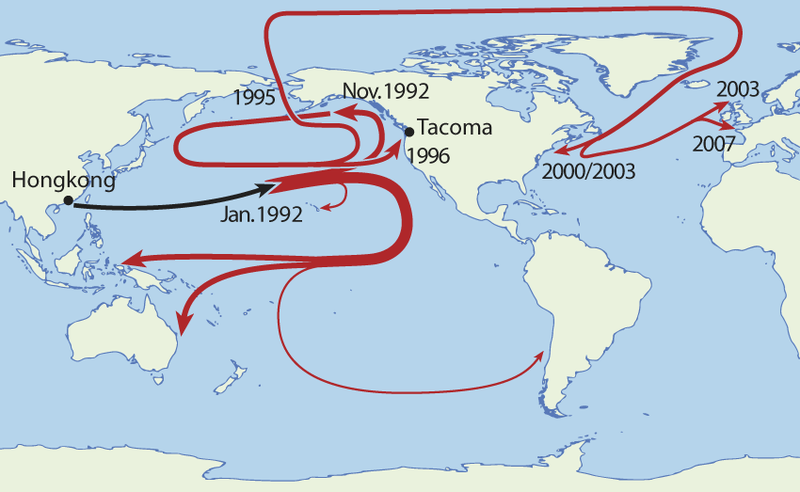
Rubber Duckies do more than bring people together: they have made a serious contribution to science. In 1992, a shipping container with Chinese plastic bath toys fell off a boat into the North Pacific. 29,000 yellow duckies, blue turtles and green frogs (a.k.a. Friendly Floatees) suddenly found themselves swimming in the world’s biggest bathtub.

Curtis Ebbesmeyer, an American oceanographer, viewed this accident as a serendipitous event for studying ocean currents. Using models that he and his colleagues had developed, Ebbesmeyer soon had people all over the world combing beaches for duckie retrieval and reporting. I show my young students the scientists’ world map of the duckies’ journeys to drive home the fact that our planet has one big ocean, not four separate ones.


I’m sure that almost everyone reading this blog is familiar with Muppet Ernie’s famous and charming song to his Rubber Duckie. But in case you haven’t heard it or are in need of cheering up, click here.

0