Rosettes

“Smell goes into the emotional parts of the brain and the memory parts, whereas words go into the thinking parts of the brain.”

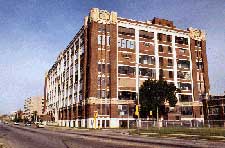
My grandmother lived downwind from a large cookie factory. Her neighborhood of tightly packed, austere German flats was populated by blue collar workers and their families. Delicious cookie aromas enveloped the neighborhood at almost all hours of the day and night.

Once every week or so, a small sign appeared on the door of the factory: “Broken Cookies Today”. Crowds would begin lining up and snaking down the sidewalk hours before the door opened. No fancy marketing here.

Once inside, you handed $2.00 to a man standing behind a counter and received in return a large, brown, grease-spotted bag. The bag was stapled firmly shut, its contents a mystery. And since adults ruled the world back then, the bag remained closed until it was safely home.

Then… bliss!  Or maybe not. If the coconut “washboard” cookies were over baked, broken or imperfect, they could fill up the entire sack.

What the neighbor kids and I all wished for was a total breakdown in the Rosette division. Rosettes were marshmallow and raspberry jam cookies entirely dipped in chocolate. We prayed that the factory workers would mangle, squish, overdip  or make the Rosettes unsaleable.

When I met my husband many years later, I soon discovered that he had a penchant for Rosettes. His mother loved “store cookies” and bought them frequently. His were not seconds.
johnston

0

Storyteller

Judy’s story came to an end on October 7, 2013. My lovely friend, the amazingly gifted storyteller, writer  and children’s librarian, Judy Farrow Busack, has died.

I met Judy over 25 years ago. She brought her storytelling programs to schools and libraries all over our state and beyond.

I am not a storyteller. I’m the nonfiction lady, doing educational programs on art and natural science topics. But Judy and I were frequently booked at the same events and a lasting friendship bloomed.

Here are two stories that I hope will convey this woman’s exceptional gifts.

When Judy was a children’s librarian, she ran theater workshops as her teen summer reading programs. Every children’s librarian knows that attracting teens to library programs is difficult; an event with 12 kids is considered a resounding success.

One summer morning I was scheduled to do a program for the younger children at her library. I arrived early to find fifty teenagers eagerly waiting for the library doors to open so they could work on their play. Judy had them fully engaged, allowing them to be creative, make mistakes, learn from their mistakes and ultimately take pride in their productions. Her theater programs continued for many summers, and some of “her” kids went on to careers in the theater.

Judy was a spellbinding storyteller. I was once asked by a school where I did frequent art programs if I could suggest a presenter for a middle school assembly. I knew this group of kids well. Sadly, many of them made the school’s anti-bullying program a dismal failure. I recommended Judy and candidly told her, “If you take this job the most charitable thing I can say is that it will be challenging.”

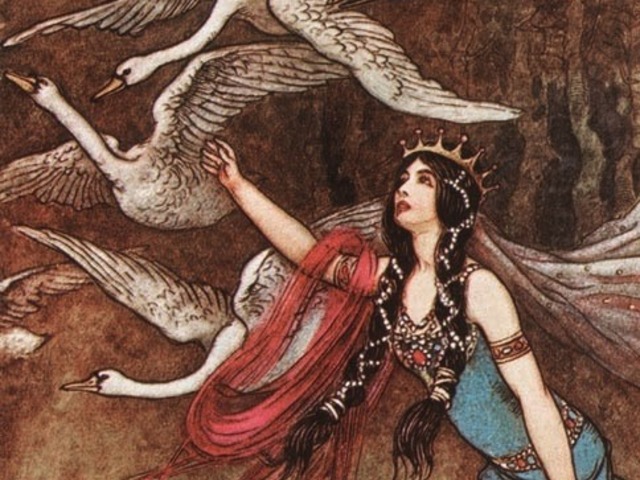
Judy arrived with no costumes or props to face 100 kids sitting in the bleachers with their usual “I dare you to make me interested in anything” attitudes. Judy had every one of them captivated in three minutes. She only told one story, a folk tale about brothers that were turned into swans. The story lasted more than a half hour. I am still in awe, a word I seldom use.

Magicians and trained dog acts now have become the hottest bookings for children’s library programs. If storytellers are hired, they often are not advertised as such for fear no audience will show up. I know few things with certainty, but I know this: we all, young and old, need our stories and our storytellers. And if you have been touched by a storyteller as gifted as Judy, you indeed are blessed.

fairytale

0

Wasps

We’ve been eating breakfast between the bees and wasps lately. The days have been sunny and unseasonably warm allowing us to eat outside on the front deck. Our table is two yards from the paper wasps’ nest next to the door and one yard from the prolifically blooming asters in front of the deck.

All of us have been enjoying our morning meals….granola, raspberries, yogurt and Sheboygan hard rolls for us, nectar from the asters for the bees and insects and nectar for the wasps. Life is good: pura vida.

The wasps have been with us all summer. Their house construction began in late spring. Walking out the door to our front deck, I noticed one perfect hexagonal cell attached to the upper frame of the window beside the door. Since no one was building at the moment, I quickly knocked it down in hopes that the project would resume farther from our outside dining area.

The Queen wasp, however, had chosen her building site with “location, location, location” in mind. The next morning a new cell was in the same spot, plus more were under construction.

“Here’s the deal,” I said to her. “I will leave you alone if you will let our guests and us eat undisturbed this summer.”  The bargain has worked. Fortunately, paper wasps, unlike their cousins the yellow jackets and hornets, are not overly interested in sugary people foods.

The bees are a recent and welcome arrival. Bee populations are crashing all over America and we saw few all summer despite our “bee friendly” yard. But last week, scores of bees were converging from all directions. Aster nectar in the bee world must be like French champagne to us.

By this time next month all of our breakfasts will be indoors. The bees and wasps will no longer be with us, and the jewel like fall colors will have faded. We know that change is the only constant, but, fortunately, each moment remains our only reality.


0

Baguettes

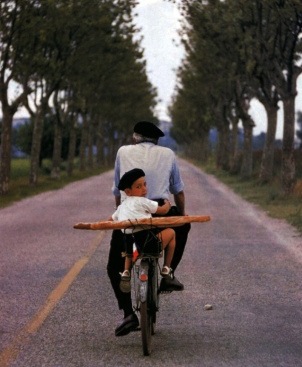
What could be better than a crusty chunk of French bread with a generous slathering of butter?

The French have been bread artisans and connoisseurs for centuries. So it was with shock that I read a recent newspaper headline, “A French Dining Staple is Losing Its Place at the Table”. France without bread lovers would be like Italy shunning pasta….unthinkable.

The average Frenchman is eating a mere half baguette a day now as compared to a whole one in 1970. Young people eat almost 30 percent less bread than a decade ago. The Observatoire du Pain, the French bread marketing lobby, is not taking this reduced bread consumption lightly. A campaign promoting bread has been launched.

“Coucou, tu as pris le pain?” (Hi there, have you picked up the bread?) is the slogan of the campaign, and the phrase has been plastered on billboards and bread bags across the country.

The marketing message rises to the seriousness of the situation, “Bread promotes good health, good conversation and French civilization.”

And, since this is all happening in France, love enters the discussion. “Remember that buying fresh bread on the way home is a simple way of showing loved ones that you have thought about them and of giving them pleasure during the day.”

French bread in France is not in danger of extinction. Ten billion baguettes are sold every year and a national bread festival is celebrated in May around the feast of Saint Honore, the patron saint of bakers. In addition, Paris holds an annual contest to find the best traditional baguette. The winner’s breads are served at the Elysee Palace for a year.

I find only one flaw in this noble campaign to encourage the consumption of fine breads. I believe the French should go global with their message……the world is sorely in need of a large serving of civilization at the moment.

french bread

0

Underground

I am a dedicated tunnelophile. I’ve been fascinated by tunnels since I was seven years old and took a trip out West on the fabled Atchison, Topeka and the Santa Fe Super Chief. The train went through many long tunnels cut through the Rockies. Being hurtled from brilliant desert sunshine into total darkness never failed to amaze me. To this day, I am always willing to detour in the direction of an interesting tunnel, especially ones I can drive through.

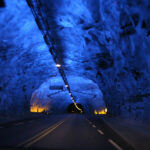
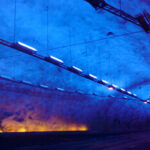
The longest car tunnel in the world at 15.23 miles is the Laerdal Tunnel in Norway. The final link in E16 connecting Oslo and Bergen, this super tunnel took five years to complete. The design is divided into four sections, separated by three large caves. The caves serve as turn around points, detriments to claustrophobia and rest spots. The tunnel roadway has white lights, the caves have blue lights with yellow on the edges to simulate sunrise. Tunnelophobes should find this soothing.

The scariest tunnels I have ever driven were in Italy in the cliffs above the Mediterranean. Many Italian drivers see no need to slow their 110mph speed when hitting the tunnel entrance; in fact, some speed up. Thrill seekers (of which I am not one) would adore this string of speed tubes.

The Ted Williams Tunnel under the Boston Harbor is my least favorite tunnel. Part of the “Big Dig”, it has various exits within the tunnel one of which connects to the airport. Make a mistake here and you can miss your plane.

The Gotthard Pass through the Swiss Alps is bilingual. Enter from the north portal and everyone is speaking German; exit to the south and the language has changed to Italian.

The eastern entrance to Pittsburgh on I-376 is the Squirrel Hill Tunnel. I love that name and tried without luck to find how the name originated. I always have images of squirrels cavorting over my head on the mountain as I drive through. I did discover the fact that because of its low height, Squirrel Hill Tunnel is notorious for trapping trucks thus creating tunnel chaos. A construction project to raise the ceilings began this June.

Below are images of the Laerdal Tunnel. A couple was so smitten with its eerie beauty that they had their wedding in one of the caves.

0