Week

The week is a human invention. Years, seasons, months and days are not our creations. Earth’s orbit around the sun, earth’s tilted axis, moon’s orbit around earth and earth’s rotation exist without us mortals.

What pressing need caused our species to invent the week? The best hypothesis is a simple one….shopping. The phrase “born to shop” is not newly minted. The ancient Babylonians needed another division of time, longer than a day yet shorter than a month. They needed a measure of time between market days. Seven days was their choice. West Africans held a market every four days so their week was four days long. The Romans had an eight day week but dropped it in the fourth century in favor of a seven day one.

People can’t resist naming everything in their sphere, so once the week was invented, the days were named. The first day is literally the sun’s day or Sunday. Early civilizations worshipped the sun, an understandable belief since we would all be nonexistent without it.

The moon gets day number two. The Romans called the day “lunae dies” or moon’s day. The Saxons in the Middle Ages called it Moneday.

Tuesday, day number three, was believed by the Babylonians and Romans to be ruled by Mars, the god of war. Many European countries still invoke Mars: Mardi in French, Martes in Spanish and Martedi in Italian. We English speakers get the Saxon version from “Tiu” the Saxon god of war. Tuesday started out as Tiwesdaeg.

Day four, Wednesday, gets more complicated. The Romans called it “dies mercurie” or Mercury’s day. It remains Mercury’s day in French, Mercredi; Spanish, Miercoles and Italian, Mercoledi. The Germans sensibly call it Mittwoch or midweek. English speakers get to honor the chief god of the Anglo Saxons, Woden, on Wednesday.

Think of thunder on Thursday. The Romans gave the day to Jupiter, the ruler of all the gods and the god of thunder. The Anglo Saxons chose powerful Thor, also the god of thunder, who brought rain to their crops. The Normans called Thor “Thur” getting us to Thursday.

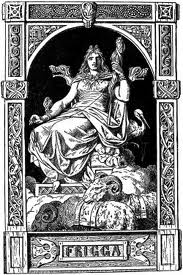
On day six, we finally get the feminine perspective. The Romans dedicated it to Venus, the goddess of love and beauty. Venus remains in the French, Venredi; Spanish, Viernes and Italian, Venerdi. The Anglo Saxons went for love as well, naming the day after Frigga, the goddess of married love, housewives, sky and clouds. Frigga was Woden’s wife and was responsible for spreading knowledge and justice.

The seventh and last day of the week belongs to the Roman god Saturn, father to Jupiter, Pluto, Neptune and Juno. Saturn remains firmly lodged in our word Saturday.

I’m grateful to the ancients for fabricating the week and giving character to its days. Who would want to live in a world without Fridays?

frigga

0

Ants

We have ants. Fortunately none are inside our house, their two residences are outside in the meadow beside our home. And perhaps, more correctly, I should have said, “The ants have us.” They were living on the land before we came and will probably be here after we are gone.

When we bought our acre lot 38 years ago, we noticed two gigantic mounds in the field. Closer inspection revealed that the yard wide, two foot high hills were massive ant colonies. We regard them as a bonus that came with the property.

Linnaeus, the great classifier, put all ants into the family Formicidae. That is now divided into about twenty subfamilies and 300 genera. Our ants are in the genus Formica (not to be confused with countertops) which includes field ants, wood ants and mound ants. I do not know the species of our ants; there are currently 12,762 ant species, and I am not an entomologist.

Formica ants are mostly beneficial to their habitats. Formica ants don’t sting, but they can bite and spray formic acid  from their abdomens. They use the acid to subdue their prey which are other arthropods, many of which are destructive to forests and plants that we cultivate. Their eating habits can be described as “predatory with a sweet tooth.” In addition to eating bugs, they also seek out honeydew which is a sugary liquid excreted by aphids as they feed on sap.

The top of the ants’ mounds is thatched, an amazing engineering job on the part of the colony. The thatched plant materials keep the rain out and are angled to heat the interior of the mound via solar energy.

Edward O. Wilson, one of the world’s leading authorities on ants, sums ants up best. He states in his book, The Ants, “Karl Marx was right, socialism works, it is just that he had the wrong species.”

0

Beans

“Better walk across your road and pick some beans,” my farmer neighbor advised. “The canning company is coming any day now to harvest them.”

I accepted his generous offer and yesterday walked down my driveway, across the road and into the massive field of green beans. I picked a modest bag full; some for dinner and some to freeze.

Since the day was sticky hot, I pondered what would make a good dinner entree with the just picked beans as a main ingredient. Our refrigerator is small, but it yielded some interesting ingredients, and the cupboards are always stocked with pasta. I created a cold pasta salad for our evening meal, and we ate it on the front deck as the sun set over the bean fields. We both pronounced the salad a success, a recipe to be written down and repeated.

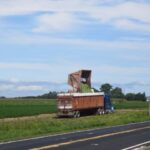
The next morning we woke to a huge racket. All the cats were hiding from the clattering, clunking noises that were coming in the windows. Three giant Pixall harvesting machines were lumbering through the fields spitting beans into their hoppers. A semitruck was waiting to haul the multiple loads to the canning factory.

So it’s goodbye to the beans…but not quite yet. I have lived in the country long enough now to know I can second harvest. Those clanking machines won’t capture every bean.

Just Picked Bean Salad

(This is a general plan, not a specific recipe, feel free to improvise)

  • About two cups each of cut, lightly cooked green beans and al dente cooked pasta
  • 1 large carrot, shredded
  • 1 handful snap peas, cut into bite sized pieces
  • 3/4 cup shredded Pecorino Romano cheese
  • Chopped chives or onions to taste
  • Celery salt to taste
  • Cajon seasoning to taste
  • Mayonaise to hold it all together


0

Workers

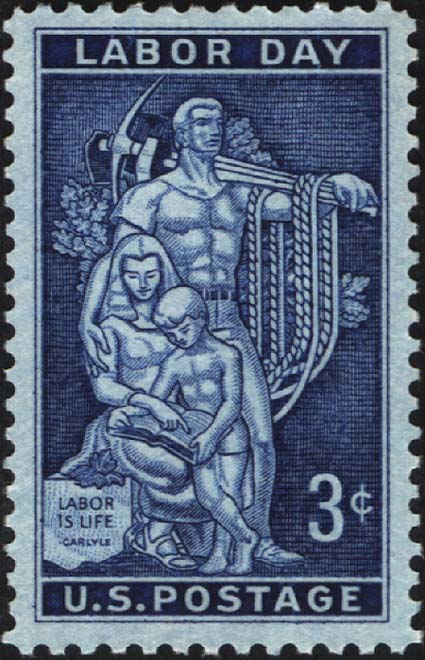
Labor Day has become the psychological end of summer in America. The original impetus for the holiday is largely  unknown or forgotten. Perhaps Labor Day needs to be revitalized with thoughts on the value of work and workers.

The height of America’s Industrial Revolution occurred in the late 1800’s when factories started to replace farms as the basis of the U.S. economy. Twelve hour days, seven day work weeks, child labor and unsafe working conditions were the norm. In response to the egregious conditions, workers began to organize and march.

The notorious Pullman Strike in the summer of 1894 saw workers protesting severely cut wages and high rents for company owned houses. Starting in the company town of Pullman, Illinois, the protests quickly spread to railroad centers across America. President Grover Cleveland declared the violent strike a federal crime and sent in 12,000 troops. Thirty strikers were killed and fifty-seven were wounded, the union leader, Eugene Debs, was jailed and the union was broken. To appease outraged workers all across the nation, President Cleveland signed the law creating Labor Day as a federal holiday six days after the strike ended.

As a young man, my father worked a six day week in a foundry to save money to get married. He lost it all in the depression when the banks failed. Starting over at a steel company, he joined a union and was roughed up by company thugs when he advocated for a five day work week. But the unions gained strength and the checks and benefits from that steel job enabled my parents to solidly join the middle class. Thanks to a childhood without want, I was able to enter and spend my life as a member of the middle class as well.

But times are changing rapidly, and the future for young Americans is not as rosy as mine. I recently ran across an interview with the gifted writer Walter Mosley, the author of the Easy Rawlins novels. These words from that interview struck me as prescient:

“The change of the century is a challenging moment for the world….The waters are rising while we are dreaming of the stars. We call ourselves social creatures when indeed we are pack animals. We, many of us, say that  we are middle class when in reality we are salt-of -the-earth working-class drones existing at the whim of systems that distribute our life’s blood as so much spare change. These subjects can be addressed in fiction or plays, even in poetry, but now and again the plain talk of nonfiction is preferred.”

ld

0

Lowriders

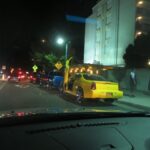
Sometimes you just get lucky. We had finished eating a late dinner at a restaurant in Albuquerque on Central Avenue, the old Route 66. It was 11:00 P.M. on a Sunday night. “Let’s take Route 66 through downtown back to our hotel,” I suggested.

As we approached downtown, the traffic suddenly became thick and then stopped. My husband began to look for an exit from the tie up, but I said, “Wait a minute, I think we may have just joined a parade of cruisers.”

A minute later this was confirmed when we spotted a lowrider parked at the curb but dancing up and down for an appreciative audience.

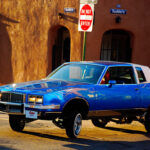
New Mexico is an epicenter for fabulously customized cars. These vehicles are truly rolling pieces of Hispanic American folk art which have been recognized by the Smithsonian’s National Museum of American History. In 1992 the Smithsonian acquired “Dave’s Dream”, a legendary lowrider from Chimayo, New Mexico.

Lowriders are outfitted with hydraulics activated by switches. The driver can change the height of the car, drive on 3 wheels, hop the front wheels off the ground or dip the sides of the car.

Paint jobs on these cars are eye popping with multiple thin layers of colors, metallic paints, airbrushed murals, pinstripes, flames or combinations of the above. Interiors are lavishly upholstered as well.

Toward the end of the cruise we saw a series of cars at the curb with wings: their doors opened upward making the cars resemble giant birds in flight. Checking that custom feature out on the computer later, we learned that vertical opening doors are called “Lambo Doors”. And, better yet, a customizing kit is available for our little Fiat 500. This is very tempting.

0