Pleasurable

For thirty years, Andre Soltner was the chef at Lutece, a paragon of New York dining establishments. Now retired and eighty years old, he recently stated in an interview, “I count my cooking by the looks of satisfaction on the faces of the people who have eaten my food. I don’t want them to be impressed; I want them to be pleased.”

I love his philosophy and seek to follow it. He was cooking haute cuisine and I am cooking nightly dinners in my home, but his goal can apply to both. A meal doesn’t have to be an elaborate feast to give pleasure.

Summer is almost upon us bringing all manner of wonderful fresh vegetables from our gardens and farmers’ markets. This is the perfect time to share one of my favorite recipes which was introduced to me by a good friend who loves to cook. This woman is so talented in the kitchen that she got me to eat grits and love them. She also introduced me to fresh picked radishes split halfway through with soft butter on the knife, known as radis au beurre in France.

Fresh Green Pea and Mint Soup with Lemon Cream

2 Tbs. butter
½ cup chopped shallots
4 cups green peas (fresh or frozen but not dried)
2 cups chicken or vegetable broth
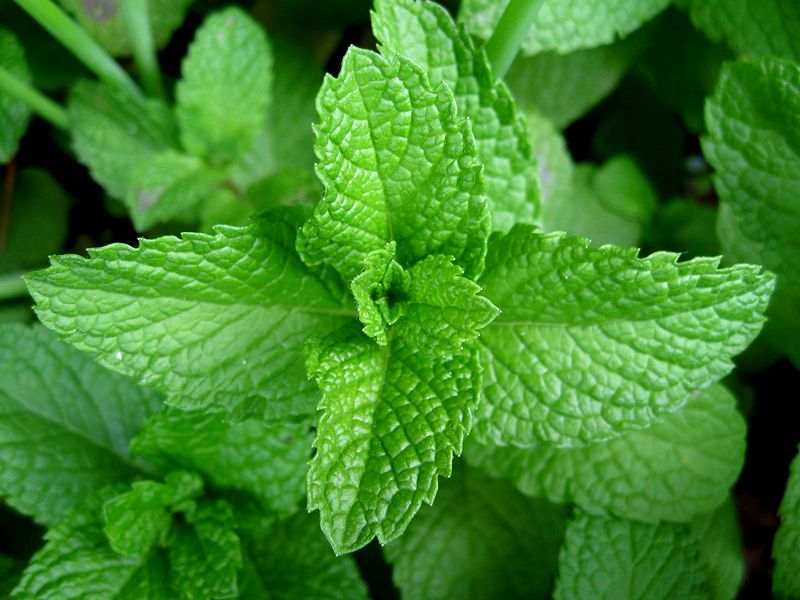
½ cup chopped fresh mint
2 cups water
Salt and pepper to taste
½ cup cream
Zest of ½ lemon

Melt butter, cook shallots and add peas, broth, ½ of the mint, 2 cups of water and salt and pepper to taste. Bring to a boil, reduce heat and cook until peas are tender. Puree in blender.

Whip cream, add lemon zest and put a spoonful on top of each serving with a sprinkle of mint.

Serves 4 to 6

Happy eating this summer!
Mint

0

Mermaids

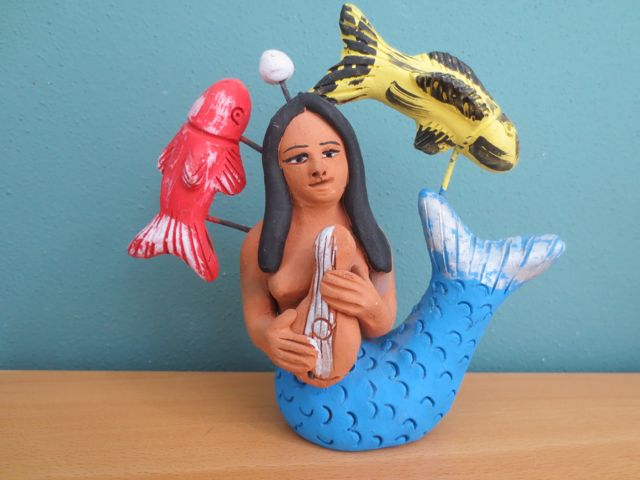
I live surrounded by mermaids. These lovely ladies have not flapped upstairs from the beach that is our front yard. They are, rather, a part of  a lifetime accumulation of art that I have acquired at folk art markets, thrift stores, art fairs and galleries.

I never set out to collect mermaids. I’m just drawn to them which is, after all, their fictitious purpose. My fascination with these ladies started at an early age when my mother read me the original Hans Christian Andersen story of “The Little Mermaid”. I simultaneously cried and fell in love with the story. Ariel, from the Disney version, will never be a stand in for the first Little Mermaid in my heart.

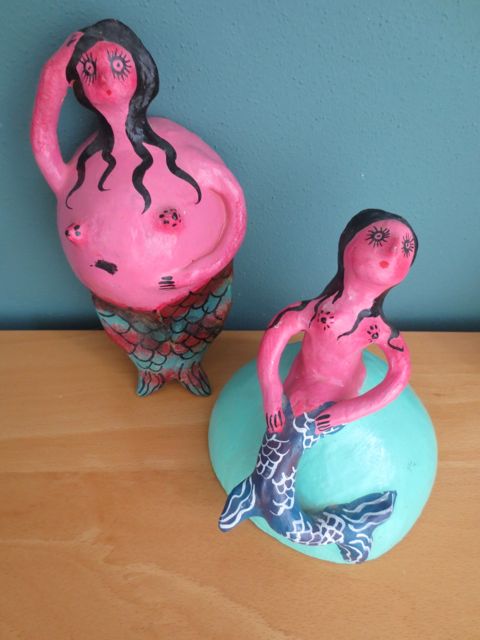
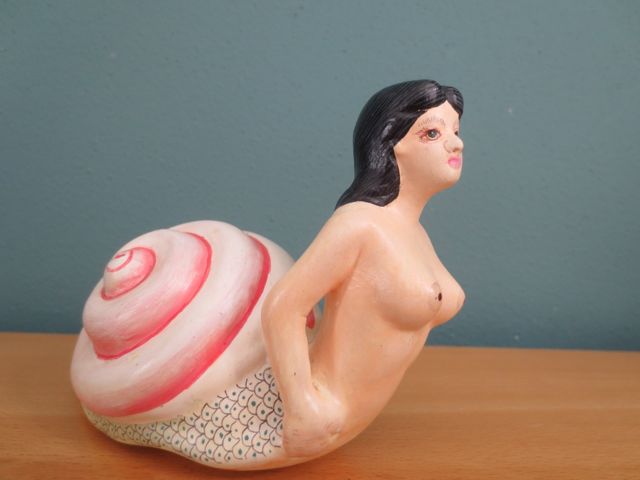
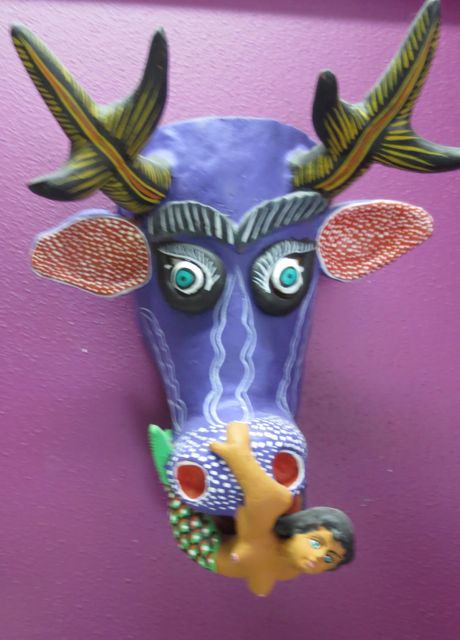
Many of my mermaids are from Mexico, where Sirenas are beloved subject matter for storytellers and artists.

IMG_0814Sirenas and their siren songs are inseparable.

IMG_0820This buxom Sirena and her skinny friend are both coconut shell folk art.

IMG_0815Not all mermaids have fish tails.

IMG_0825Curious and curiouser

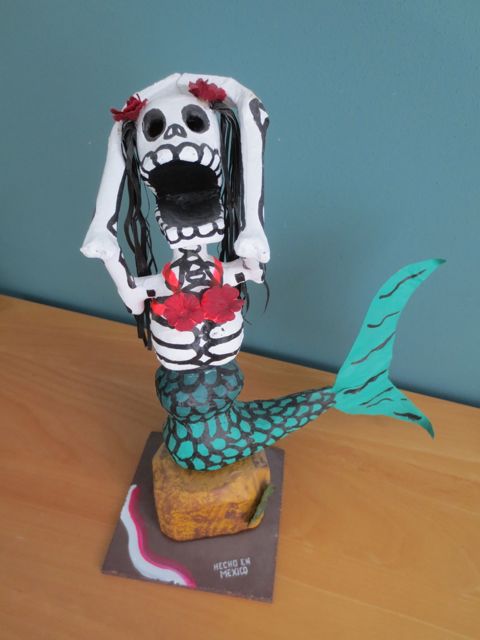
IMG_0829A hysterical skeleton mermaid greets me as I walk in my downstairs door …it is hard not to smile.

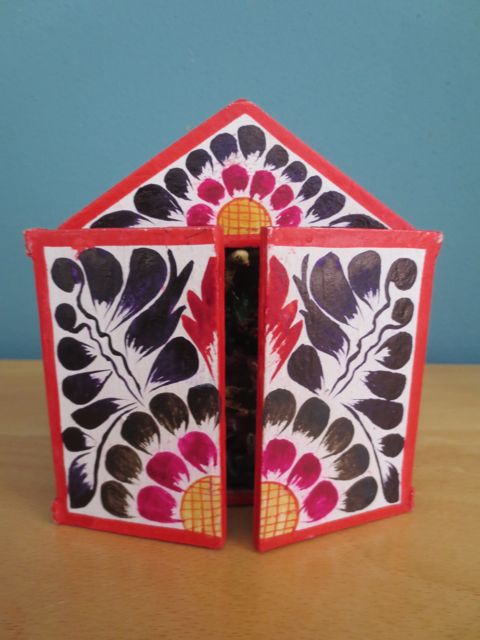
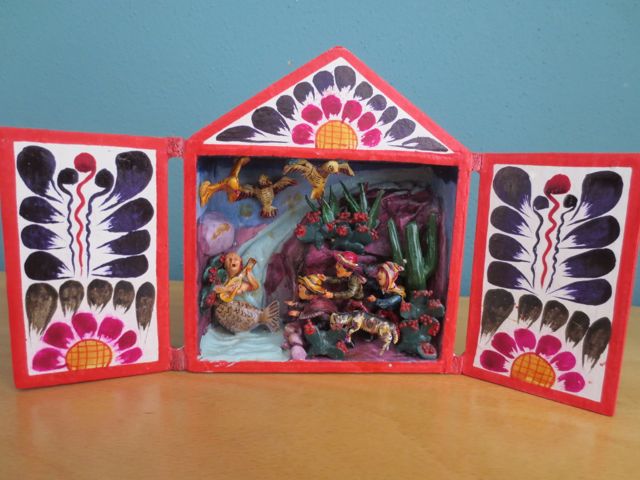
IMG_0834 IMG_0833Nicario Jimenez is a third generation retablo maker from Peru. Retablos, small wooden boxes filled with tiny figures, were originally used by Spanish priests to teach stories about the saints. The figures are made from boiled potato and gypsum powder clay. Nicario has won numerous awards for his intricate and imaginative scenes.


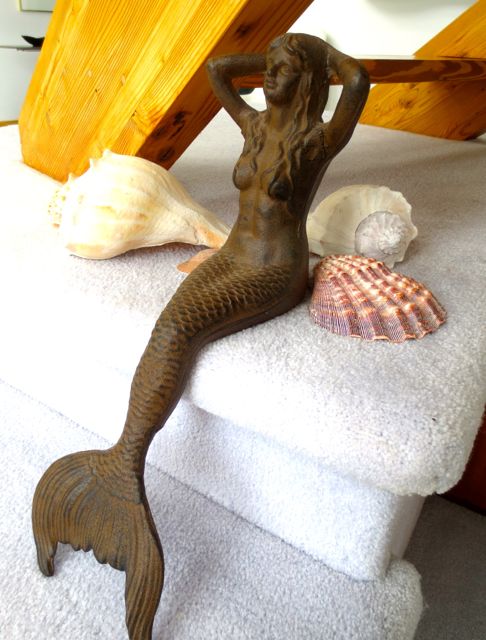
IMG_0836This mermaid spends all her hours staring out at Lake Michigan.

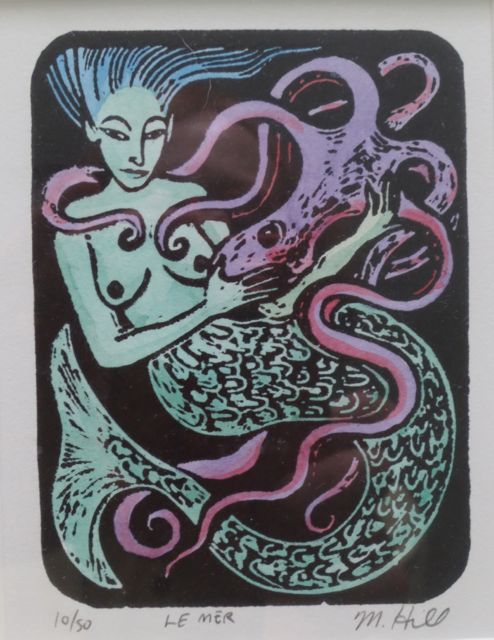
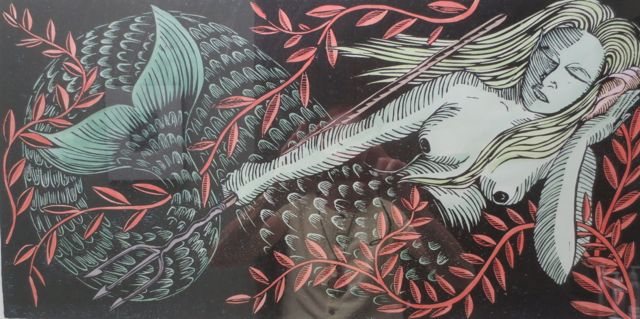
IMG_0823 IMG_0821Marvin Hill was a gentle, immensely talented and witty Wisconsin printmaker whose life was ended by cancer. He was irreplaceable. His mermaids are my favorites.

Note that the last mermaid is holding a shell to her ear. The title of this print is “Hear the Forest?”

0

Crabby

Our first animal rescue was not a cat. This fact probably comes as a surprise to those who know us. Our first rescue was a crustacean, a grapefruit size hermit crab.

All rescue animals come with sad stories, and his was no exception. This gigantic crab plus his shell home and small terrarium was dropped off at the creative arts kindergarten where I worked. His pincers were strong enough to snap off a tot’s misplaced fingers. A note suggested that crab would be an interesting pet for our school. We knew otherwise.

None of the school’s staff volunteered to take him home, but one person offered to dispose of him.  That’s when I raised my hand and left with a crab in the back seat of my car.

A pet rock would have had a more scintillating personality than our crab. For months and months, we never saw him move. In fact, the only proof of life was a small amount of missing food and water each morning.

But then one day I was cleaning his terrarium and decided to put Crabby on the laundry room floor so I could thoroughly scour his tank. A few moments later, I heard a strange thumping, clunking sound. Our “comatose” crab was scooting down the hall to the living room banging his shell against the baseboard he was following. I was simultaneously stunned and heartbroken. His message was clear; would I or any other creature sprint about if confined to a small, uninteresting environment? From  that day for the rest of his life, Hermit Crab had play time every day. Clunk, clunk, clunk became a familiar sound as he explored the entire house via the baseboards.

crabby 1

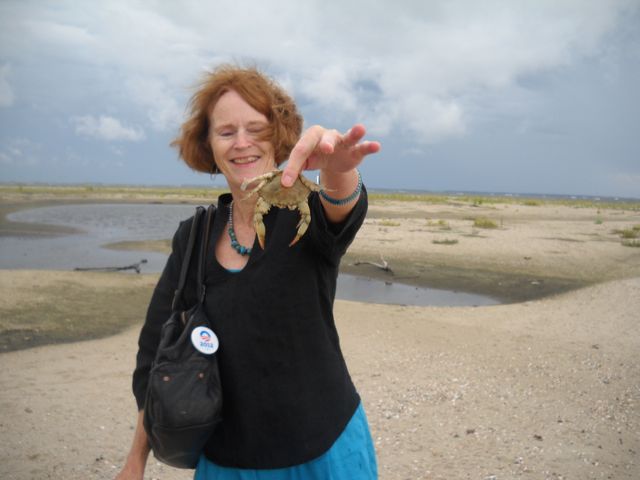
Another “crabby” friend.


0

Gallery

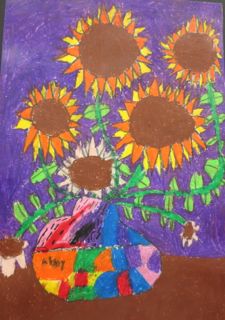
I am the curator of a delightful gallery of art. The artists are my students ages 4 to 13 who attend a number of different schools.

Thanks to digicams and computers, I am able to enjoy and share their art for years to come. The original art goes home with the artists. My fervent hope is that the artwork will survive the trip home and be treasured. I am extremely versed in saying, “DO NOT PUT YOUR ART IN YOUR BACKPACK!”

A short video highlighting our year’s efforts follows. Since I teach art by discussing famous artists, art works and art movements with the students, our gallery will likely induce a feeling of deja vu. Van Gogh’s sunflowers, Renoir’s Girl with a Watering Can, Kandinsky’s geometric abstractions, Rembrandt and Katz’s portraits, Thiebaud’s pop art sweets, Belle Epoque posters and more were all on our art menu this year.

I may not be able to hang the kids’ art on my walls at home, but my screen savers are a rotating exhibition of their lovely creations. We hope our virtual gallery brings you joy as well. All artists, no matter how young, want their art to be seen and appreciated. Feel free to share.

Click here to view Gallery 2013

Gallery 20131

0

Sprung

This past winter was harsh, but now we are being rewarded for our endurance. Spring has announced her arrival with unparalleled exuberance making the cold and snow distant memories.

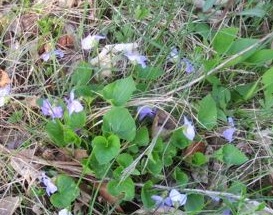
We decided to celebrate with a beach walk from our house to the nature preserve on a nearby bluff. As we climbed the bluff and stepped into the forest, wood violets were poking their petals above the leaf litter. These petite blooms are our state flower and one of Spring’s earliest harbingers.

IMG_0742sm

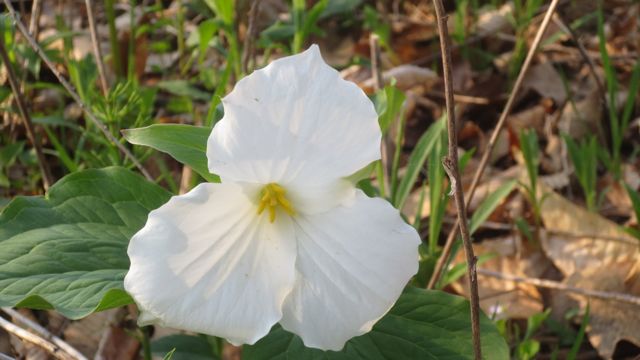
Following an old deer trail up the side of a steep hill, we emerged into a snowy glen. But this “snow” was trilliums, thousands of them mocking the real snow that only last month covered this same patch of forest.

The Chicago Botanical Garden describes trilliums eloquently:

In the constellation of singular spring flowers, there are a few stars that shine more brightly than the rest. Perhaps the fairest of them all is the great white trillium, Trillium Grandiflorum… also known as wake-robin, snow trillium or trinity flower, it is easily recognizable by its waxy white flower with three petals and three sepals blooming atop a single stalk arising from a whorl of three deep green leaves.

We will be back next weekend to check the trilliums’ progress; the petals fade to a delicate pale rose color before the show ends.

IMG_0732

IMG_0741

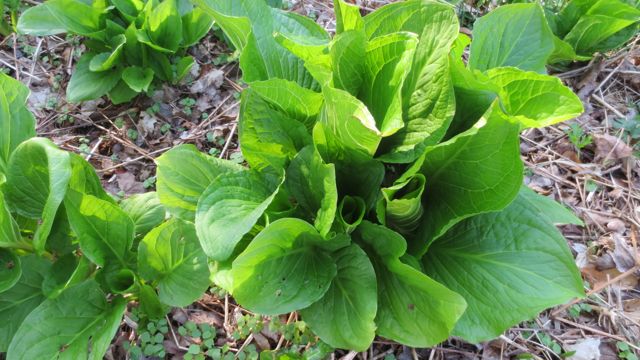
Going from the truly sublime to the delightfully nutty, skunk cabbage lined the roadside on our walk home. This remarkable plant is an early bloomer as the buds within the plant create enough heat to melt the snow around it. Buds can reach 70 degrees even in freezing weather.

Skunks do not dine on skunk cabbage. The name comes from the plant’s skunky smell which attracts pollinators. Large predators steer clear as the giant leaves contain calcium oxalate crystals which create a burning sensation in the mouth.

When not disturbed, a skunk cabbage plant can live a long time. Some researchers believe the largest ones could be hundreds of years old.

IMG_0743

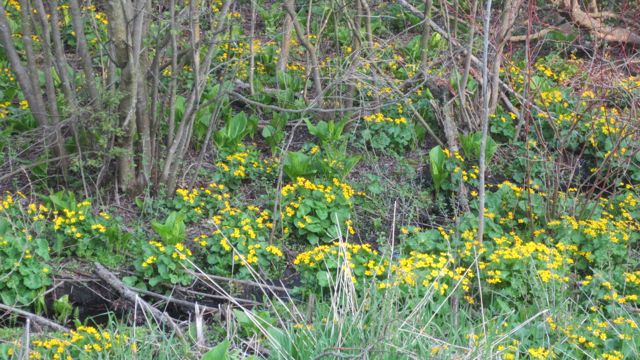
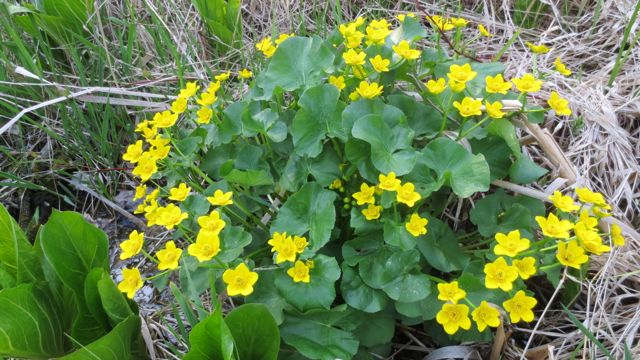
Mixed in with the skunk cabbage in low lying wet places, marsh marigolds were also heralding Spring. Mounds of these sunny yellow flowers light up the forest floor. Marsh marigolds are in the buttercup family and are referred to in our locale as cowslips.

IMG_0747

IMG_0745

Nature loves spirals, and Spring’s spirals, ferns, were everywhere on our walk. As the days grow longer, the spirals will slowly unfurl into huge green plumes. Then we will know that Spring has completely unsprung.

IMG_0749

0