Nostalgia

The New York Times Science section recently had a lead article entitled “Fond Remembrances”. For the greater part of three pages, clinical psychologists expounded on a radical new finding: Nostalgia, previously though to be a psychological disorder, is now considered to be beneficial to our species.

These academics could have saved a stack of money by simply asking happy people their opinion on the matter.

I have spent thousands of hours in the last 20 years chatting with octogenarians in nursing homes and assisted livings in three states. Anyone who doubts that nostalgia brings joy should get out of their ivy covered walls and listen to the elderly.

One of my favorite 80+ friends would light up when she would tell me about a beloved barn cat from her childhood. “That cat would never drink her milk,” Mrs. P. would say, “she would daintily dip her foot in the bowl and lick the milk off her paw.”

My dear friend Margaret taught me that even people who have had horrific childhoods can garner happiness from memories. Margaret grew up on a farm, and when she was twelve, her mother died of cancer. Her father was an abusive, stingy alcoholic who made it clear that Margaret would have his dinner on the table at whatever hour he staggered in. Yet, Margaret would radiate happiness when she would tell me about her mother’s love of growing flowers, or the day the cows got loose and ate the vegetable garden or the kind, young teacher at her one room school. Memory is selective, frequently it is the good memories that stick.

Young people thrive on nostalgia as well. One of my most popular programs is “Festivals of Light” which compares holiday traditions all over the world at the time of the Winter Solstice. I conclude the program by inviting the kids to share their special family traditions. Multiple hands always shoot up. I frequently have to escort a group of students out the door and down the hall to their next classes so they won’t be late. They are sharing stories all the way.

Somewhere during my long tenure as a City of Milwaukee Historic Preservation Commissioner, I heard someone say, “Without our past, how would we know it’s us?” I agree and would add that enjoying the past does not preclude living fully in the moment. After all, the present moment is where all nostalgia is born.
n

0

Tomato

My lack of gardening skills is legendary. I am the woman who can’t grow mint. Each spring, I head to the garden center and buy yet another little pot of mint and start all over again.

When mint is a challenge, a tomato is totally daunting. Last year we could only manage two spindly plants with yellowed leaves and a yield of  two and one half tomatoes. Some unknown creature ate the other half.

Enter our gardening friend, Dawn, the horticulturalist. She patiently listened to our woeful tomato tale and cheerily said, “You can do this!”

A few weeks ago she arrived at our house with a colossal flower pot. Attached to the mega pot was a super size saucer and sticking straight up out of the soil was a one inch diameter pipe with a cap. Clearly, high technology was being employed.

The pot was lugged up onto our east facing deck along with a medium size tomato plant with several little green tomatoes dangling from it. A good teacher reinforces her students: our friend again assured us that we would have a tomato crop this year.

But she wasn’t taking any chances. Out of her bag came Epsom salts and eggshells which she patiently worked into the soil. Then the tomato plant was set into its new environment.

“Just pour water in the pipe every few days,” she instructed.

I must admit that my husband and I felt a bit of trepidation. If we messed this up, we would end up in the Worst Gardeners of the World Hall of Fame.

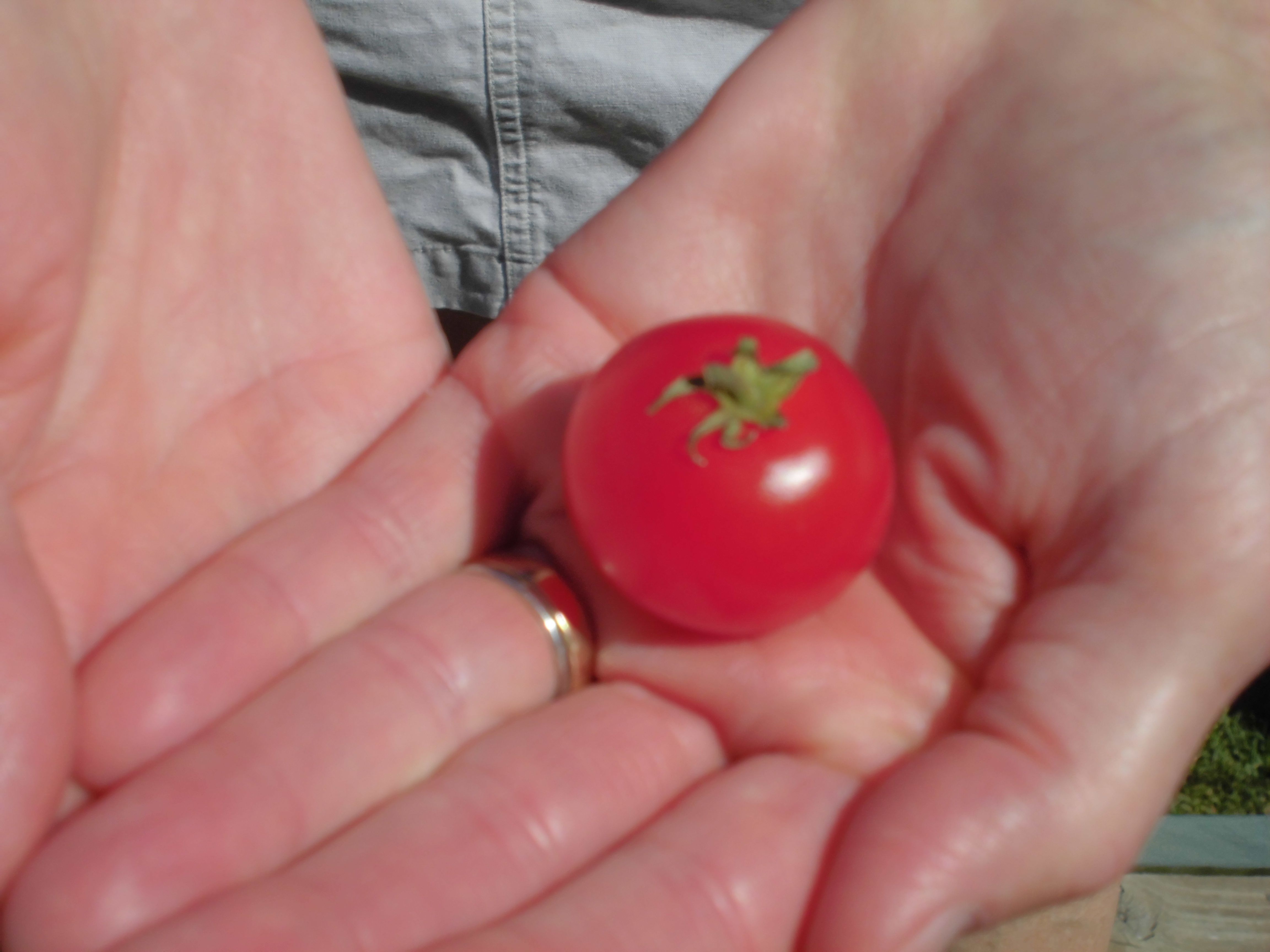
I am happy to report that we just picked our first red, ripe, perfect little tomato. The plant has turned into a leafy green tomato bush with numerous flowers. We are anticipating a bumper crop.

My husband and I are midcentury people and firm believers in the wisdom of the Beatles’ lyrics,” I get by with a little help from my friends.”

CIMG0461 CIMG0465 CIMG0469

0

Lighthouse

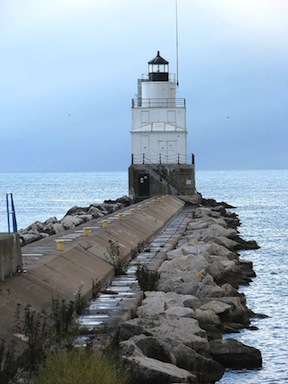
Souvenir shops near our house feature T-shirts with pictures of “Lighthouses of the Great Lakes” emblazoned on the front. Unfortunately, my husband’s lighthouse is not represented.

Our lighthouse story starts at a garage sale in Milwaukee where our son spotted a  long catamaran and boat trailer. The price was an amazing bargain, and he became a boat owner on the spot.

The yard sale boat proved seaworthy, and one summer Sunday our son and a friend decided to sail 70 miles up the Lake Michigan shore to our house. He gave us an estimated time of arrival to which we prudently added a few hours.

The E.T.A. came and went and the daylight was leaving as well. We were worried: Lake Michigan has more shipwrecks than any of the other Great Lakes. To make matters worse, the night was moonless and the winds were rising.

My husband quickly began going through the house collecting every extension cord he could find.

“What are you doing?” I asked.manitowoc

“Building a lighthouse,” was his sensible reply.

He managed to plug together 150 feet of cords, the distance from our house to the edge of the 70 foot bluff that drops down to the shore. Then he hauled out our highest ladder and brightest trouble lights. He had created a lighthouse in fifteen minutes.

We did not have to wait long for the lighthouse to do its job. From the pitch black darkness below we heard the sounds of laughter and the scraping of a boat being hauled ashore. The mariners were safely into port.

I believe there are some seafaring genes in my husband’s side of the family.

0

Tonkas

Assume nothing. This advice is a splendid way to avoid all manner of life’s surprises.

Breaking that rule, I’ve always assumed that the famous children’s toys, Tonka trucks, were made in Minnetonka, Minnesota. We frequently stay in a hotel in Minnetonka and, when there, I think of myself as being in “little truck city”.

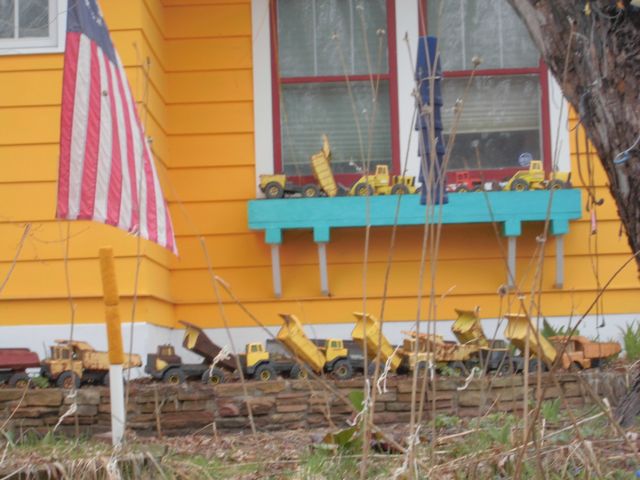
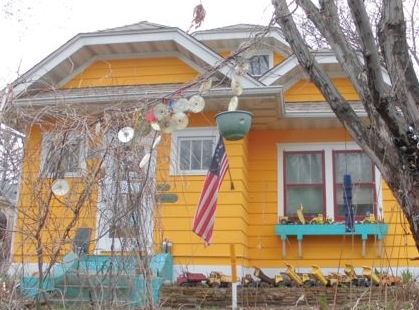
We were recently in Minneapolis where we parked our car on Xerxes Avenue . The neighborhood was a mix of well tended, modest 1940’s homes. And then we spotted a house with incredibly imaginative landscaping…..it was landscaped with Tonkas. We stood on the sidewalk admiring the homeowner’s handiwork and obvious love for these sturdy playthings.

CIMG0383   CIMG0382

Back home, I decided to learn Tonka’s history. The first thing I discovered is that Tonkas were never made in Minnetonka, Minnesota. Mound, Minnesota is the birthplace of the Tonka toy. The trucks got their name from Lake Minnetonka on which Mound is situated.

My second discovery is that America has a National Museum of Play in downtown Rochester, New York, which houses the National Toy Hall of Fame. Tonka trucks were inducted into the museum in 2001.

A field trip to Mound is definitely in order. Even though Tonkas are now made in China (no surprise here, everything is) I want to visit the ancestral home of America’s favorite miniature earth moving equipment. What would a backyard sandbox be without them?

0

Flyer

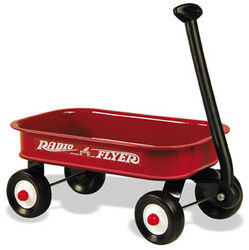
A few days ago, driving home with the groceries past the Pigeon River, I spotted a quirky little scene. A good sized green canoe was sitting by the side of the road. It was filled with fishing rods and gear. Two young men were standing beside the canoe. And beside them was a small, red Radio Flyer wagon.

In that instant, a thought zipped into my head, “They can’t be going to do what I think they are.”

As I drove past, the guys enacted my premonition: they lifted the canoe onto the coaster wagon and started down the shoulder of the road. My immediate impulse was to turn around and watch this funny caravan to see how far they would go. Unfortunately, the hour was late, the groceries were heating up and dinner needed to be made. I mentally wished them luck.

We have never towed our canoe on a Radio Flyer. In fact, our canoe is never transported anywhere. It resides on the beach chained to a poplar tree. We use our canoe on those rare days when Lake Michigan is totally calm and the weather forecast indicates no changes in the direction of the wind.

Our home is surrounded by rivers, creeks, marshes and inland lakes which we would love to explore via canoe. We have often lamented that our cars are too small to haul the canoe.

Silly us, all we would need is a Radio Flyer. Bravo to all the creative thinkers in the world.

radio_flyer

0