Mars

Don’t plan any vacations to Venus. Despite being named after the goddess of beauty, Venus is far from a beauty spot. With 800 degree plus temperatures, sulphuric acid clouds, a crushing carbon dioxide atmosphere and hurricane force winds, this planet can make hell look desirable.

I always thought that our other neighbor, Mars, had vacation potential, but I have learned otherwise. Mars only looks promising because Venus is a complete nightmare.

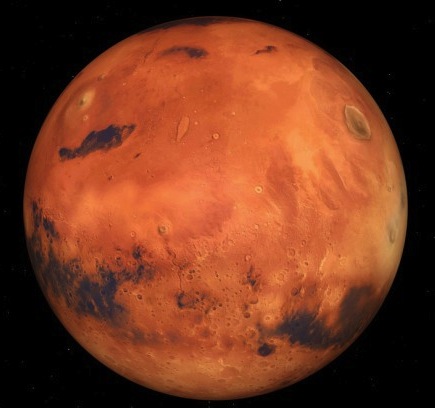
For unknown reasons, Earth had the Great Oxygenation Event and turned lush, while Mars had the Great Desiccation Event and became arid. More graphically, one turned green, the other red.

Visitors to Mars would find a pinkish atmosphere composed mainly of carbon dioxide and air pressure one-hundredth that of Earth. Winds are sufficient to stir huge dust storms which can envelope the planet for months. Days are about a half hour longer than ours, but months occur in a matter of hours. Mar’s two small moons, Phobos and Deimos, are fast orbiters.

Sightseers on Mars should be prepared for cold weather in all seasons. The average annual global temperature is 40 below zero (Earth’s is 59 degrees Fahrenheit).

Lovers of the extreme are perfect candidates for a sojourn on Mars. A Martian mountain, Olympus Mons, is the highest in the solar system. Just imagine the Alps on top of the Himalayas on top of the Rockies.

Mars also has a giant canyon that makes the Grand Canyon look like a hole in the backyard dug by a kid with a Tonka bulldozer. Valles Marineris (Valley of the Mariners) runs along the Martian equator and is 2,500 miles long, 125 miles wide and 4 miles deep. Be forewarned: no donkeys are available to carry tourists to the valley floor.

Thrill seekers are eager to sign up for future missions to Mars. Most of us, however, should heed the words of advice from John Grotzinger, the chief biologist on the Mar’s Curiosity mission. “You look at enough pictures from Mars, and you really start to appreciate the Earth.”

But you can go to Mars; at least your name and your poem can. NASA is sponsoring a Mars Haiku contest. The three winning poems and the names of all who submit poems will head for Mars on the upcoming MAVEN mission. Here is a link to the details.
mars

0

Duckie

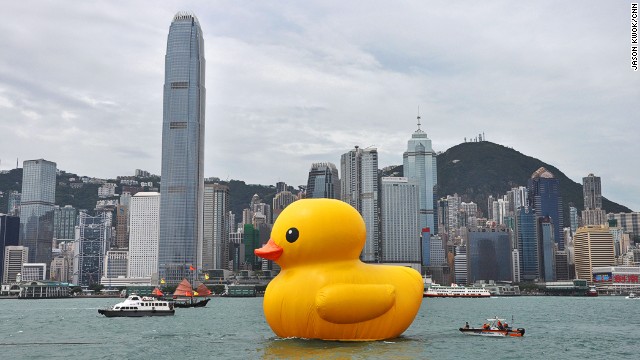
Rubber Duckie WAS the one last week. This particular 54 foot tall rubber duck sailed into Hong Kong harbor to the cheers of hundreds.

rubber-duck-in-hong-kong

Designed by Dutch artist Flortentijn Hofman in 2007, duckie has visited 13 cities in 9 countries. He is rumored to be heading to the U.S.A. as well.

I was not surprised that the duck’s creator was a Dutchman. The Netherlands always ranks high in listings of countries with the happiest people in the world. Rubber Duckies will do that to you.

Mr. Hofman states, “My sculptures cause an uproar, astonishment and put a smile on your face. They give people a break from their daily routines. Passers-by stop in front of them and enter into conversation with other spectators. People are making contact with each other again.”

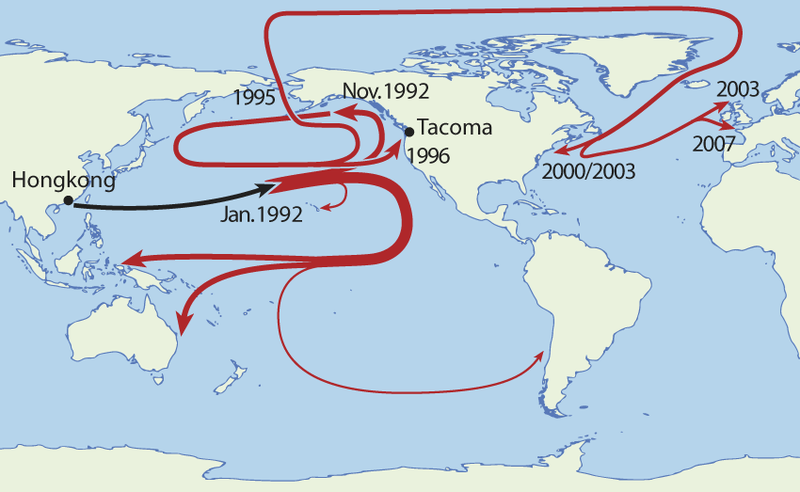
Rubber Duckies do more than bring people together: they have made a serious contribution to science. In 1992, a shipping container with Chinese plastic bath toys fell off a boat into the North Pacific. 29,000 yellow duckies, blue turtles and green frogs (a.k.a. Friendly Floatees) suddenly found themselves swimming in the world’s biggest bathtub.

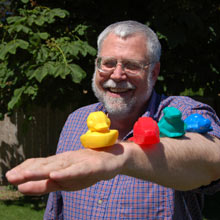
Curtis Ebbesmeyer, an American oceanographer, viewed this accident as a serendipitous event for studying ocean currents. Using models that he and his colleagues had developed, Ebbesmeyer soon had people all over the world combing beaches for duckie retrieval and reporting. I show my young students the scientists’ world map of the duckies’ journeys to drive home the fact that our planet has one big ocean, not four separate ones.


I’m sure that almost everyone reading this blog is familiar with Muppet Ernie’s famous and charming song to his Rubber Duckie. But in case you haven’t heard it or are in need of cheering up, click here.

0

Redheads

I saw two big redheads standing in a field beside the highway this week. At up to five feet tall with a flaming red streak on their foreheads, Sandhill Cranes stand out like exclamation points on the landscape.

The Sandhills are one of only two crane species in North America and they number about 530,000. In contrast, the Whopping Crane is extremely rare with a total population of both wild and captive birds numbering around 600.

Wisconsin is Sandhill country. These impressive birds return from their Florida vacations as early as the end of February or the first weeks of March. Pairs, which mate for life, stake out a territory in a marsh. Having sex in a cold, wet marsh wouldn’t appear to be a turn on, but the cranes go at it with gusto. They preen mud into their feathers and engage in unison calling and dancing, which consists of bowing, jumping, running, stick and grass tossing and wing flapping. The Sandhills can jump 20 feet high in the exuberance of a mating dance.

Their nests are built from large clumps of vegetation and are in low, wet places or even floating in the wetlands. Mom usually lays two eggs. Within 24 hours of hatching, the young, who are called colts, can walk, swim and find food. Their shape resembles “eggs on legs”. By day two, the baby Sandhills, who are all highly aggressive, start fighting. They play for keeps: frequently, only one survives. Real life is not a Disney movie.

The remaining family spends the summer together in farmers’ fields eating their favorite food, grain. But like most survivors, they are not fussy eaters……berries, seeds, insects, crayfish, worms, clams, reptiles, amphibians and even small birds and mammals are all on their menus.

When Sandhills take to the air,  they always fly with their necks extended and their legs trailing behind, like giant arrows transversing the sky.

Click on this link to view these magnificent birds.

sh


0

Remains

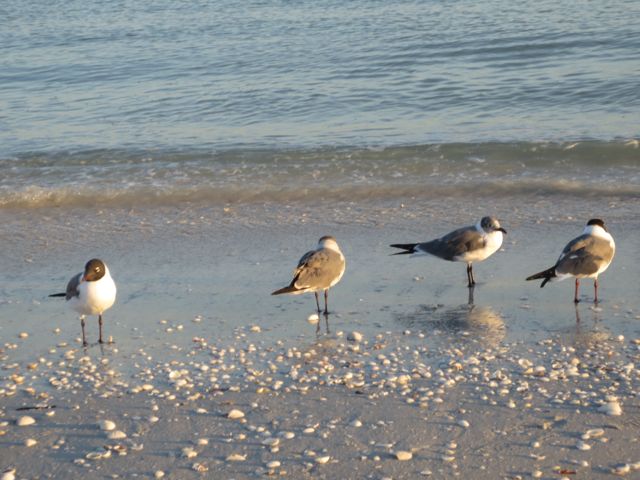
The hour before sunset on an ocean beach exudes calm. The wave-jumpers, sand castle builders, sun seekers, shell collectors and volleyball players all have departed. Shore birds do swoop down to catch a last fish and the sandpipers run around like over-wound wind up toys. Otherwise, the peace is palpable.

The remains of the day are everywhere. Complex sand castles and shell gardens await  the ravages of high tide. The day’s deposits of shells, sponges and seaweed are scattered on the beach like hundreds of still lifes. I attempt to capture these vignettes with my camera. A poor photographer at best, I don’t know how to deal with the rapidly lengthening shadows and diminishing light. I click and hope for the best.

As our part of the planet spins into darkness, the sun puts on a spectacular show. My vision-impaired Aunt used to ask me, “Do you think we will have a good one tonight?” Her tired eyes could still see brilliant sunsets. I wish she could have seen this one.

Click here for 40 seconds of tranquility.

Note: The long, curly things on the beach are whelk egg cases. Filmed at Sanibel Island, Florida.

birds

0

Puddles

“There’s a big one, go get it!” the mom gently suggested to her little boy. He was about four years old and was wearing shiny, new rubber rain boots. He headed for a big puddle and splish splashed through it, a huge grin on his face.

“How do they work?” his mom asked.

I spotted this duo as I was leaving a school at the end of the day. They were checking out all the puddles in the school parking lot while waiting for an older sibling. What an excellent pursuit!

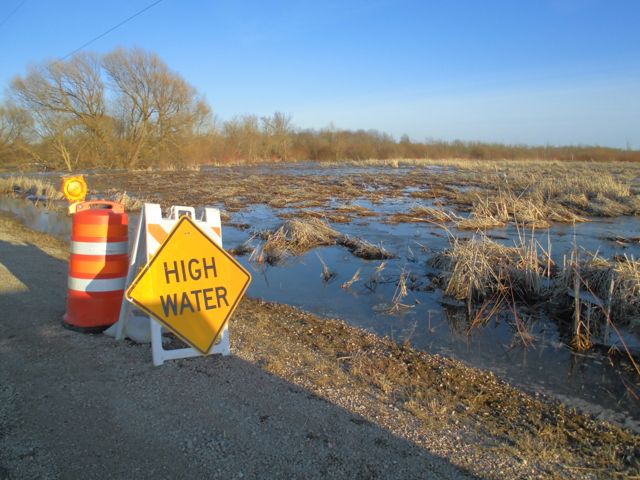
Springtime is puddle time. This year promises to have a bumper crop. When I looked out my kitchen window the other day, Lake Dennis had appeared in the field across the road. Our good neighbor, Dennis, owns the field and gets an ephemeral lake each spring in a low spot. One year the gigantic puddle lasted so long that it acquired a resident pair of ducks. This year it could host a flock.

We have puddles as well. The plow guy created a story high mountain of snow at the end of our downward sloping driveway. Now that the temperatures finally are inching above freezing, I asked my husband if we might possibly need a few sandbags, a dike or an ark. The ark idea was quickly dismissed as our resident cats (mostly toms) would never peacefully go two by two up the ramp.

My husband choose a different solution. He emulated the Netherlands and has dug little canals to contain and control the direction of the melt. This system is not yet perfect, but the water has been diverted from running into the garage.

E.E. Cummings described the springtime world as “mud-luscious” and “puddle-wonderful”. We should all go out and stomp around a bit. By August we may be in the clutches of drought with puddles merely memories.

CIMG0318 


0