Lilies

At this moment, big, orange daylilies are the reigning flowers of our roadsides, fields and yards. At our house, they’re looking in the windows, marching around our mailbox and waving in the meadow. Even though each individual flower only blooms for one day, a daylily stem makes multiple buds that bloom sequentially. Our happy orange explosion will last for several weeks.

Since daylilies are prolific from the Atlantic to the Pacific, many people assume that they are native wildflowers. Not so: these hardy flowers are from China and Eastern Asia where their buds have been roasted and eaten for many centuries.

Daylilies are world travelers, being brought to Europe by traders in the 16th century. These easy to grow, mostly beloved plants spread through Europe from the 1500s to the 1800s. The Dutch, who are known for cultivating hybrid blooms, derisively called them “ditch lilies”.

When the Colonists came to America, their daylilies often came with them. The plants were welcome additions to colonial gardens for their low maintenance and cold weather hardiness. The lilies thrived and multiplied. Many westward pioneers further helped the spread by taking clumps of lilies with them in the backs of their wagons.

One important fact about daylilies must be noted: they are not a member of the lily family (Lilaceae). Daylilies (Asphodelaceae) are more closely related to asparagus than to tiger or Easter lilies.

Here are the differences between daylilies and true lilies:

  • Daylilies grow from roots; true lilies from bulbs.
  • Daylily flowers last one day; true lily flowers last many days.
  • Daylilies grow atop a leafless stalk; true lilies atop a stalk with many leaves.
  • Daylilies have edible parts; many true lilies are toxic, some extremely so.

In summation, feast your eyes on the daylilies’ beauty, but do not eat your Easter lily.

0

Wings

The other morning, a red admiral, a mourning cloak, black and yellow swallowtails and numerous monarchs joined us for breakfast in our front yard. The butterflies dined on their preferred menu of nectar from our prairie plants while we had toast, granola and fruit. All of this fluttering about caused me to say aloud, “I wonder how many wings are flapping in and above our acre of land at any given moment?”

I’m sure the answer is a staggering number and one that could only be estimated. The bird wings could be counted; the insect wings would be impossible to total. Even the huge dragonflies that ply our airspace are not candidates for individual tracking. When a big hatch of them pepper our skies, their flight paths resemble those of helicopters gone berserk.

I envy all these winged creatures and often think how fabulous it would be to take off and soar through the skies. My flight envy often surfaces as we are watching the purple martins just before sunset. As the sun goes down, they are making their last round of the skies to scoop up bedtime snacks. The spectacular soaring, scooping and snacking continues for about fifteen minutes after the sun disappears below the horizon. Then the birds’ trajectories get lower. Each bird then makes a perfect bull’s eye entrance into its small hole in our Martin houses. There are no misses, no traffic jams…it’s a perfectly coordinated ballet in the sky, all done at super speed.

After the birds have all settled down for the night, the bats and moths claim the airspace. Seeing bats is a rare occurrence, and we wish we had more. But the moths with their fat, furry bodies and feathery antennae are everywhere. And, unlike butterflies who close their wings when they land, the moths keep their wings fully open when they settle.

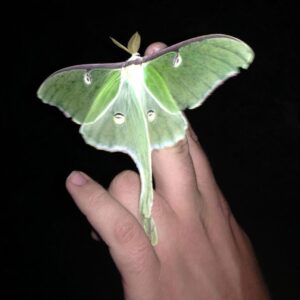
There is one moth in particular which we would love to host. I have met a number of people who have found a huge Luna moth clinging to a screen door or window. They all say it is an unforgettable sight. These giant, lime green silk moths were given the name “Luna” because the eyespots on each of their four wings look like miniature moons. They have short lives as they never feed.

We humans may all be grounded at the moment, but we can soar vicariously by welcoming winged creatures into our yards.

0

Reenactment

As we approach the Fourth of July holiday, I believe a historical reenactment is in order. America needs another Boston Tea Party, but with a change of venue. I would propose the Potomac River.

“Taxation Without Representation” was the rallying cry of our first Tea Party. Led by Samuel Adams, the Sons of Liberty were merchants and tradespeople who opposed the onerous taxes imposed by the British government. The Tea Tax was a special windfall for the British Treasury as the colonists drank 1.2 million pounds of tea a year.

The protest began with a boycott of tea from the British East India Company. Dutch Tea was smuggled into America, and Sam Adams and John Hancock were among the smugglers. This action resulted in lots of surplus tea and impending bankruptcy for the British East India Company. The British parliament then reduced the price of tea but retained the tax. Even with the lower price, the colonists preferred to smuggle.

On December 16, 1773, three British ships, the Dartmouth, Beaver and Eleanor, entered the Boston Harbor loaded with tea from China. Thousands of colonists rallied and refused to pay the tax. But their colonial governor ordered the taxes to be paid and the ships unloaded. That night, 100 colonists disguised themselves as Indians, boarded the ships, split opened the chests with their tomahawks and dumped 342 tea chests into the harbor. This act of civil disobedience took 3 hours and involved 45 tons of tea which would cost around a million dollars at today’s prices. No property was damaged (other than the tea), no looting occurred and the ships’ decks were purportedly swept clean by the “Indians” before they disembarked.

If you visit Washington D.C. today, you will notice the residents’ license plates bear the words  “End Taxation Without Representation”. The population is 702,455 and 49% of the population is African American. Wyoming and Vermont have fewer people.  Residents of the District pay taxes and fight in wars, but have no voting members in Congress.

A 51st State is in order. And while we are at it, let’s make it 52 by adding Puerto Rico. It’s time for America to get out of the business of having colonies.

0

Pits

As a graphic designer, I try to keep up with the latest art fads. However, until recently I was clueless about a hot art craze that surfaced in 2017.  How could I have missed avocado art? Perhaps it’s because I’m a Midwesterner, and we are always a bit behind the cutting edge.

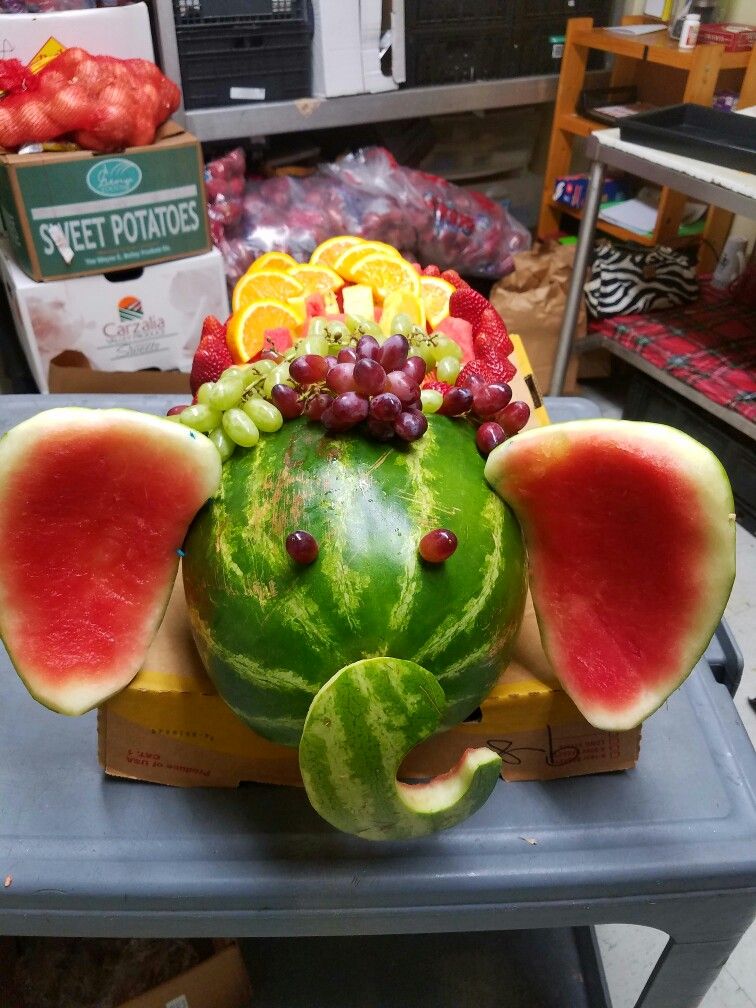
Food as art is a long-standing culinary tradition. Think of radish roses, butter sculptures, watermelon baskets and myriad other fruits and veggies turned into dazzling banquet displays. Down through the ages, chefs have ignored their mother’s command, “Don’t play with your food!”

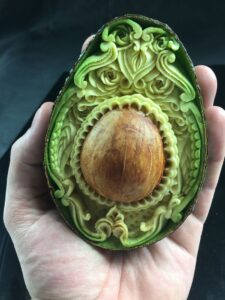
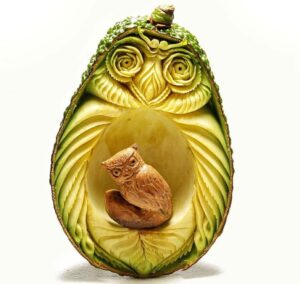
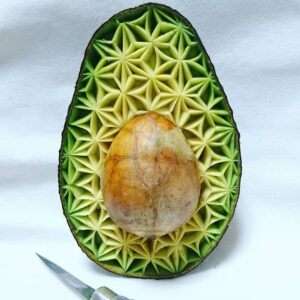
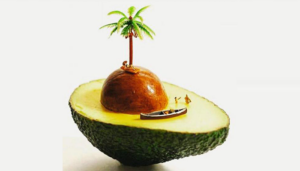
Nevertheless, the humble, squishy avocado, mostly associated with guacamole, seems like an unlikely candidate as an art media. But it, too, becomes a masterpiece in the hands of a culinary wizard, And wait, there’s more. The pits are turned into tiny works of art as well.

These intricately carved avocados (a.k.a. alligator pears) and their pits are a delight.

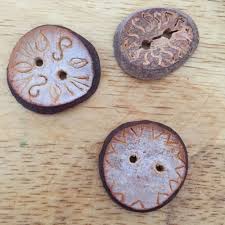
This all goes to prove that there is no excuse for ever being bored. And if you are a bit art challenged, don’t worry. You can always make avocado buttons.


0

Undaunted

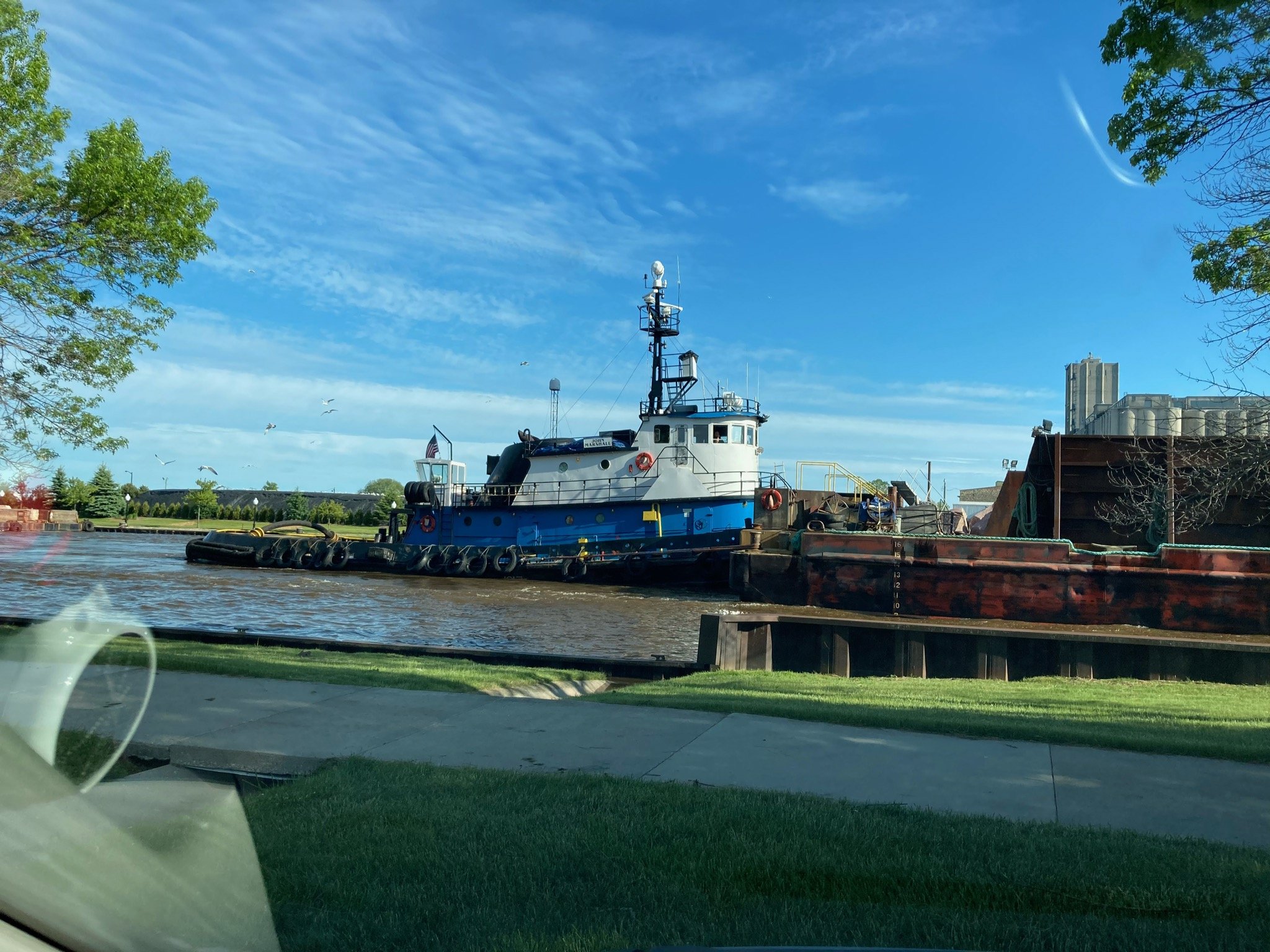
Driving home from a hike last Saturday, we spotted a little tug and its huge, empty barge turning into the Manitowoc River from Lake Michigan. Since our house is a reporting station for Marine Traffic (1080 Cat Cove) we decided to detour down to the riverbank to check out the tug’s name. We are familiar with the vessels that regularly ply the lake 5 to 7 miles in front of our house.

The tug was our old friend, the John Marshall, and we instantly decided to try and track her down the river, no easy task as the river soon would twist and turn through an industrial area of huge factories, overgrown foliage and no frontage roads.

She was quickly out of sight and we were zigzagging up and down many dead end streets trying to get her back in view. When we found her, she was moored, but not loading, an activity we wanted to see. Then we noticed two giant cranes on the opposite side of the river busily swinging back and forth, their vessels obscured from our view.

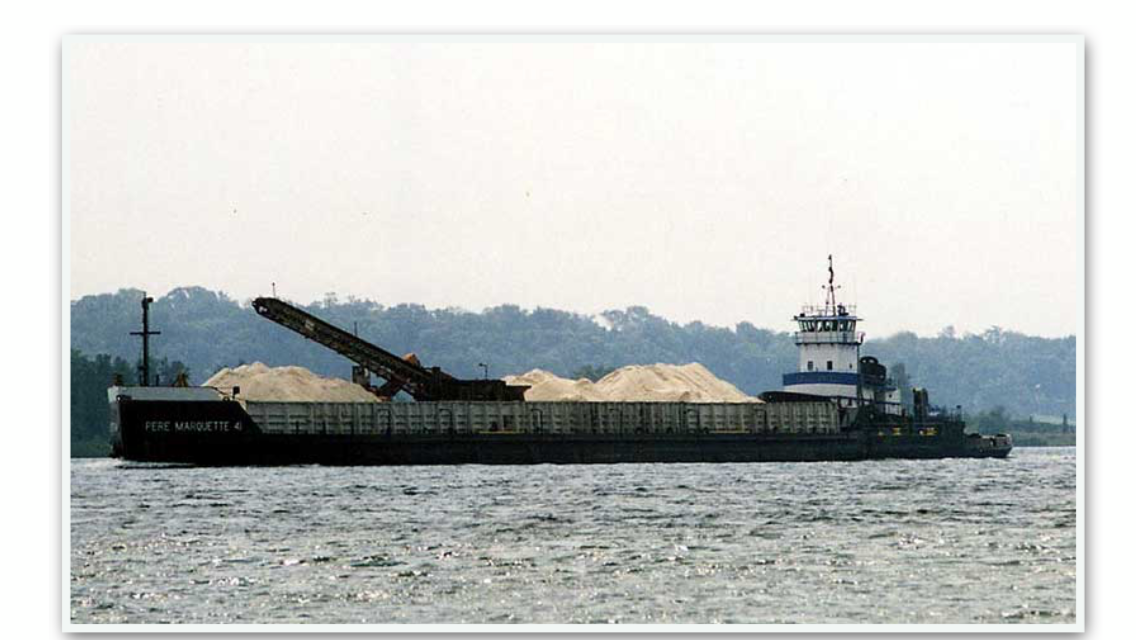
A quick check to Marine Traffic on our phone informed us that the Undaunted, another tug familiar to us, was over there. Determined to view the action, we continued our pursuit to find a viewing point. We found it on a hill high over the river where a small break in the trees afforded us a partial view of a big, old, tired looking boat named the Pere Marquette that was being loaded with giant scoops of gravel. We could not see the Undaunted.

When we got home, we immediately started a computer search to find out what we had seen. Why was an unreported boat receiving cargo? We found an amazing and detailed answer to our question.

The “boat” we saw was a boat but wasn’t a boat at the same time. It is a marvelous tale of use, recycle, and then recycle again and again. Here is a quick summary.

The Pere Marquette began as a Lake Michigan carferry, the City of Midland, that was launched in 1940. She had room for 367 passengers,  60 luxurious staterooms, 12 parlors, 34 rail freight cars and 50 autos. For 45 years the vessel faithfully traversed the lake until the cross-lake  service was ended in 1985. Upon inspection, the City of Midland was found to have an unrepairable boiler, and she was retired and moored in Ludington, Michigan. Then, in 1998, her two powerful engines and deck cabins were removed and she was converted to an open- deck barge. She would never move again without a tow boat, but an extremely historic vessel was found and fitted to her.

The tug, Krystal K., was built in 1943 as a Rescue Ocean Class tug and was used during World War II to service and salvage U.S. war ships. After the War ended, she was renamed Undaunted and became part of the National Defense Fleet. That lasted until 1963 when she was moved to the Merchant Marine Academy at Kings Point, New York, where she was called the Kings Pointer. Her Great Lakes debut came in 1993 when she was sold to Basic Marine who once again called her the Krystal K.. They, in turn, sold her to the Pere Marquette Shipping Company in 1998 who reverted her name back to Undaunted and made her the permanent tug partner to the Pere Marquette barge.

Both vessels are still going strong after combined service of 157 years. I find that wonderfully daunting.

Undaunted


John Marshall


0