Nurseries

Garden centers are dangerous places. Put me in a shoe store, jewelry store or art gallery, and I have sales resistance. Nurseries, however, are gardens of temptation. Those plants sing siren songs to me.

Who doesn’t want their yard to look like a photo shoot from Sunset Magazine? The fact that I know I’m a bad gardener is absolutely no deterrent. Garden centers exude hope from every leaf and bloom, and I’m buying in….literally.

That cute little wagon they let you borrow doesn’t help matters either. It’s fun to pull it up and down the damp paths through rows of lush plants. Naturally, it looks better filled with flowers.

Nurseries are epicenters of instant gratification. Someone else has guided these plants through the birth, baby and teen years. The racks of seed packets at my local Fleet Farm can’t possibly compete. I know those seeds won’t turn out to look like the pictures on their packages. And I will wait a long time for them to sprout and go spindly.

So off to the garden center we go. My husband is as much of a plant junkie as I am. We quickly fill the coaster wagon with hopes and dreams of Eden. The only saving factor is our cars. They are both pint sized. Sheer space limits our flower frenzy.


IMG_1720

0

Update

On September 30, 2014, I published a blog about New Jersey. (“Jersey” in the archives.) I’ve recently discovered a vitally important fact about the Garden State that I omitted. An update is in order.

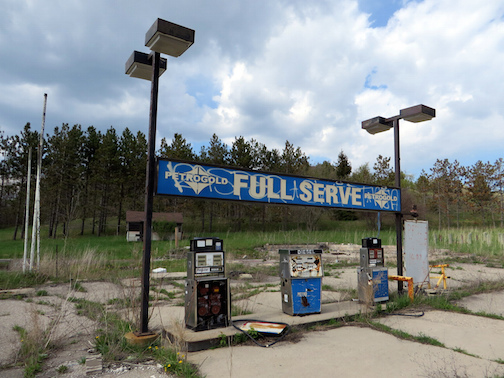
For seventy years, New Jersey by law has prohibited self serve gas. The only other state with a similar law is Oregon where the ban is currently being repealed. New Jersey will be the last bastion of full service pumps.

A recent poll of Jersey residents found 63 % in favor of the no self serve law. The issue appears to be a sacred cow to the population.

Proponents of self serve bring the issue up in the legislature, but can’t get traction. Assemblyman Declan J. O’Scanlon says, “Nobody can make a sound argument why we should not allow this. The only way to win that argument is if you can make a legitimate argument that New Jerseyans are more flammable than other people.”

To arguments that repeal would be a burden on the elderly and people who cannot reach the pumps,  O’Scanlon quips, “do they have no senior citizens in other states, no short people?”

New Jersey residents know that rational arguments are irrelevant. They want this little luxury, this special treatment and this distinction. And they are street smart enough to know if they give full serve up, they will never get it back.

The next time I’m standing in the rain, wind and cold, fumbling with a smelly gas hose, I will be exuding envy of those Jersey drivers who get to say, “Fill er up!”

0

Curiosity

I’ve just finished another year of Art in a Suitcase programs. One overriding thing made all these years possible….curiosity. My curiosity was the catalyst that started the adventure, and the curiosity of thousands of children and their parents has allowed it to flourish.

When I began teaching art many years ago, I frequently had my young artists draw, paint or sculpt animals. Somewhere along the way, I felt a need to expand the lessons to give the children a few science facts about the animals and habitats they were portraying. My curiosity was sparked as well, and I quickly became hooked on the natural sciences.

Art in a Suitcase was the result. In hindsight, a more appropriate name should have been Art and Science in a Suitcase. (Since this is a mouthful, I decided to keep the original name intact.)

The curiosity of children is a never-ending source of joy. Almost all the young people I work with want to learn. If I throw out a few facts about the planets, Komodo dragons, fireflies, oceans, sharks, volcanoes, the Arctic or any other topic found in a natural history museum, hands shoot up to ask questions.

When I do encounter children with an attitude that announces, “I dare you to say anything that interests me”,  I know that something has gone terribly wrong in their young lives. Paradoxically, I’ve noted that these children are most often from homes with a shocking lack of material resources or an egregious abundance of them.

Our current educational system in America is not focused on the power of curiosity. The emphasis on testing and grades trumps all else. We need to bring back the wonder.

Historian David McCullough, a two time Pulitzer Prize winner, succinctly notes, “Curiosity is what separates us from the cabbages. It’s accelerative. The more we know, the more we want to know.”


0

Grawlix

“Do you know what a grawlix is?” a young relative recently asked me.

“I certainly don’t, but I would like to know,” was my reply.

“Well”, he said, “it’s the name for those funny symbols cartoonists use in place of swear words.”

He and I are both hard core readers, and we were delighted to acquire this new word which he had come across in a witty young adult book he had been reading.

My curiosity piqued, I decided to find out more about the grawlix. The word was invented by Mort Walker, the cartoonist who created Beetle Bailey. In 1980 he wrote a book, The Lexicon of Comicana. Intended as a satire, the book explores the devices cartoonists use in their drawings. After researching cartoons from around the globe, Walker catalogued a set of symbols he calls  “symbolia”. Then he invented quirky names for the symbols.

One day in a book store, Mort was looking for his book and couldn’t find it. He asked a salesperson for help and was told his book was in the “Language” section. He had been looking for his book under “Humor”. The joke was on him: his satirical book was taken seriously and his tongue in check names are now found in dictionaries.

Here are a few samples of his witty word inventions.

Agitrons: wiggly lines around a shaking object or character

Blurgits, swalloops: Curved lines preceding or trailing after a character’s moving limbs

Briffits: Clouds of dust that hang in the spot of a swiftly departing character or object.

Plewds: Flying sweat droplets that appear around a character’s head when working hard or stressed.

Grawlix

0

Vera

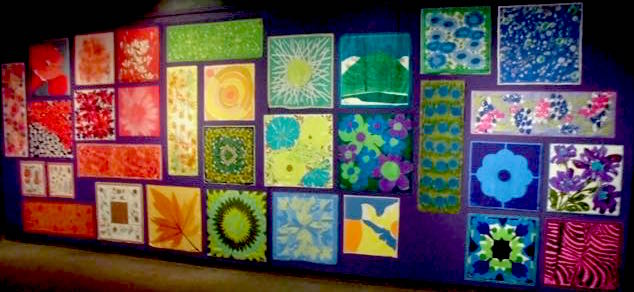
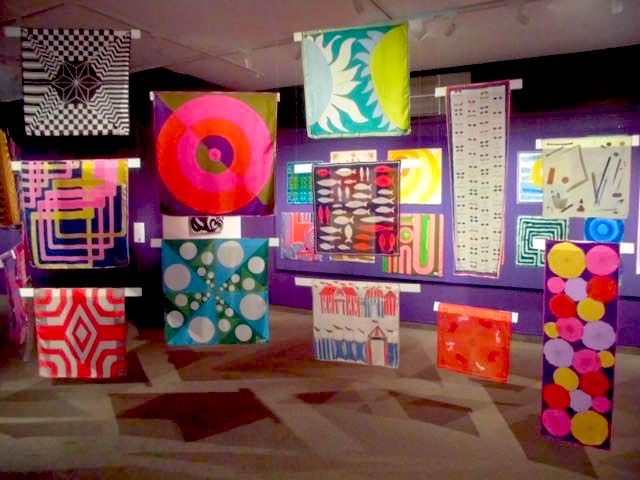
A rainbow must have been overhead on the day Vera Neumann was born. This iconic mid-century artist’s scarves are explosions of color and design.  She is also famous for making wearable art affordable in an age when the term “wearable art” didn’t exist. “Color is the language I speak best,” she said.

Born to Russian immigrant parents in Stanford, Connecticut in 1907, Vera was given art lessons as a child and taken to New York’s Metropolitan Museum of Art every Sunday. Her father gave her 50 cents for every sketchbook she filled. After graduating from Cooper Union and Traphagen School of Design, Vera began her career designing children’s furniture and murals.

The perfect alchemy occurred when Vera married George Neumann. His family was in the textile business, and together they created their company, Printex. Beginning with placemats which they silk screened on the dining room table in their small apartment, the company flourished.

The outbreak of World War II brought fabric shortages. Vera began experimenting with parachute silk which was available at army surplus stores. The scarves she created are now part of design history.

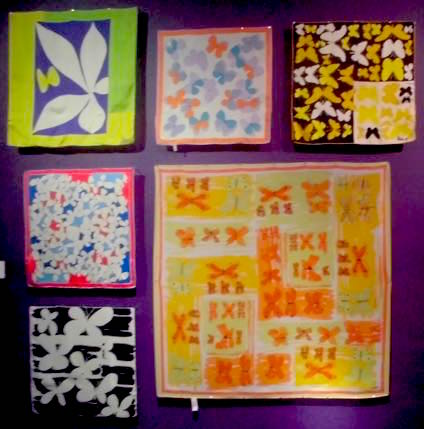
Vera was an astoundingly prolific artist. Using a Japanese sumi brush, she painted designs filled with bold colors, movement and spontaneity. Subject matter ranged from flowers, fruits,vegetables, butterflies and leaves to geometric designs. In addition to her scarves, other products with her trademark signature of “Vera” followed by a ladybug include sheets, towels, table cloths and napkins, dishes and casual clothing. Her mission was to produce one print a day which explains why her archive encompasses 7,000 designs.

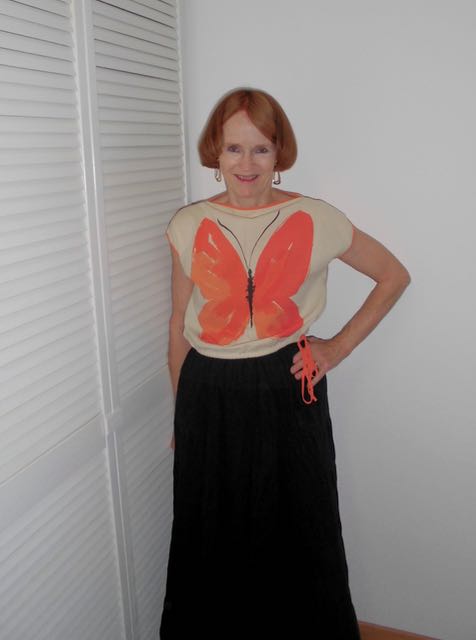
When I was thirteen years old, I was thrilled to find a Vera blouse marked down to a dollar…..definitely within my budget. I happily still wear that blouse and my collection of Vera treasures continues to grow. I check out the scarves in every antique and thrift store I visit and sometimes I find a vintage Vera. That is a rainbow day!

CIMG0682

CIMG0678

CIMG0687

CIMG0688
Above photos taken at Goldstein Museum of Design, St. Paul, MN


CIMG1046

0