Eclipsed

Yesterday was the solar eclipse and we were duly eclipsed. Unfortunately, it was a low cloud cover doing the eclipsing resulting in a non-event in southern and central Wisconsin.

My husband and I are life long residents of the Badger state, and we must admit that we did not have high hopes that we would witness the solar sky show. Anyone who has spent time here realizes that planning outdoor weddings, family picnics or concerts on the lawn has a high statistical chance of facing disappointment. Stuff like clouds, rain, sleet and golf ball size hail falls out of our skies with great regularity.

However, we did harbor a slight glimmer of hope as we spent all day Sunday and Monday morning in Chicago. Perhaps, we thought, Chicago would have sunshine and we could hang around for a while and take in the big sky show. Alas, no such luck.

As we headed back to Wisconsin, we listened to Chicago’s top, all news radio station broadcasting live updates on the eclipse from reporters all over the city. Here is our favorite report during the actual eclipse:

“I’m reporting from the special solar eclipse cruise boat in the harbor, and we are all looking at the thousands of people on shore staring up at the sky.”

In other words, a great enactment of the Second Coming, but nothing else for that highly priced boat ticket. Which brings us to another point. Since we were in a hotel room that morning, we turned on the television, a rare event for us as we haven’t owned a TV for over 30 years.

That is how we discovered that the eclipse, THE MOST DEMOCRATIC OF ALL EVENTS, was being hyped for profit like a rock concert or a blockbuster movie release. A helicopter tour company in Oregon was offering an exclusive viewing site on the side of a mountain for $80,000. The price included a freshly brewed cup of coffee.

I’m all for hyping the event, but my pitch would be as follows:

Don’t forget to catch the eclipse, folks. It’s called science and it is really real. And if you are clouded out, don’t worry. Nature is putting on great shows every day all around us. P.S. Nature is part of science, too.

In lieu of seeing the eclipse this video had to suffice for us.

0

Puppetry

My list of museums to visit just got two new additions; the new Center for Puppetry Arts in Atlanta and the Museum of the Moving Image in Queens.

I visited the Atlanta museum when it was in its old building. My husband and I were driving in downtown Atlanta and serendipitously spotted a sign for it. The museum was housed in an old, musty building with dim lighting and puppets from around the world in glass fronted cabinets. In one of the small galleries we found ourselves alone and surrounded on three sides by these frozen figures. And then, after we had been in the room studying the puppets for some time, we detected slight movements. It was positively uncanny….slowly and subtly, the puppets appeared to be coming alive.

The museum has moved to a new, larger building and houses a substantial portion of Jim Henson’s archive. During his lifetime he was a major supporter of the museum.

The bulk of the Henson archive, however, was donated four years ago by his family to the Museum of the Moving Image in Queens. New galleries were built to display this treasure trove and have recently opened. Fittingly, Sesame Street is just around the corner at the Kaufman Astoria Studios.

Visiting would be like meeting old friends; Kermit, Miss Piggy, Cookie Monster, Elmo, Bert and Ernie, in total 40 Muppets all of whom have been lovingly restored. Being a stay at home mom when our children were little, I had the fun of getting to know the Muppets well. Mr. Henson knew that puppetry was not only for children, and the muppets always had some quips that only adults could appreciate.

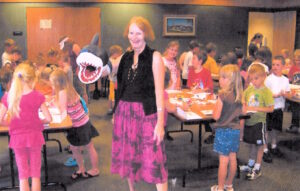
In addition to loving good puppetry, I also get to use puppets in many of my natural science programs for children. We have over 40 puppets living in our house with us. Most are Folkmanis puppets all of which are extremely realistic animals. Judy Folkmanis started her business in her home and it has grown to be one of the largest suppliers of quality hand puppets in the world. I have not given her puppets names or personalities…..they are props to help me explain the features of the real animals they  resemble.

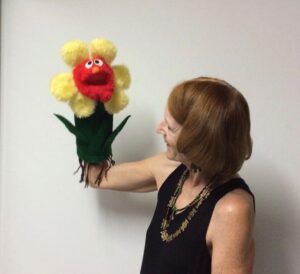
But then there is Flora. She is not a Folkmanis puppet, and I can’t even remember where I found her. Flora helps me do my plant science program for very young children. She has been such a hit with kids that she wore out and had to have a complete body transplant, right down to her roots. Flora always upstages me. Funny how a few pieces of felt and fake fur can have such an outsize personality.

0

Queen

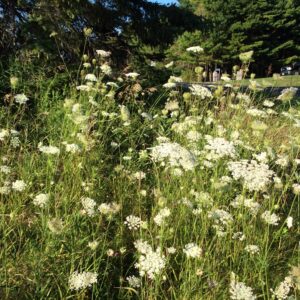
The Queen was reigning along all the roadsides and meadows as we were driving to Madison last week. Despite low, gray skies and a deluge of rain, the trip was a visual delight thanks to her beauty.

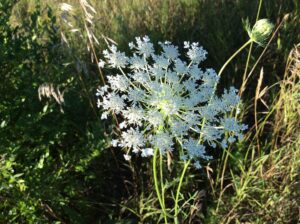
A prolific wildflower (some would say weed) Queen Anne’s lace blooms in August, often alongside her shorter consort, blue chicory. It’s a heavenly match.

Queen Anne’s lace, officially known as Daucus carota, is a wild carrot. Originating in Europe and Asia, it was brought to America by European settlers.

Genetic evidence establishes wild carrots as the direct progenitors of our orange cultivated carrots. Check this out by crushing any part of Queen Anne’s Lace, especially the taproot, and it smells exactly like a carrot. BUT DON’T EAT IT!

Queen Anne’s lace is a member of the Apiaceae or Parsley Family along with caraway, fennel, coriander, celery, anise root and poison hemlock. Since the hemlock is a dead-ringer for Queen Anne’s Lace (which does have edible parts), it is best not to make a deadly mistake and nibble the wrong plant. Remember Socrates.

The use of wild carrots goes back 5,000 years and these carrots came in a variety of colors including white, yellow, purple, red and black. Most cultivated carrots up until the 16th century were purple. Then breeders in the Netherlands developed orange carrots, perhaps in tribute to their rulers known as the Royal House of Orange.

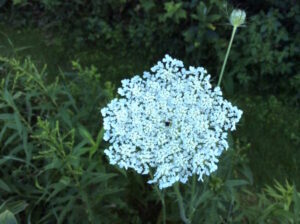
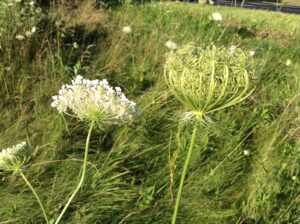
Queen Anne’s Lace is a biennial, low leaves and taproot develop the first year, stalk, flowers and seeds the second. The flowerhead or umbel can reach 5 inches across and is made up of many tiny flowers each of which will produce two seeds. When the seeds ripen, their delicate stalks turn inward and the flower head resembles a small bird’s nest.

Look closely at the umbel and you may see one minute cluster of purple flowers slightly off center amidst the lacy white froth. Botanists suspect that these sterile blossoms might be practicing plant mimicry. The small cluster resembles a bug sitting on the flower. Perhaps the fake bug attracts real insects which would help pollinate the plant. Scientists admit that the purple spot remains a “mystery” spot requiring more research.

It is also a mystery exactly which Queen Anne the plant was named after, and there are several contenders. Whichever  Queen it was, a beloved myth is that she pricked her finger when making lace and her dot of blood is the purple floret. One thing seems to be certain…….Queen Anne’s Lace is a fascinating carrot.


0

Obituary

I do not make a habit of reading the obituaries. But when the obituary is on the front page of the New York Times and is for a person I’ve never heard of, my curiosity is aroused.

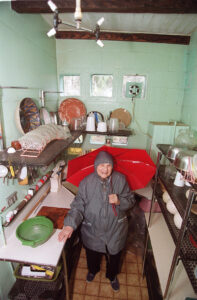
Frances Gabe died at the age of 101 in Newberg, Oregon, her longtime home. The photo accompanying the article shows Mrs. Gabe in full rain gear and open umbrella standing in her kitchen. That’s because her claim to fame was designing and building the world’s only self-cleaning house.

The cinder block bungalow took decades to plan and 10 years to build. Completed in the 1980’s, the 1,000 square foot house cost $15,000 and was patented.

She credits her children and jam as her inspiration. One day her kids got fig jam all over a wall and, in frustration, she hosed it down.

Most mothers of young children have had similar experiences. I recall looking at my son’s high chair after he ate spaghetti for the first time by himself and wondering if I would survive all the messes ahead. After that spaghetti-eating boy grew up and was a father himself, he once threatened to stick a garden hose in the kitchen window and hose the whole room out.

Mrs. Gabe simply made our fantasies come true…..she turned the entire interior of her home into a car wash or gigantic dishwasher. Ceiling jets sprayed down, suds flew, fans dried and water exited via floor drains out through the doghouse. Clothes on hangars were washed in a tightly sealed cabinet and mechanically transported back to a closet. The patent on the house consisted of 68 individual inventions.

In fascination, I’ve read numerous articles and watched videos (click here) about the house and its unique inventor.

Here’s the sad news. One article reported that “Ambitious as it was, it didn’t really seem to work, video clips of the home in action are more like blooper reels.”

Here’s my take on the house from my minimalist viewpoint. It’s probably easier to get out the bucket, scrub brush and vacuum than deal with 68 different gadgets which will inevitably need constant maintenance and repair.

The new owner of the house has removed all the cleaning gadgets. That’s also sad, the house should have been turned into a museum to the eccentric spirit.

0

Door

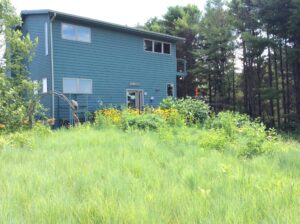
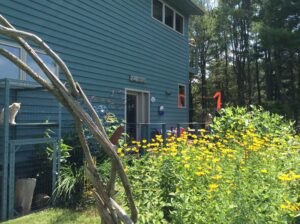
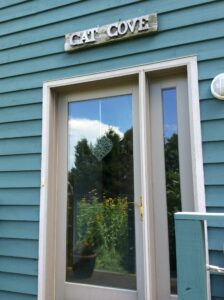
If you visit our house, please do not attempt to use our front door. Thanks to the consequences of our gardening efforts, our front door is no longer accessible. We did not intend to make this door private, but sometimes nature just takes charge.

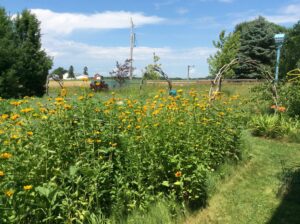
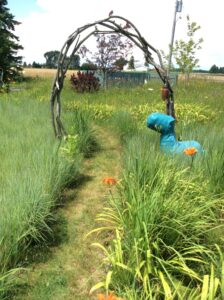
For the past 21 years, my husband and I have been striving to create a prairie that extends from the front of our house almost to the road. Growing little blue stem prairie grass from seed turned out to be a daunting challenge. To give the grass every chance to thrive and not get trampled on, we created a path from the far end of our driveway around the periphery of the blue stem up to the front door. The path is ordinary grass and clover and is marked by three driftwood arches.

To shelter our prairie grass and flowers, we planted little pines and Cleveland pear trees between the road and the prairie to make a wind block. The westerly winds that blow in over the open fields across from us are mighty.

Years passed and the little trees became big trees, their branches and boughs extending over one entire side of our path. Of course, we could get out the pruning shears and severely cut back the trees, or we could create a new path by mowing down the little blue stem. But neither of us have the heart to do this. We worked hard to help these plants thrive and we are happy they like living with us.

Fortunately, we have a side door right next to the end of our driveway. It’s our main door now and visitors can come in and upstairs to our home. Once inside, the front door leads to the deck and a lovely view of the prairie which is currently in full bloom. And the path under the arches remains …..all the way to a dead end. We wonder what nature has in store for us next.


0