Pumpkins

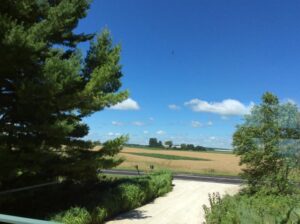
This is a true story about an incognito pumpkin patch. I view, or more accurately, don’t view, the patch every time I look out my kitchen window.

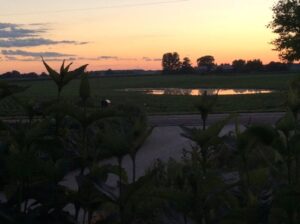
The story begins a year ago when our good neighbor, Farmer Dennis, planted winter wheat in his fields across the road from our house. The wheat sprouted but, unfortunately, a low spot of about two acres developed in the middle of his fields. When the abundant spring rains came, they flooded the low spot and drowned the wheat there. We named this flooded spot Lake Dennis and were not unhappy to see ducks and geese coming to paddle around in their new lake and rest in the wheat that surrounded it.  I kidded Farmer Dennis that maybe he should dig it out a bit and create a permanent waterfowl sanctuary.

However, the inevitable happened, and his ephemeral lake dried up when the spring rains stopped.

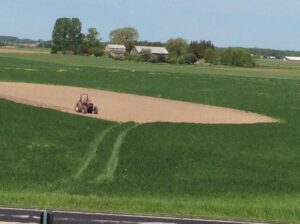
“I can’t stand to see good land be fallow,” he said to me one day. “I think I’ll try something.” Shortly after, I looked out the window and saw him driving his tractor through the wheat to the dead spot. He proceeded to dig up the soil (I believe the correct word is till). A few days later, he was back with equipment to seed the empty patch.

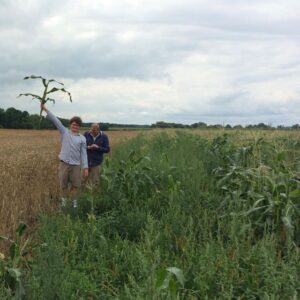
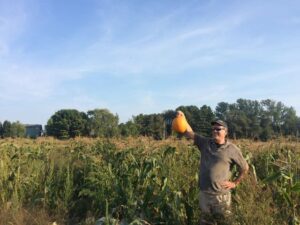
Naturally, I was dying of curiosity to know what I would be looking at all summer when I stood at the sink washing dishes. “I thought I would try for two acres of sweet corn,” he told me. “And I threw in some pumpkin seeds, too”.

“What a brilliant experiment”, I said. Sort of like turning lemons into lemonade, or in this case, a flood into corn on the cob and jack-o-lanterns.

We took frequent walks all summer into the middle of the wheat field to watch the progress of this grand experiment. Visiting family members often joined us. And, as these pictures relate, the hidden pumpkin patch was a huge success. The sweet corn was delicious, too. And, even better, it was all free. We are truly fortunate to have such a generous, caring and imaginative neighbor.

0

Bones

I always explain to children at my programs that I don’t ask trick questions. I want to be an educator, not a trickster conjuring up inscrutable problems which convince many children they are stupid. But I do warn children when a question is especially difficult and assure them that no one knows all the answers.

In the spirit of the upcoming Halloween holiday, here are some frightfully hard questions about bones. Treats don’t depend on getting all the answers right.

Who has more bones, cats or people? Felines have more. Cats have between 230 and 250 bones…tails and toes account for the variance. Manx cats lack tail bones, polydactyls have extra toes. Humans have 206 bones.

How many bones are in a giraffe’s neck? The answer here is 7. That is the same number of neck bones in mice, us and all other mammals with two exceptions, sloths and manatees. Short-necked manatees have 6, the three-toed sloth has 9 and the two-toed sloth has 6.

Are animals with internal skeletons in the majority or minority on the planet? We lose, vertebrates comprise only 2% of the earth’s animal species. The other 98% are invertebrates such as insects, arachnids and mollusks.

How many bones does a shark have? None. Sharks and their cousins the rays and skates have only cartilage.

Which animal has the most bones? Snakes. These reptiles can have from 200 to 400 vertebrae with ribs attached.

Which parts of our bodies have the most bones? Our hands and feet contain more than half of our body’s bones….27 for each hand, 26 for each foot.

Who has the most bones, a baby or an adult human? The baby has around 300 bones at birth which fuse together into 206.

Which human bone is the smallest? The longest? The stapes in the middle ear is the smallest. The femur, or thigh bone, is the longest and strongest.

Photo:convoke.info
0

Debunked

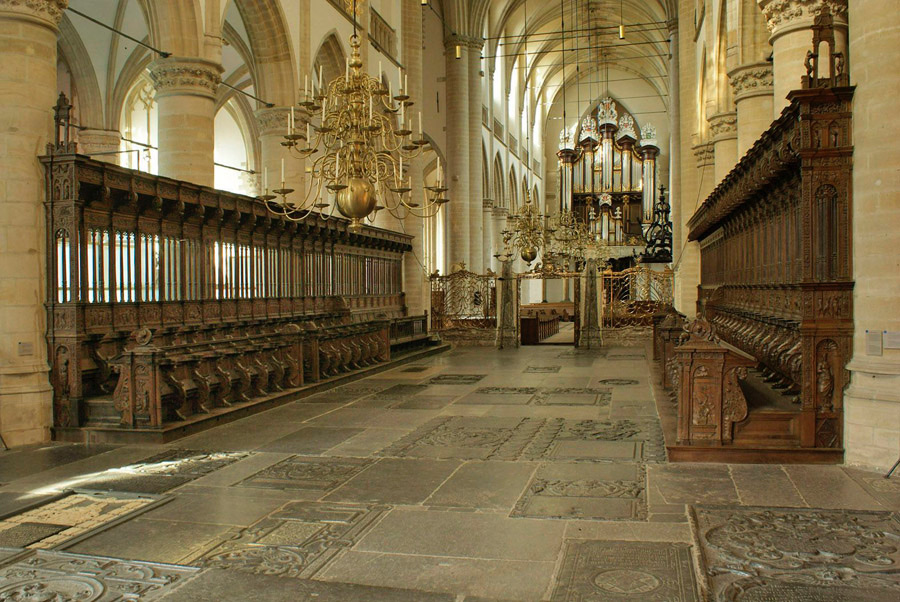
I recently read an explanation of the term “stinking rich”. The phrase was derived, the travel guide stated, from the fact that nobility and rich people were interred under the floors of medieval churches. Since the Europeans did not posses the embalming skills of the Egyptian mummy makers, the stench from opening a family tomb was gagging, making church attendance a true penance in the Middle Ages.

This explanation sounds plausible, plus it gives ordinary folks license to mock the rich, a favorite pastime down through the ages. Being a born fact-checker, I decided to do some research on the origin of the phrase. I quickly discovered from multiple sources that “stinking rich” is most likely a fabrication, the dead rich didn’t literally clear out the pews thanks to quicklime or other odor reducing measures. However, this is not to say that the medieval world was as odor free as our modern one.

My research on the “stinking rich” serendipitously led to another gross myth being debunked. The popular nursery rhyme “Ring Around the Rosy” was not about dropping dead from the Black Plague, an oft cited explanation of the lyrics. The rhyme did not surface in print until 1881, and probably refers to some Protestant sects ban on dancing. Children’s circle games popped up to substitute for dancing……..kids need to move!

However, one medieval holdover in our speech appears to be true. “Lousy” does really hark back to being covered with lice. Now that’s lousy.

Medieval Memoria Online
0

Escarpment

Geology rocks……literally. Look up America’s top natural attractions and you will be looking at the Grand Canyon, Rocky Mountains, Zion and Bryce National parks, Yellowstone and Yosemite.

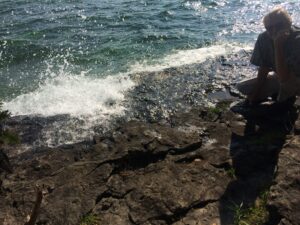
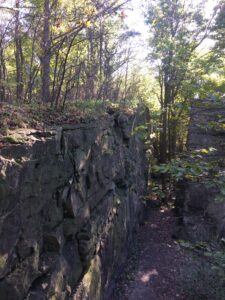
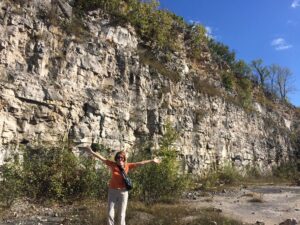
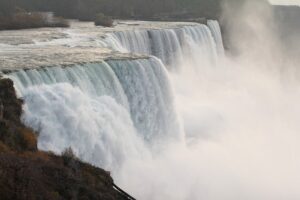
Our rocks here in Wisconsin aren’t on the list, but they should be. Wisconsin is home to part of a world famous geological formation that runs through the eastern third of the state and then through the Upper Peninsula of Michigan into Canada and down to Niagara Falls. This massive, 1,000 mile stone ledge is called the Niagara Escarpment.

The Escarpment plays a game of hide and seek. In some places such as Door Country, High Cliff State Park and Horicon Marsh it is unmissable. But in other places it is underground, only to pop up a few miles later.

The geology of the Escarpment is fascinating. Essentially, it is the rim of a vast, ancient sea that formed 430 million years ago in the Silurian Period. In comparison, that makes the 70 million year old Rocky Mountains mere kids.

The rock was originally lime mud on the sea floor. What we see now is the result of “uplift, weathering and erosion”. When the sea dried up, the layer that was soft shale eroded quickly, the harder dolomite limestone remained. A close inspection of these dolomite cliffs reveals wonderful sea fossils such as corals, cephalopods and chrinoids.

More than 10,000 years ago (modern history in geological time) glaciers covered the eastern part of Wisconsin. Those mile thick frozen rivers of ice acted like bulldozers knocking down the Escarpment in some places and creating fissures and caves in others.  So we can blame the glaciers for the “now you see it, now you don’t” aspect of the formation.

Geologists classify the Escarpment as a cuesta, which is a ridge with a gentle slope on one side and a steep slope on the other. In Wisconsin’s Door County, the cliff is on the Green Bay side and the gentle slope on the Lake Michigan one.

People have been drawn to the Escarpment from the earliest times. An 11,200 year old projectile point has been found on the Oakfield Ledge in Wisconsin. Pioneers settled near the ridge as well building lime kilns to burn the rocks to produce white lime powder that was used for mortar, plaster and paint. The limestone itself was used to build homes and churches. 500 designated historic sites and structures can be found within two miles of the Escarpment’s path in Wisconsin.

So lift a glass of wine to this amazing piece of geology. And be sure the wine is from an Escarpment vineyard. The slopes and micro climate of the ledges make it ideal for growing grapes. The Wisconsin Ledge Viticulture Area is a federally designated grape growing region of 3,800 square miles from Cedarburg to Door County, Wisconsin. Watch out, Napa. We are more than Cheeseheads.


0

Commitment

My husband uses words sparingly, but when he does he is insightful.

The other morning we were in bed, cozy and content, luxuriating in those last moments before we had to get up, when he said, “Getting up is a commitment”.

I laughed out loud. Those five words tell the whole story.

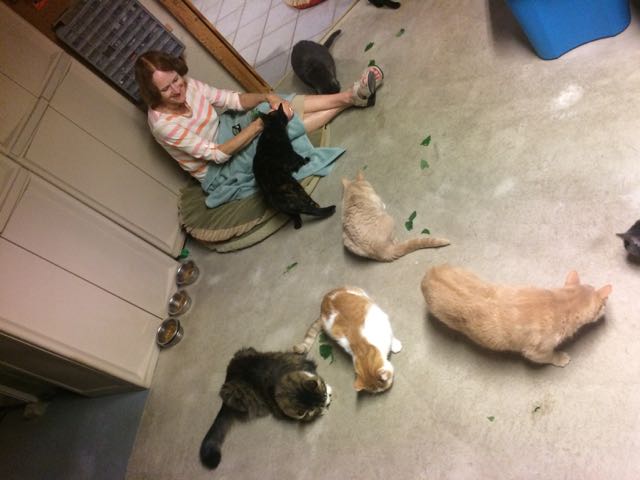
The commitment begins when our feet hit the floor each morning and continues until late at night when we fall into bed. I was still laughing as I went downstairs to feed and water our herd of rescue cats, clean multiple litter boxes, sweep floors and mop up fur balls. Then I opened the garage door to feed the outside stray cats who have found safe harbor in our yard.

Once upstairs, I made breakfast (minus coffee) and then did morning exercises, my commitment to staying in shape.

In the meantime, my husband was doling out various medicines to our aging animals and brewing lattes, his commitment to providing great coffee every morning.

The day proceeded with commitments to our jobs, communicating with family and friends, cooking up “slow food” and being part of a neighborhood.

Country living is not as impersonal as city life. Caring and sharing with neighbors is a way of life where we live. We have been the recipients of a wealth of home grown produce from our neighbors this summer, and we do our best to reciprocate. My husband excels in this department by sharing his talents in all things technical.

Another huge area of commitment is to “stuff”. “Don’t have it if you can’t take care of it” is a motto we both subscribe to. Since it’s no secret that stuff of all kinds needs constant maintenance and repair, much time is spent keeping the house and yard from reverting to disarray.

Painful as it is in these surreal times in America, being an informed citizen also takes a portion of each day. We may not want to know the day’s news, but being willfully ignorant is not a path either one of us wants to take.

So getting up is a commitment. It is also a privilege and an excellent investment in happiness.


0