Project

My husband and I are working on a big project. It all came about because of a bad case of misidentification.

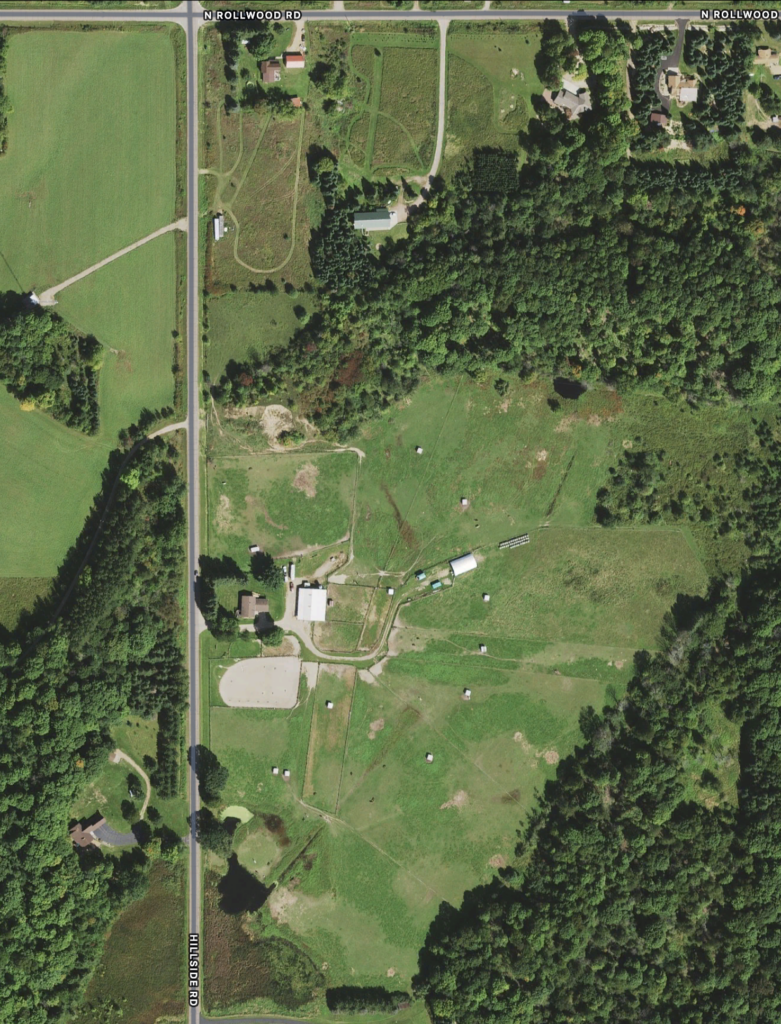
Our acre of land is three quarters meadow and one quarter little blue steam prairie. We worked hard for over fourteen years to get the prairie established. The meadow more or less takes care of itself…or so we thought.

Two years ago, we noticed some interesting tall grass popping up in the meadow. A neighbor identified it as Indian Grass, a desirable prairie plant. By the end of last summer, we realized that something was wrong.

The “Indian Grass” had spread wildly and densely taking over a thirty foot diameter area of our meadow. Somehow, we had a northern version of a kudzu problem in our midst. Action needed to be taken.

Research on the computer helped us identify the beautiful but invasive visitor as Chinese Silver Grass. It has thick, underground rhizomes, like spreading tentacles, from which spring the 4 foot blades of grass. It cannot be dug out by hand. So last fall we sprayed it and mowed it down.

This year, when the spring snows melted, we had a big dead-looking circle in our yard. My husband borrowed a rototiller and spent the better part of two days tilling the circle numerous times. We followed this up by spending hours pulling the chopped up rhizomes out of the soil. We did not want the “starfish effect” when you chop off its arm and the arm grows into a new starfish. By mid May we were looking at a patch devoid of all vegetation.

Several of our master gardener friends have told us that much of gardening is trial and error. We couldn’t agree more. After much discussion, we decided to turn the empty spot into more prairie. We made many mistakes developing the first prairie and hope we have learned a few things. Mostly we have learned this is a very, very big project.

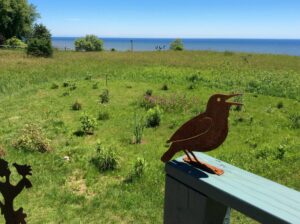
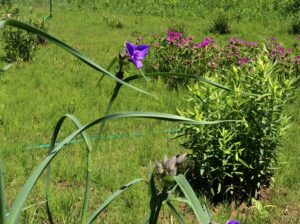
Here’s a picture of what’s happened in the six weeks since we were staring at that giant circle of bare earth. Mother Nature took pity on us. Even though we still have a long way to go, hope is springing up.
0

Solar

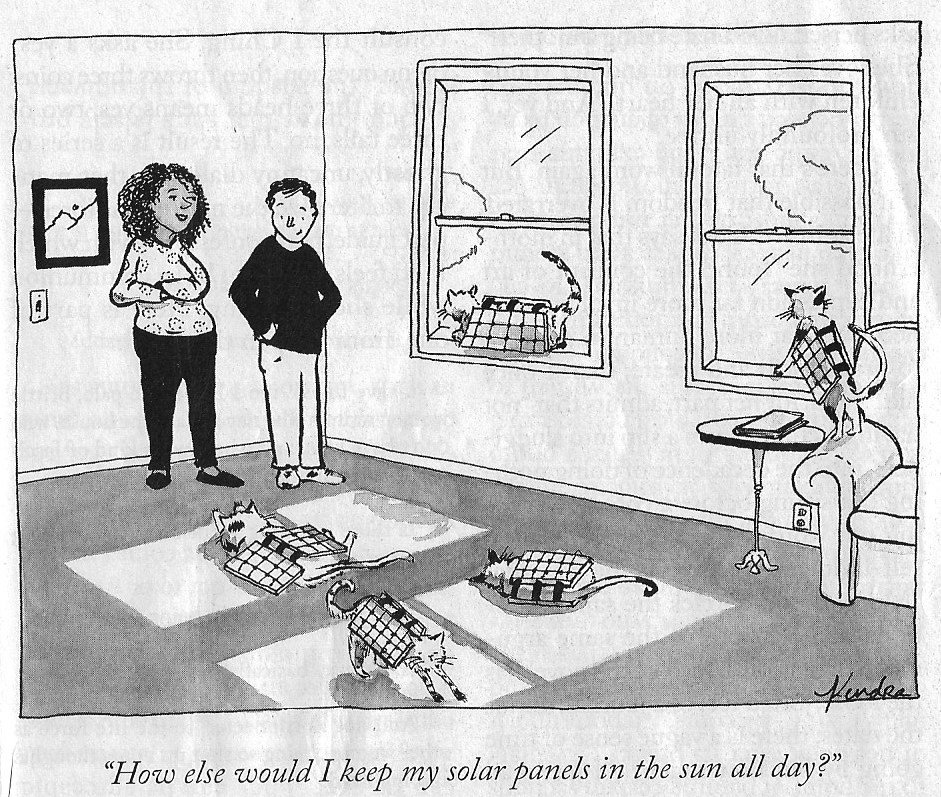
I was reading my New Yorker magazine the other morning after breakfast…….no, amend that to say, I was reading the cartoons in the New Yorker when I came across this gem.

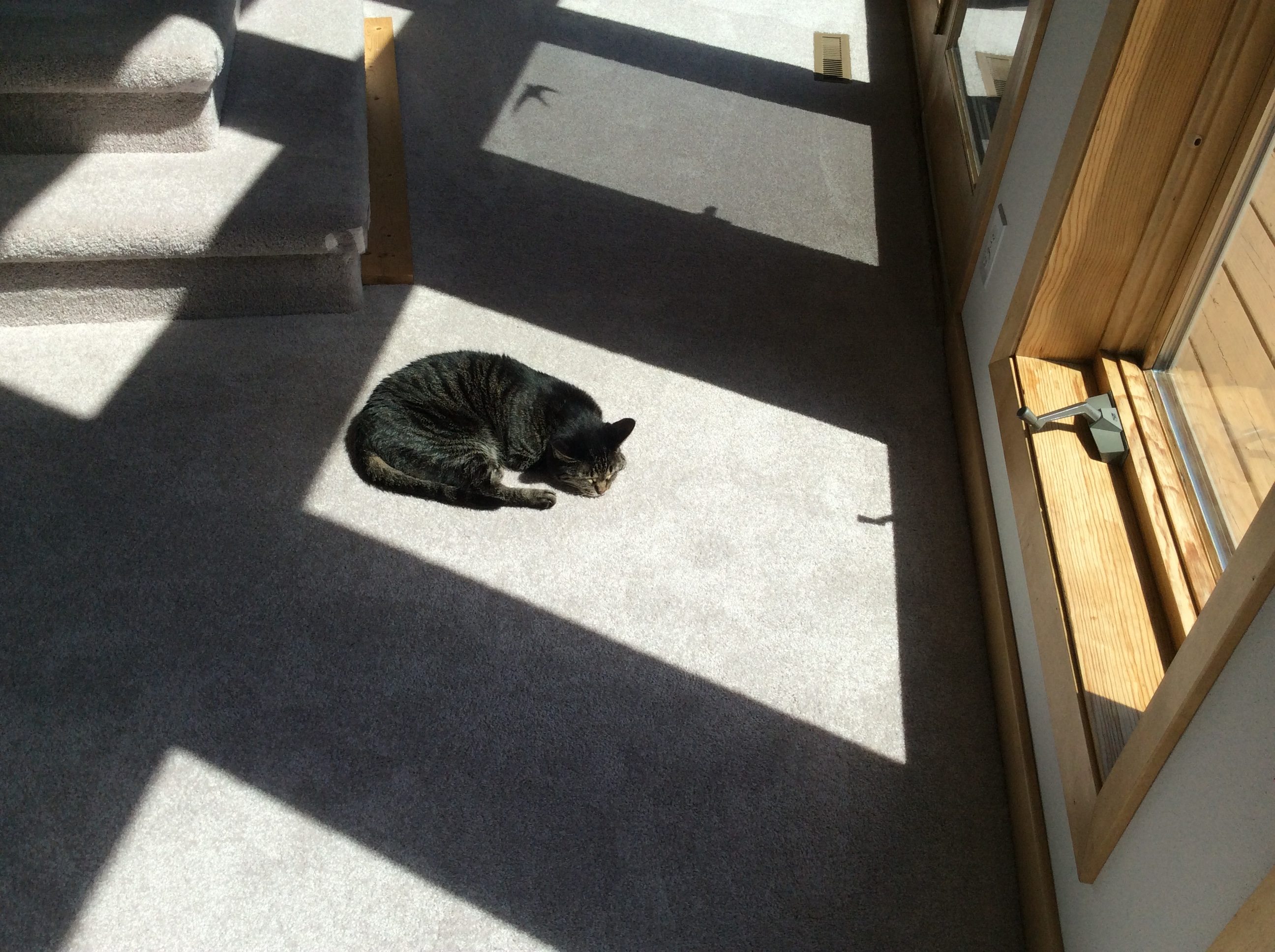
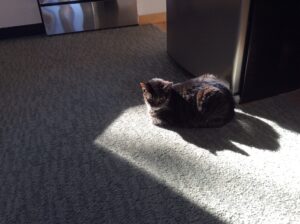
I glanced up laughing and the first thing I saw was Sasha who strategically had placed herself in a patch of sunlight.

Our domestic cats, Felis sylvestris, are all descendants of small desert cats from Egypt and the Middle East. Like the Egyptians who domesticated them, they are sun worshipers.

With a normal body temperature of 101.5, they can tolerate temperatures up to 124 degrees. Cats do not sense heat the same way we do which explains why we have banned candles from our house and occasionally have to pull a cat back a bit from the fireplace.

Our lovely tortoiseshell cat, Sousa, has a unique way of heating herself. In winter our girl eschews the patch of sunlight in favor of a more direct warming method. She perfectly aligns her body over the furnace vent on the floor. With paws tucked and tail curled around her, she can sleep for hours while the rest of us notice a distinct drop in the room’s temperature. She’s a heat sink.

Last month we noticed that Sousa had abandoned her heat register in favor of a big rectangle of sunlight. She is a far superior predictor of up coming summer weather than any calendar date.

Happy Summer Solstice.

0

Plastic

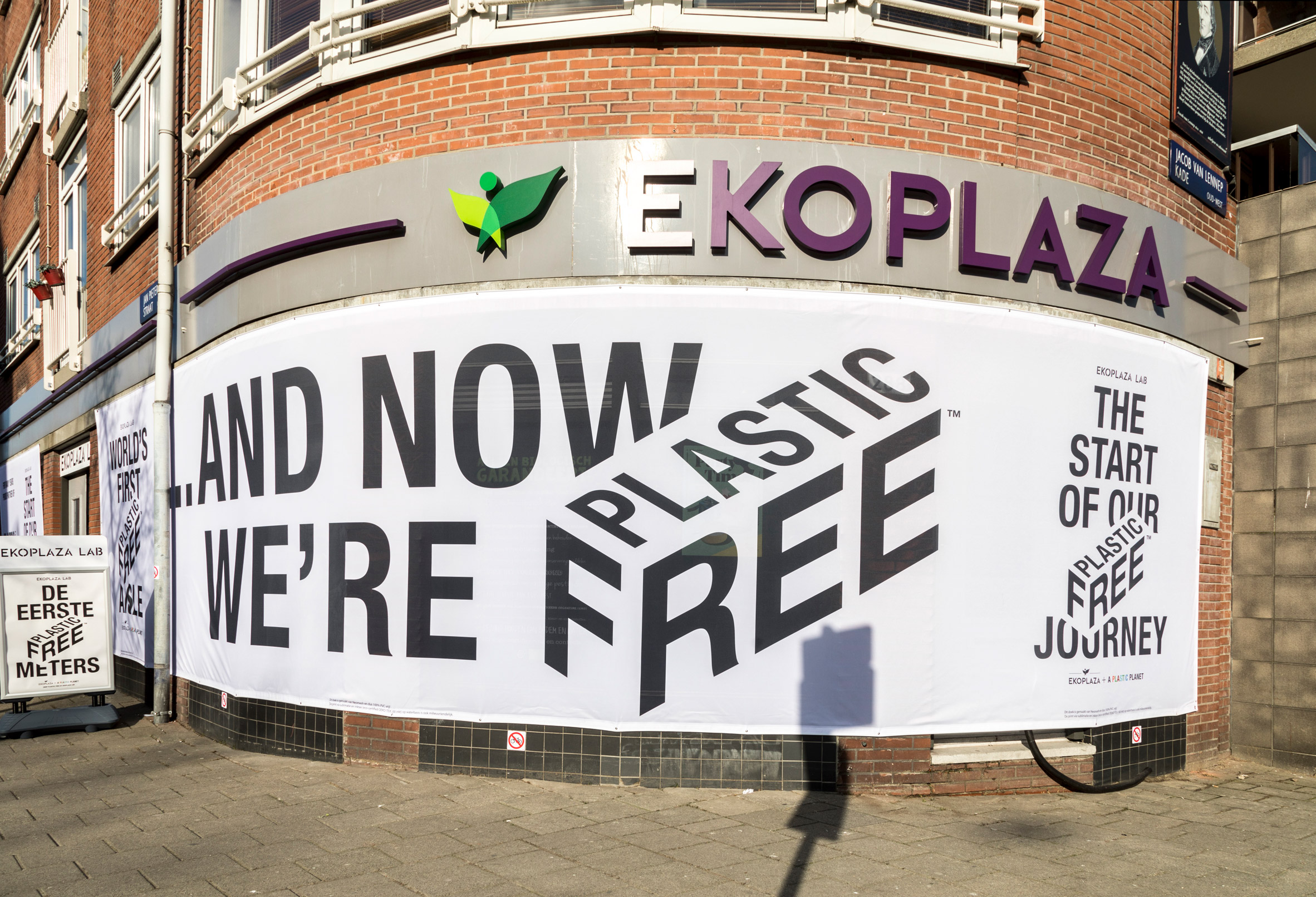
A grocery store in the Netherlands just made news by introducing an aisle of diverse food items all of which are free of plastic packaging. This got me thinking about plastic. It also made me wish I could shop in that store.

Plastic has an interesting history. Elephants probably escaped extinction because of its invention. In the late 1800’s, billiards was all the rage and billiard balls as well as all piano keys were made from ivory. The invention of a plastic called cellulose at that time spared many elephant lives.

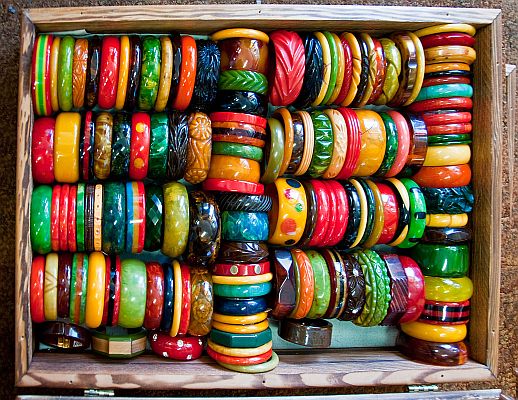
bakelite jewelry

In 1907, the first fully-synthetic, commercially successful plastic was invented by a Belgian-American named Leo Hendrik Baekeland. He named it Bakelite which is much easier to say than its chemical name polyoxybenzylmethylenglycolanhydride.

World War II was the catalyst that made plastic go viral. Rubber was scarce and a substitutes had to be used. Every GI got a plastic, formerly rubber, comb in his hygiene kit. Parts for military vehicles and planes, ropes, insulators and multiple other wartime uses of plastic caused its production to increase 300%.

After the war ended, the plastic factories turned to making plastics for the booming consumer goods sector. Tupperware was invented in 1946. A flood of plastic products and packaging soon took over every corner of the marketplace.

Now, in 2018, the world is literally being chocked with plastics almost all of which take 500 years to decompose in a landfill. Oceans, lakes and landfills have become plastic storage sites. Yet, technology exists to burn plastic to create electricity. European countries are doing this safely and successfully. New types of plastics are also being invented that decompose more rapidly. Unfortunately, an industry that generates trillions of dollars in sales will not change quickly.

Despite my best efforts, I still find myself drowning in plastic. Peanut butter doesn’t come in glass jars nor shampoo in glass bottles. Even major parts of my car are plastic.

The other day at the grocery store I bought three items. “Don’t give me a plastic bag,” I said to the check out person,”I’ll just put them in my purse.” He looked at me like I was crazy. Fortunately, I’m not. I’m just fond of my planet.

Consider this sobering fact from a 2017 study in the journal Science Advances. Of the roughly 8.3 billion metric tons of plastics produced worldwide since the 1950s, about 6.3 billion have been thrown away.

0

Forest

My local school district is one of the poorest in the state. But we are rich in outstanding educators plus one huge physical asset. We have a school forest.

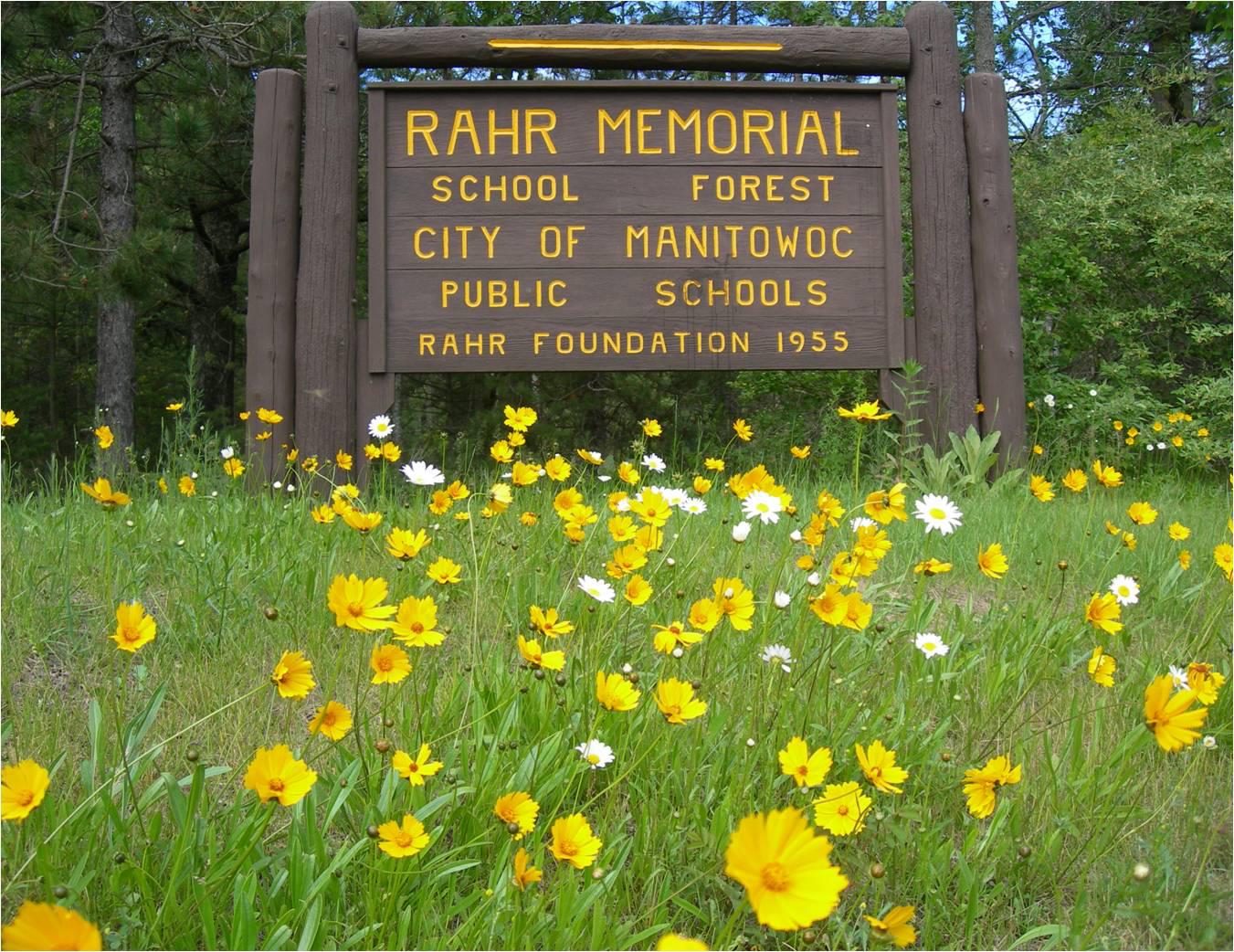
Given as a gift in 1955 by a wealthy family, the Rahr Memorial School Forest now consists of almost 300 acres along the Lake Michigan shoreline. The land includes mixed forests, pines, sand dunes, fields, a swamp, a pond and a rocky, fossil-strewn beach. In other words, it’s an incredible treasure. All students in our district from kindergarten through senior high visit frequently for environmental education.

That is how I found myself on a school bus last week with 50 first graders, their teachers plus several volunteers like myself. I am happy to report that our kids do not have nature deficit disorder. On the contrary, they were all overjoyed to be going back to “their” forest.

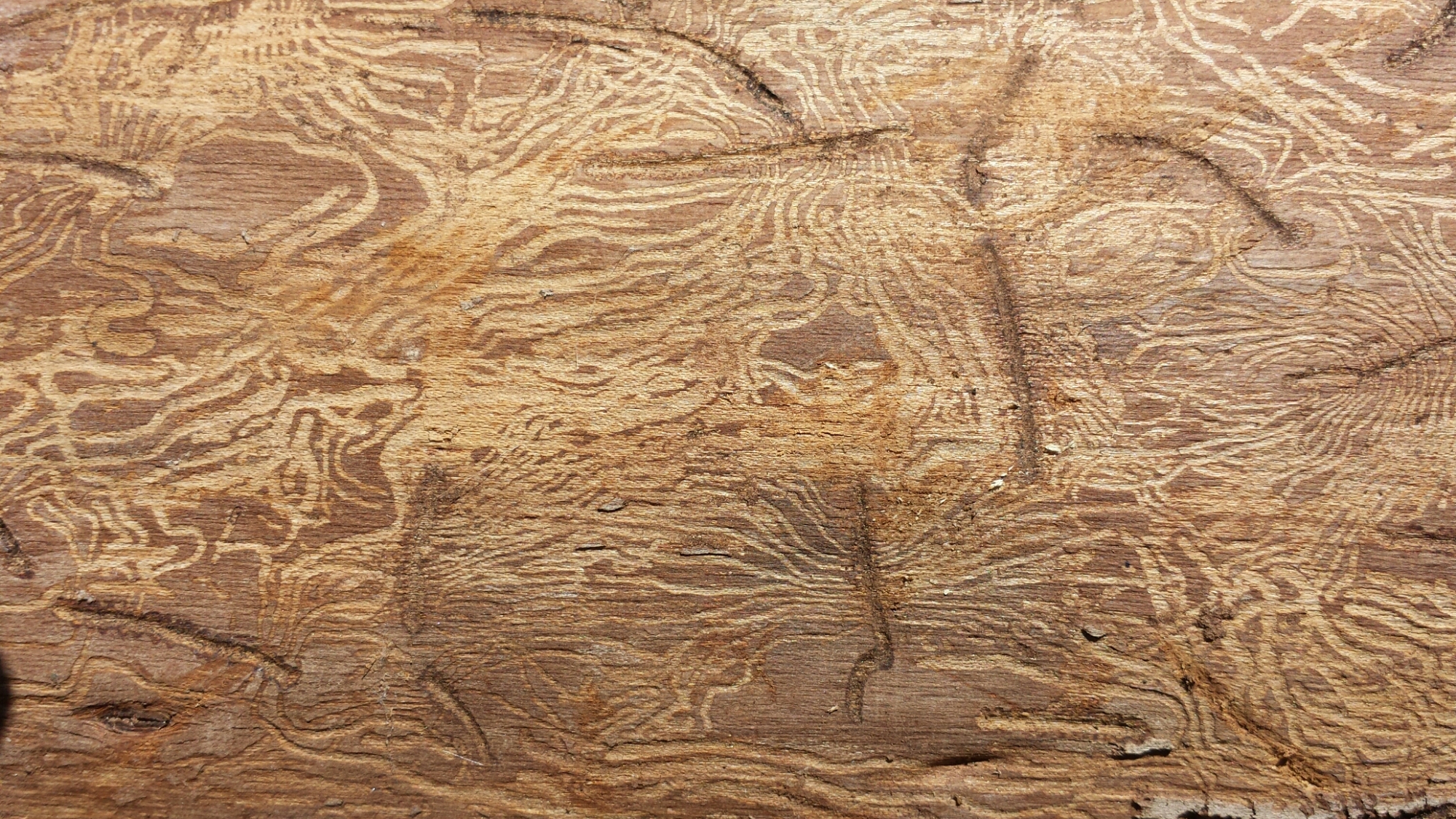
Arriving at the woods, we broke up into three groups and began a round robin of three carefully planned activities. My group started by solving a nature mystery presented by the school forest coordinator. “Who do you think made the strange designs in these pieces of wood I found in our forest?”, she asked while passing out the wood and large magnifying glasses. After observation, the kids presented their hypothesizes. Several students guessed “insects” which turned out to be correct. Our teacher then explained the life cycle of the engraver beetle.

Next, one of our first grade teachers began her presentation by dividing the kids into small groups and giving each group a hula hoop. They were told to put the hoop down on a spot of sandy soil at the forest edge and search for bugs and other creepy crawlies in their circle. The kids loved this arthropod treasure hunt and shrieked with joy whenever they unearthed June bugs or other specimens. They could view and share their finds by putting them in clear plastic jars with magnifying glass lids. At the end of the session, all the creatures were released.

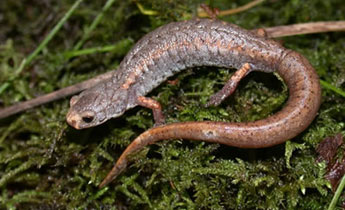
The last adventure was in a pine and hemlock forest where all the fallen trees and leaf litter is left to decompose. The children each got a plastic spoon and were instructed to GENTLY dig in the rotting logs and leaves to discover who lived there. And here is where one student found the best discovery of the day, a beautiful, little, three inch long salamander.

All this focused observation and field work culminated with play time in a gigantic sand dune, literally a bowl of sand near the lake. The exuberant kids would have stayed there happily until nightfall.

At the end of this day, I had only one thought…..if only every child in America could have a school forest or nature center like ours and dynamic teachers to interpret it.

0

Bread-Update

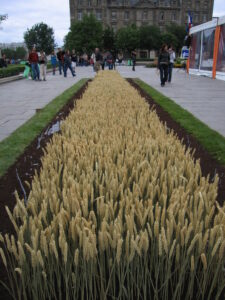
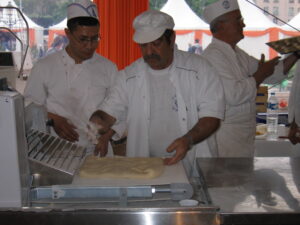
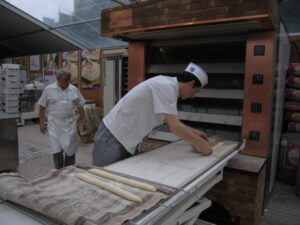
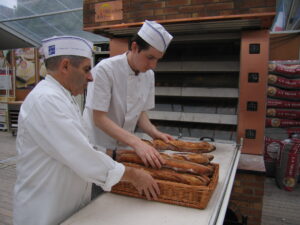
I just found out that my cousin Peter, a photographer, visited The Bread Festival in 2006. Here are four of his photos to go along with Tuesday’s blog.

0