Beads (Part Two)

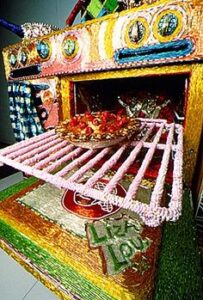
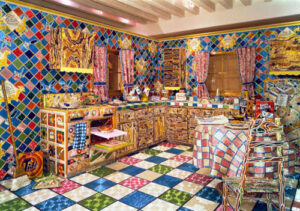
Last week’s blog featured the Vochol, a beaded Volkswagen. This week is about a more domestic beaded creation, an entire kitchen, and it is the work of one person.

American artist Liza Lou attended the San Francisco Art Institute where she was scorned for applying beads to her paintings. She subsequently dropped out of school and started using minuscule seed beads as her sole art media.

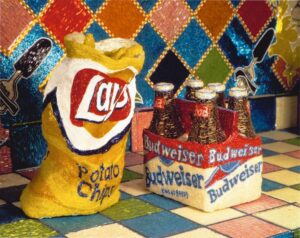
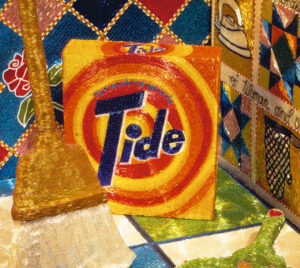
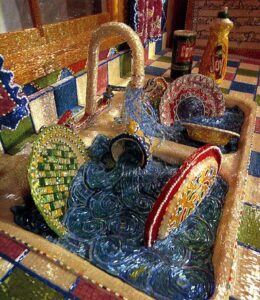
Her first major work was a life size reproduction of a suburban kitchen entirely covered in beads. This mind boggling project took five years (1991- 1996) to complete. Each of the millions of beads used was hand set with a tweezers.

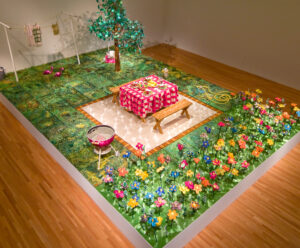
Her next project in 1996 was entitled “Backyard”. It features a picnic table laden with food, a lawn mower, garden hose, flowers and grass. For this work she used help: volunteers came to her studio on Saturdays and worked on the 250,000 blades of grass. Overall, 30 million beads were used.

In 2006, Liza Lou went to Durban, South Africa for a two week visit to see Zulu beadworkers first hand. The ‘visit’ kept being extended and she has a studio there to this day. In it, Ms Lou employs both male and female African artisans. She, in turn, learns from them.

Liza Lou received a MacArthur Genius Fellowship in 2002. She is, indeed, a genius, and a very patient and generous one as well.
0

Beads (Part One)

(This one is for Jenny)

Bead work is a beloved art form of people all around the globe, and the Huichol, an indigenous culture from the Sierra Nevada mountains of west-central Mexico, are among the most amazing practitioners of this art.

Descendants of the Aztecs, the Huichol strive to keep their culture alive with highly symbolic bead work and yarn paintings. Although each Huichol artist develops his or her own personal style, recurring symbols are maize, peyote, deer, candles, arrows, serpents, eagles and god’s eyes that point to the four cardinal directions.

The intricate artworks they create are petitions to their gods and links to the natural world around them. Sale of some of their work is also a means of economic survival.

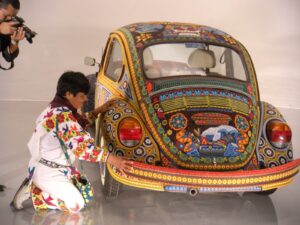
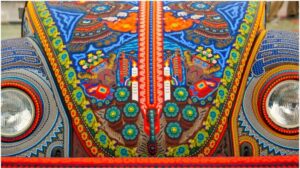
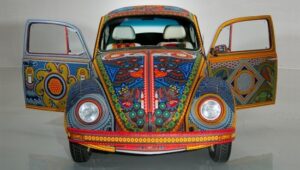
The Huichol typically cover objects such as gourds, masks, bull horns, wooden jaguar heads and animal shapes with minuscule beads set in a special wax. However, in 2010, the Museo de Arte Popular in Mexico initiated and sponsored a more contemporary version of this traditional art form with the aim of promoting more recognition for the Huichol artisans. Eight artists from two different families were hired to cover an entire Volkswagen Beetle with their stunning bead designs.

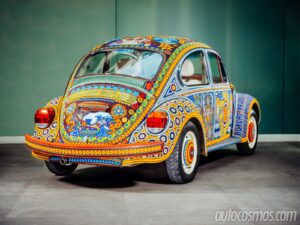
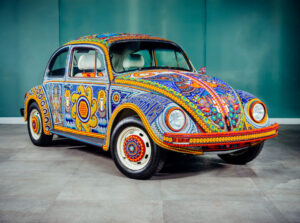
Called the “Vochol” a combination of “Vocho”, a popular name for VW’s in Mexico, and “Huichol”, the car was covered with 2,277,000 beads. The project took seven months and 4,760 hours of work to complete. After being displayed in museums in Mexico, the Vochol went on a world tour for several years. Currently, it is back home in Mexico.

Here are images of this fabulous car. For those of you who drive VWs, bet you didn’t realize you owned a potential piece of fine art!

0

Outsourcing

A few weeks ago, we were walking in a supremely beautiful and tranquil forest when the silence suddenly was shattered. My husband’s phone began shrieking an emergency alert. Since we live in a tornado-prone state, he immediately checked the message. “High flood waters in your area”, the robotic voice said.

At the moment we received the alert, we were standing on an eighty foot bluff. A short downpour had occurred earlier in the day, but our first thoughts were of relief as our farmers were badly in need of rain. Our smart phone was unsmartly calling “wolf” into the 50 mile radius around us.

We both concurred that some people with big brains are concocting electronic devices to take everyone else’s brains away. If we let electronic gadgets do all the thinking for us, we soon won’t be able to navigate our way out of a paper bag, let alone a real flood.

Examples of human deference to computer intelligence are rampant…the voice on the dashboard that supplants map reading ability, the ‘smart’ refrigerator that makes grocery lists, the cars that drive themselves and the medicines the are implanted in the body to release at prescribed times.

When some members of the wolf clan evolved into the creatures we call dogs, a large number of brain cells were lost along the way. That’s what happens when a master calls the shots.

I definitely think it is in my best interest to be able to figure out where I am on the planet, when my milk is running low, my pill needs to be taken and the river is at flood stage. Contracting out my brain doesn’t seem to be a winning proposition.

0

Forgetting

Getting older and getting more forgetful go hand in hand. I do not intend to beat myself up over this fact. I know my brain is functioning: I didn’t vote for Trump and I manage a house, a job and a herd of cats.

But not remembering small things can be annoying. If you also experience these little memory glitches, such as the name of that book you just read, here is some consolation.

Michael Perry, Wisconsin’s own chicken-raising author, has written a new book, Montaigne in Barn Boots-An Amateur Ambles Through Philosophy.  In it, he addresses the “treachery of memory”. Here is an excerpt:

In the category of driving off with things on my car roof, I count one wallet (circled back and found it in the Culver’s drive-through; celebrated my good fortune with a second order of curds), one iPhone (heard it thump the luggage rack, then watched in the rear view mirror as it pinwheeled down the highway), and an infinity of coffees of which I placed on the roof “just for a second” only to forget it in two.”

How wonderful! The coffee sailing off the car roof, the room we enter and promptly forget what we went there to get, the packed suitcase that got left behind…….we are not alone in being sidewacked by these memory tricks.

I was personally comforted by this passage….. “recently I wrote 482 words of a column eulogizing my old manual typewriter before nagging deja vu drove me to scroll up and down to discover I had already written that exact column three weeks previously”.

This is the 595th consecutive weekly blog I have written. Since I don’t want to bore you, dear reader, by repeating subject matter, I find myself frequently checking my own archives. Perhaps I can occasionally out-trick the memory trickster.

And here is one final thought on this topic. Younger people have these temporary memory lapses as well. A younger family member of ours once set her filled cup of take out coffee on her driver’s seat just for a second. You know what happened.

0

Tallest

In the city down the road from us is what purports to be “the tallest symbol of freedom in the world”. A wealthy insurance company flies a gigantic American flag from a pole that resembles a huge industrial smokestack.

I personally believe the flag and pole, outsized as they are, cannot live up to that claim. The French are as free as we are, are part of the world and have an iconic symbol, the Eiffel Tower, that checks in at 1,063 feet. The behemoth flagpole is only 400 feet tall.

I do, however, give the company credit for understanding a basic American cultural belief that biggest is always better. Ours is a country that puts its faith in size. Unfortunately, biggest and best are not interchangeable words.

The idea that more is always better is an unsustainable idea on a small, mostly blue planet with limited resources. Plus, it is an ideal that did not show up in our Constitution. Our wise founders had had enough of kings so they did not say that “All the tallest men with the biggest piles of stuff” are created equal. Patriotism is not about making everything; flags, houses, cars, food, televisions, bombs, jails, armies and campaign contributions, bigger and bigger all the time.

A huge number of Americans now think that patriotism and nationalism are the same thing. It is not hyperbole to say that at this moment in history, America is in a fight for its soul. If we must deal in superlatives, may we be among the most democratic, decent  and wise countries of the world. I can’t think of a better wish for the Fourth of July.

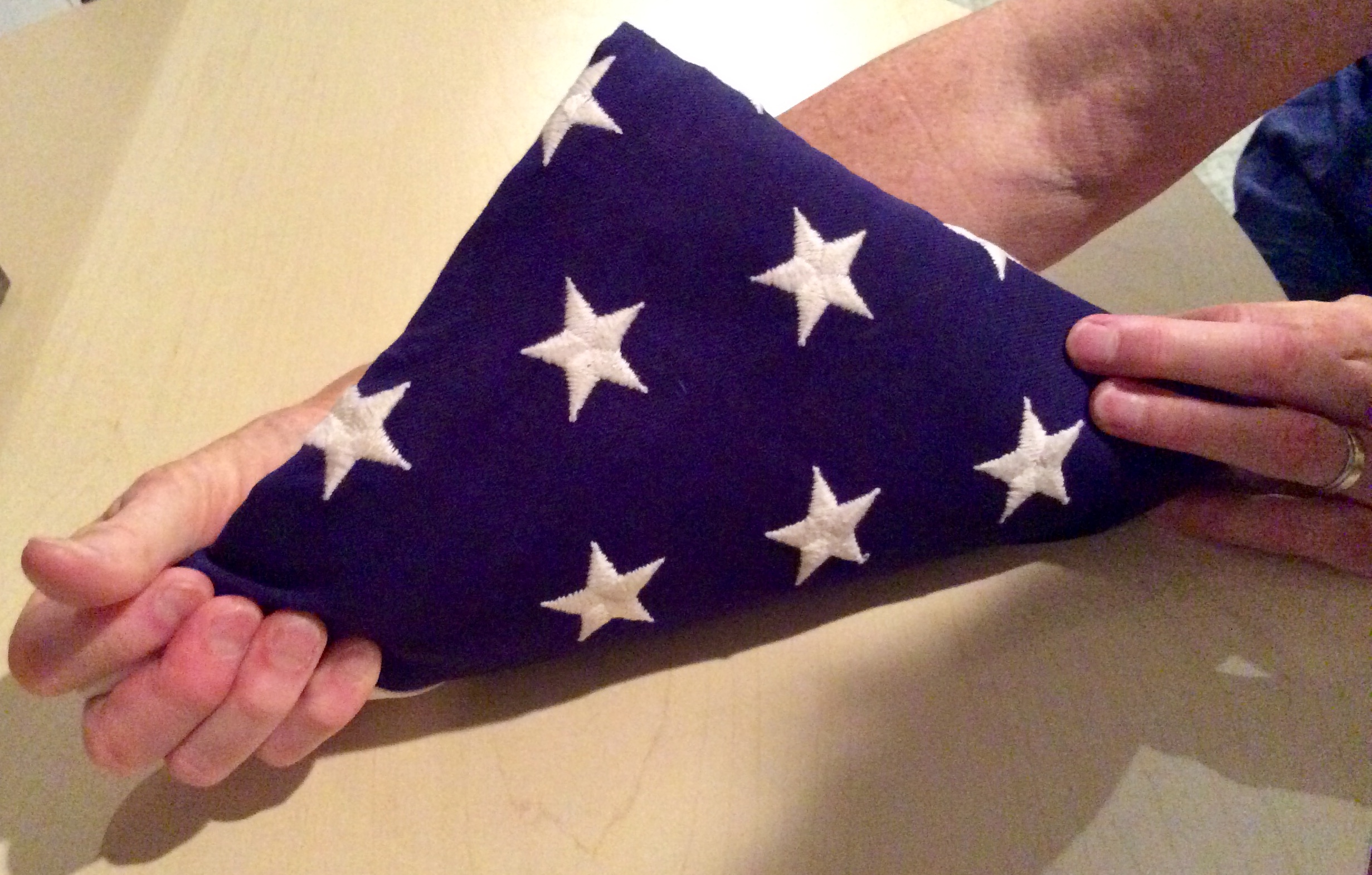
Note that we will be flying our flag tomorrow. We received that flag after my beloved Aunt Jane’s military funeral. She was an army nurse in World War II working with the wounded and dying in a tent hospital behind the front lines in the Pacific. Her flag, of course, is not the tallest symbol of freedom in the world. But it is among the best, and thousands and thousands of families like ours have them.

0