Trumpets

The other day my husband was absorbed at his computer, and I asked him what he was working on so intently. I expected him to say “water quality graphs” or “zoning laws”. His answer was “champagne glasses”.

Champagne does not flow at our house. But we do celebrate special events with Prosecco, a lovely and affordable sparkling wine from Italy. Valentine’s Day, anniversaries and other celebrations would not be complete without bubbles rising in our two tall champagne glasses.

After this year’s  Valentine’s dinner, I was clearing the table and accidentally toppled my elegant glass which promptly shattered. And I did feel sad, a sentiment I don’t usually have for a broken dish. Our two glasses weren’t family heirlooms and weren’t expensive. But they stood tall and sparkling at every celebratory table at our house for well over thirty years. My husband and I both love traditions.

After losing my glass, I started checking the glassware sections in every thrift store I visited in search of two more equally beautiful glasses. I saw literally hundreds of glasses, but none were as perfectly proportioned as our broken one. So I joined my husband at his computer for an online search.

We both quickly discovered that wine connoisseurs take their glasses very seriously and that champagne glasses come in a variety of shapes.
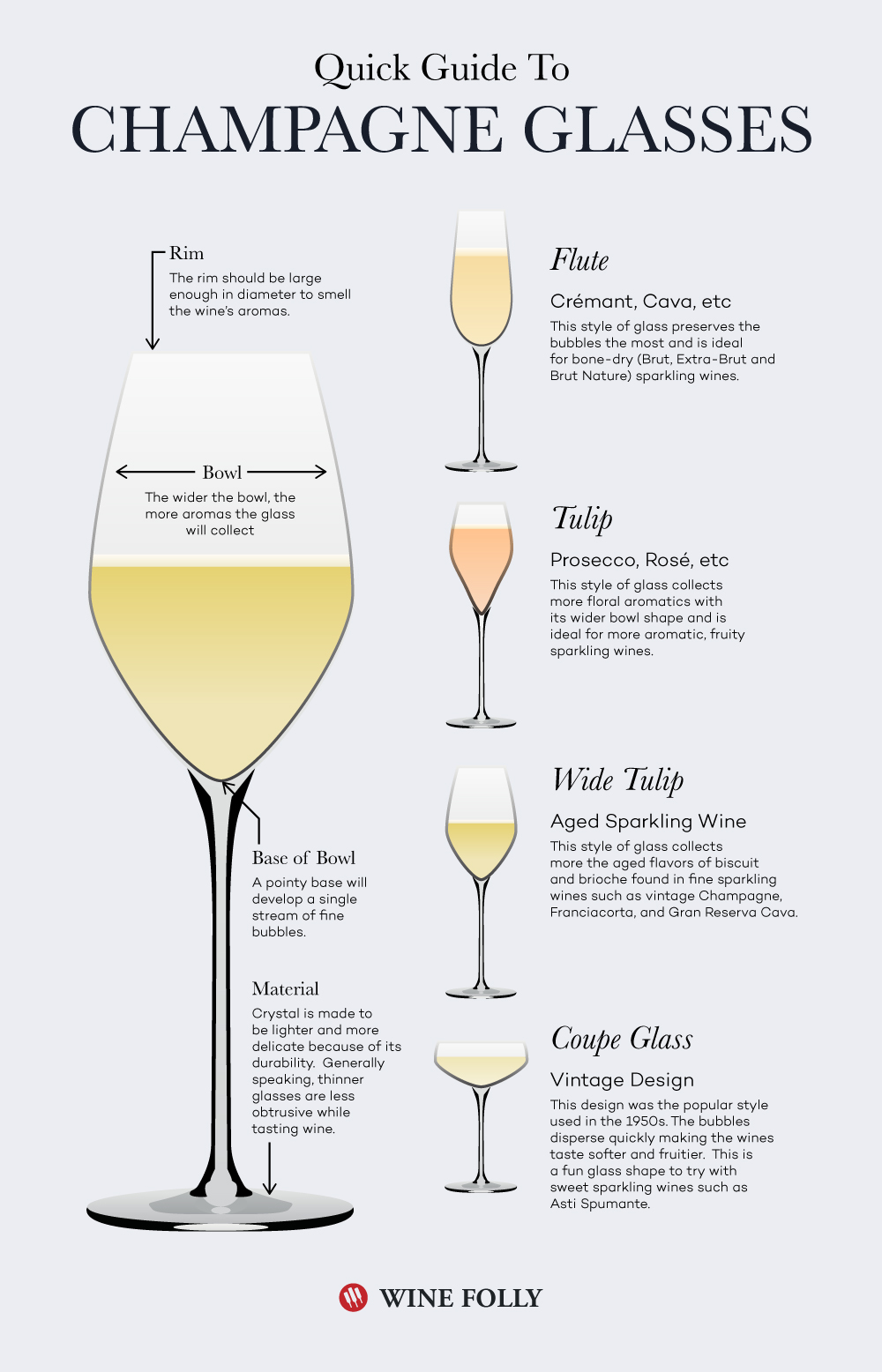
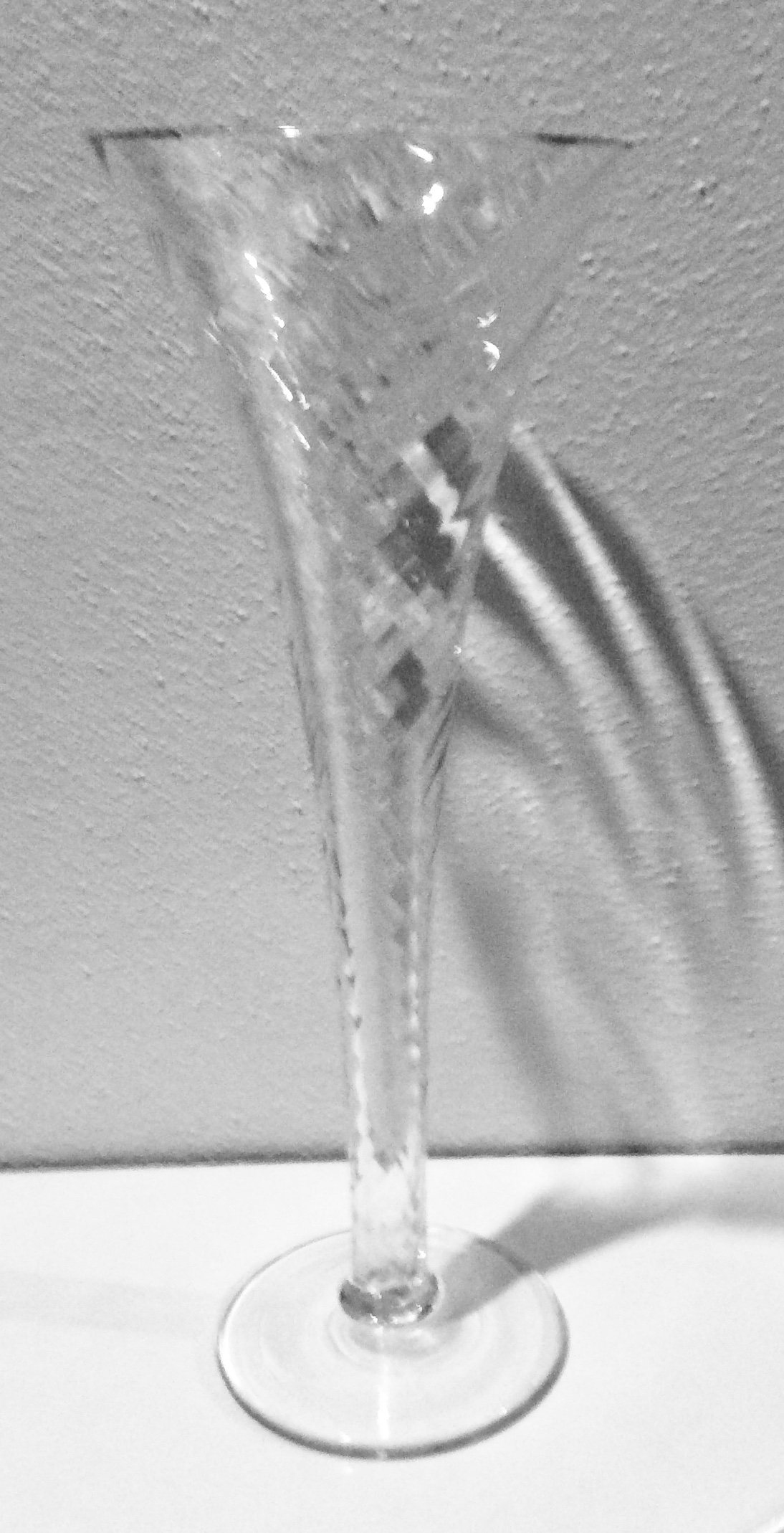
Unfortunately, none of these styles matched our broken glass. Continued searching finally revealed the more unusual style of glass we owned. It’s a trumpet.

The happy news for us is that our search for “trumpets, champagne” came up with a replacement at a down-to-earth price. Our anniversary is coming up on April 4th, and we will be ready. Bring on the bubbles!
0

SOB

The state of Utah is in the process of designing a new state flag. Vexillologists, or flag experts, agree that one is needed, calling the current flag a “seal on a bedsheet”, or SOB for short. I laughed when I heard that description. A second later I realized that my own state flag, Wisconsin’s, is also a seal on a bedsheet as are almost 50 percent of America’s state flags.

In “Good Flag, Bad Flag, How to Design a Great Flag”, vexillologist Ted Kaye gives five rules: “Simplicity, meaningful symbolism, basic colors, no lettering or seals and distinctiveness.”

As a graphic artist, I certainly concur that seals on bedsheets are horrible designs. They can’t be seen from a distance such as on top of a flagpole, a place that flags frequently hang out. The Nebraska flag once flew over their capital for ten days before anyone noticed it was upside down.

My home state flag violates the design maxim “less is more”. It incorporates all of the following; a sailor, a miner, a badger, a cornucopia, a pile of lead bars, thirteen stars, an anchor, a pick and shovel, a plow, an arm and hammer, two shields, the word “Forward”, the phrase “E Pluribus Unum” plus decorative curlicues. Only a kitchen sink is missing.

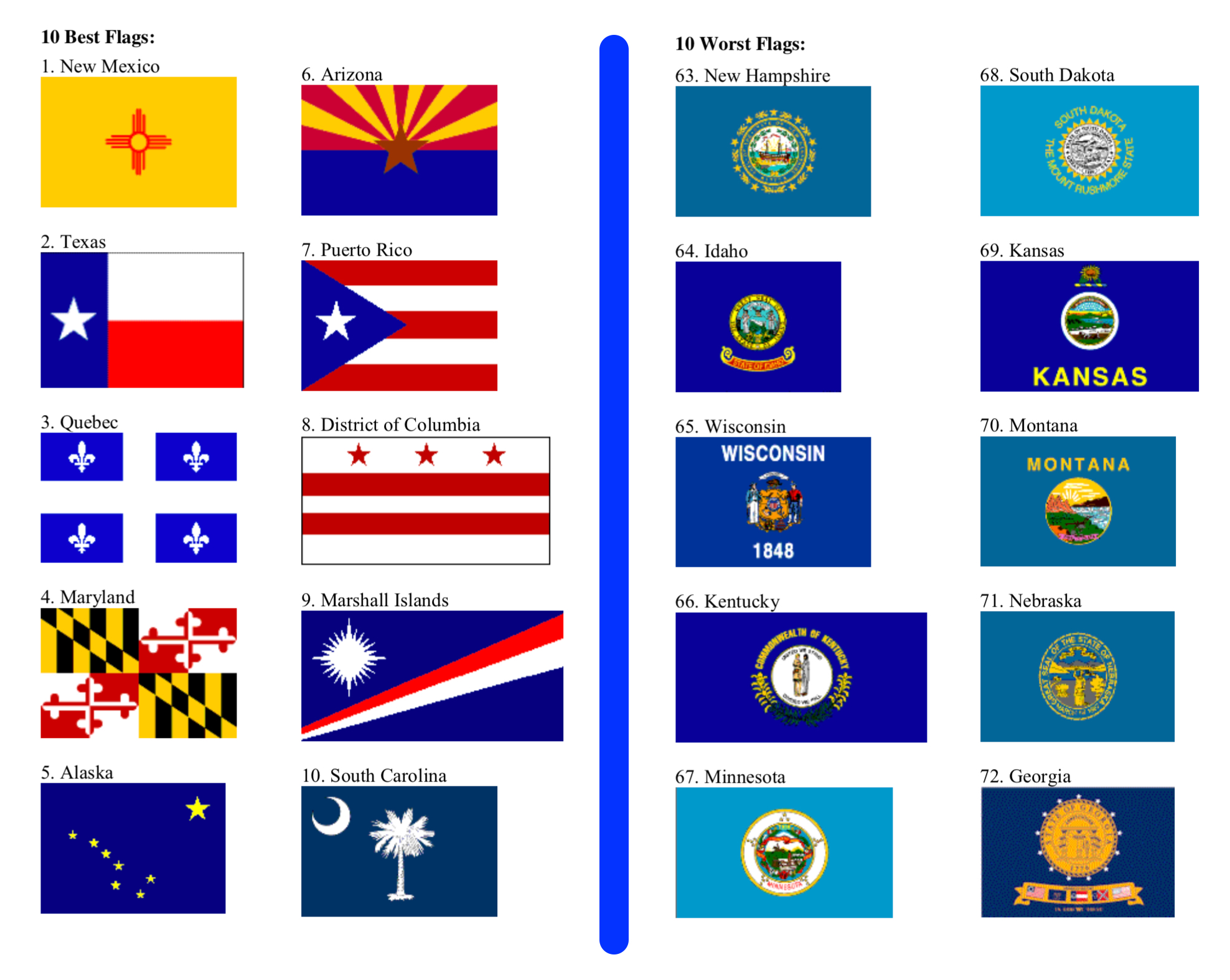
In 2001, the North American Vexillological Association invited their members plus the general public to rate the American state and territorial flags along with the Canadian provincial flags from best to worst. Here are the top ten winners and losers. Note that all the losers are SOBs.

And I must add one more flag story in conclusion. A few years ago, we drove up to our daughter’s house in Madison and saw a large, beautiful flag flying out front. The flag was medium blue with what appeared to be a Zia sun symbol in the center. “Did you rip off New Mexico’s state flag,” we asked?

“No, it’s the city of Madison’s flag”, was her reply. The circle represented our hilltop state Capitol dome and the rays were the streets radiating out from the building. Turns out that the plagiarism of the Land of Enchantment’s flag was unintentional, but it has since been modified out of respect to the Zia tribe.

Here is a link to all the state flags with notes about their origins.


0

Dog

For the last 31 years, I have traveled everywhere with a large dog in the back seat of my car. His name is Rex, and he is an extremely well-behaved canine. Rex is white and made entirely of plastic.

All those years ago, I adopted him from a thrift store in Sheboygan, Wisconsin. Our kids had never had a dog, and I was finally going to give our son, who by then was living in his own apartment, a “dog” for his birthday. Since our house was small, the dog large and the birthday several months away, I decided to store Rex in the back seat of my car…..belted in and looking out the window.

But after many months passed, Rex became my traveling companion, and I couldn’t part with him. And besides, in the meantime, our son had acquired a real dog, a crazy Dalmatian, so I could rationalize that he didn’t need two dogs.

The first time I went to the bank after acquiring Rex, he was offered a dog biscuit at the drive-through window. Through the years, he has made friends wherever we go. Children are his biggest fans, and because I am pulling up in front of schools and libraries all the time, Rex never lacks for attention.

Rex does have to visit the vet clinic frequently, but he never goes in the front door. He remains serenely in the back seat watching as our very irritated cats get hauled in for their shots and check-ups. There are advantages to being made of plastic.

Summer does present health problems for Rex. When it gets extremely hot, he gets extremely skinny. The first time this happened, I was in a library doing a program for the children. Returning to my car, I opened the door to a blast of 100 degree air. Even though he is made of a hard plastic, Rex had succumbed and was about three inches wide. The good news is that he puffs back up out when the temperature goes down.

Rex and I have gone through many cars together. When I trade in my old cars, he is always there with me, gets unbuckled and then strapped into the backseat of the new one. We roll out of the dealership together.

The only time Rex has to stay home is when having four people in the car or are hauling a big load of stuff. Rex is a big boy, and all my cars are compacts.

I have made a rough calculation of the miles we have driven together in 31 years. It comes to 1, 240,000 miles. That equals 2.6 round trips to the moon. Rex and I are looking forward to many more miles ahead.


0

Green

I have a degree in art and have been an art teacher and graphic designer all my life. However, I am the first to admit that the technical and scientific aspects of color are diabolically difficult for me to understand.

It wasn’t until my college years that I learned that the primary colors aren’t always red, blue and yellow, something that every teacher from kindergarten on drilled into me. I was shocked that green could be a primary color. Was this a hoax initiated by the Irish?

The answer, of course, is “no”. I couldn’t blame the inhabitants of the Emerald Isle. The visible part of the electromagnetic spectrum just does its thing, and it is called science.

But when I began reviewing the primary colors for this blog, I got an even bigger shock. Red and blue aren’t primary colors at all. The standard red, blue and yellow pigment color wheel is simply a holdover from Newton’s experiments. Science has advanced beyond his understanding, but most art classrooms have not.

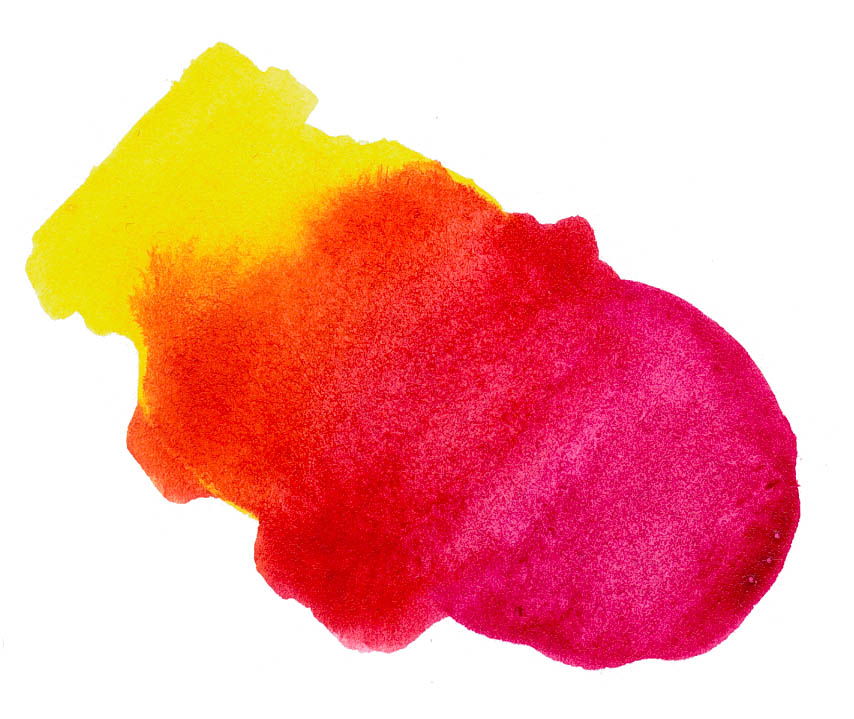
So here is an explanation of the TWO sets of primary and secondary colors, the primary colors that are made from LIGHT (which are separated by prisms) and are known as additive primaries, and the primary colors which are made by PIGMENT and are known as subtractive primaries.

  • The primary colors of light are RED, BLUE and GREEN.
  • The secondary colors of light are MAGENTA, CYAN and YELLOW.
    • Magenta = blue and red
    • Cyan = blue and green
    • Yellow =  green and red


  • The primary colors of pigment are MAGENTA, CYAN and YELLOW.
  • The secondary colors of pigment are RED, BLUE and GREEN.
    • Red = magenta and yellow
    • Blue = cyan and magenta
    • Green = cyan and yellow

I’ve known since my college days that the printing industry used magenta, cyan and yellow as their primaries. I just thought they had their own set of primary colors. Turns out that those are the pigment primaries for everybody which is fine with me. Ask any of my former students: magenta is my favorite color. Plus, every time a teacher told me to mix the “primaries” to get the secondary colors, the results were dismal…muddy khaki green, dull orange and yucky purple.

So happy St. Patrick’s Day to all the Irish. Green truly is a primary color and that is no blarney!

Click here for a brilliant explanation of the pigment primary colors and see red mixed before your eyes.


0

Relocation

The entire city of Kiruna, the most northern berg in Sweden and 90 miles north of the Arctic Circle, is about to be moved en masse. The cause of this gargantuan move of 18,000  people is not global climate change but iron ore.

Situated on top of the world’s largest iron ore mine, Kiruna is sinking from seventy years of mining activities beneath the town. No other city of this size has ever been relocated, and surprising lessons are being learned.

According to the architectural team in charge of the project, “The challenge of moving the city is not only about moving an entire city, but about moving the minds of citizens and creating a new home and identity.”

The architects quickly discovered that moving buildings and creating new ones was much easier than understanding what makes history and identity, a sense of place.

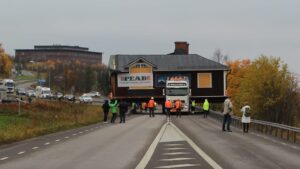
Over twenty significant buildings are being moved from the old town to the new location two miles east. These structures will be dismantled and reconstructed. The rest of the town will be entirely new buildings with an elegantly designed city hall as a focal point.

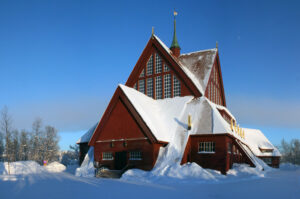
Kiruna’s old church, which has been honored as one of Sweden’s most beautiful buildings, will be moved piece by piece. Here is what Göran Cars, an urban planner for Kiruna, learned from this challenge:

“We are moving the church. When I speak to people they say, ‘Yes, I know that, but what about a grave?  How about the birches?’ I didn’t understand that. They are small trees! But they are 100 years old- as old as the church. I get that question time and time again: ‘What about the birches?’ So now we are moving the birches.”

In spite of the fact that their town is being swallowed up so the mining beneath can continue, the people of Kiruna are lucky. Their government, which owns the mine, is footing the entire mind-boggling one billion dollar cost of the move. Under Swedish law what you mess up you have to fix up.  And equally important, the voices of the people are being heard.

As global warming inevitably will cause the oceans to rise and claim islands and coastal cities around the globe, other citizens around the planet will probably not be as fortunate as Kiruna’s residents.


0