Filthy

There are only four weeks in the entire year when we can keep our car clean and shiny. The first occurs in late spring between the end of the snow and the start of the bug hatches. The second is in fall after the first hard frost kills the bugs but before the first snowfall that sticks to the ground.

Since last week didn’t fall into either of those categories, I suggested to my husband that a visit to the car wash should be on our Saturday agenda. You know it’s time when your car’s back window is opaque and your winter coat is coated with salt and grime if it brushes against your vehicle.

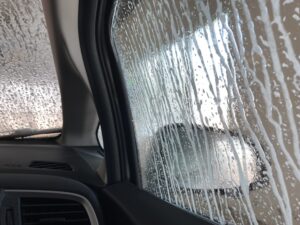
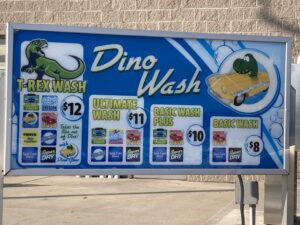
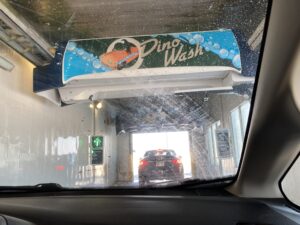
The first car wash we tried had a massive line of cars waiting to be scoured. We are patient people, but an hour’s wait seemed excessive. The next wash we found had only four cars in a queue. Plus, it promised our car would get a “Dino Wash”. How could we resist this?

While waiting our turn, we had time to read the Dino wash menu and pick one of its four options. I must report that the $12.00 T- Rex option was mighty tempting. We did need to “take the bite out of dirt” as our car’s surface was buried under road slop. And one feature promised “Dino Glow”, a most intriguing option even though real dinosaurs, to the best of my knowledge, were not bioluminescent.

After a few moment’s thought, we eliminated the T-Rex wash for three reasons:

  • It cost $12.00.
  • It did not have tri-colored (pink, blue and yellow) bubbles which other expensive washes have, thus turning a mundane wash into a psychedelic art happening.
  • A snowstorm was forecast for two days after our wash.

The basic wash proved to do a decent job, despite the fact that our car did not acquire a glow. For a day or two our car would reveal its true color and the windows would be transparent.

I must add that there is a third car wash in the immediate vicinity of the two aforementioned ones. It was never under consideration. We are boycotting it for an extremely good reason… it only washes the car 3/4s of the way down.
0

Honored (Part Two)

The Tooley cats were incensed when I published my blog about monuments to dogs last week. My plea that I didn’t know of any memorials to virtuous cats was met with feline disdain. To mollify them, I embarked on serious Google searching which proved fruitful. The cats are now saying, “We told you so.”

If you are a cat owner (or more correctly a person who a cat has decided to tolerate)  you may wish to share the following with your felines.

Trim – A black cat with white paws, chest and chin, Trim was a sailor through and through. He was the constant companion of Englishman Matthew Flinders on his many voyages, most notably his circumnavigation and mapping of Australia.
Trim was born aboard a ship and fell overboard as a kitten. Managing to swim back and climb back aboard by scaling a rope, Trim became a favorite of Flinders and his crew. The two of them went on to have years of adventures including a shipwreck and imprisonment.

These words by Matthew Flinders are on a plaque beside a statue of Trim in Sydney:

To the Memory of Trim
The best and most illustrious of his race
The most affectionate of friends,
faithful of servants,
and best of creatures
He made a tour of the globe, and a voyage to Australia which he circumnavigated,
and was ever the delight and pleasure of his fellow voyagers.

Trim has five memorials; Sydney, Adelaide and Port Lincoln, Australia, and Lincolnshire and London, England.


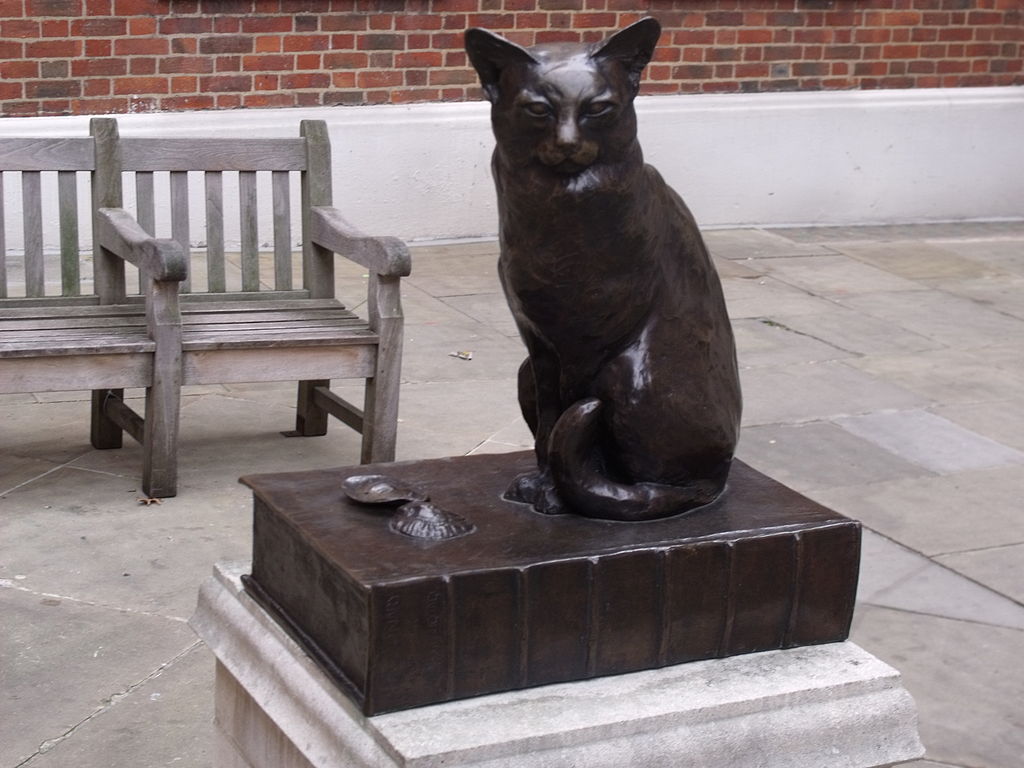
Hodge – Dr. Samuel Johnson was a towering literary figure in the 1700s who is most famous for writing the dictionary. A lover of cats, Johnson would personally go to the markets to get oysters for one of his favorite cats, Hodge. A memorial to Hodge stands in front of Johnson’s home in London. Note the oyster shells in front of Hodge who is serenely sitting on a dictionary.
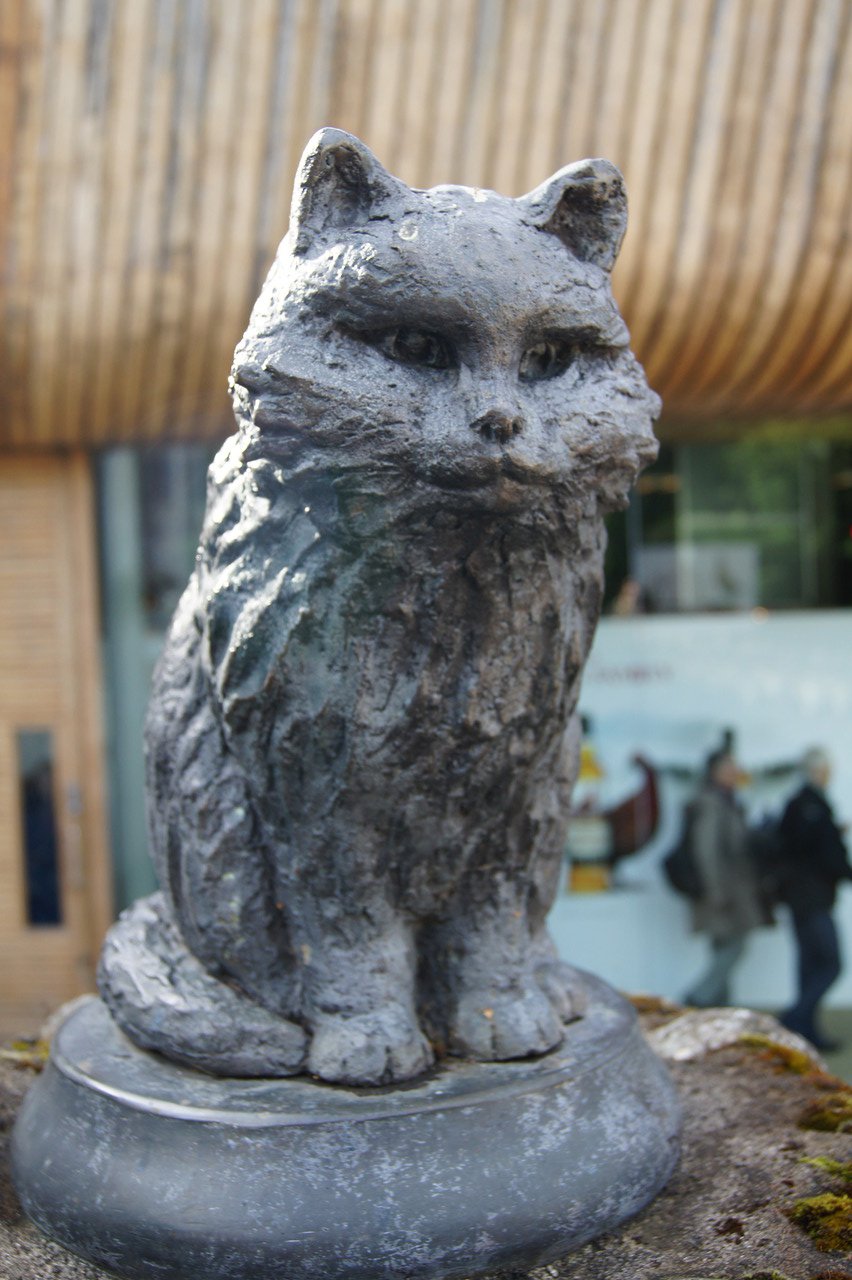
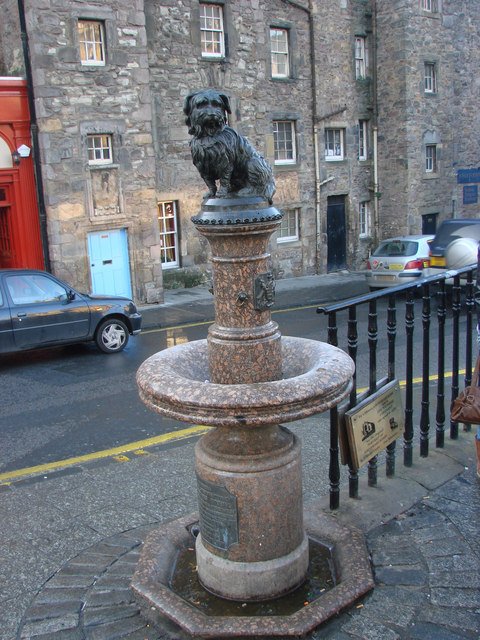
 

photo: waymarking.com

Dick Whittington’s Cat – Richard Whittington (1354-1423) was from very humble origins, but became a Lord Mayor of London as well as a wealthy textile merchant. The famous stories and nursery rhyme about Dick Whittington and his famous cat are, however, pure legend. In the fables, Dick is a penniless orphan who reluctantly sells his cat to a ship’s captain. The cat excels at catching rats and is subsequently given by the captain to a king in Africa whose palace is overrun by vermin. In gratitude, the king bestows a fortune to the sea captain who graciously turns it over to Dick Whittington enabling him to live like a gentleman.


Towser – Cats have long been called upon to rid farms, homes and businesses of mice and rats. But one cat stands above all the others and is honored as “the most productive cat of all time” in the Guinness  Book of Records. Towser the Mouser caught an estimated 28,899 mice in her 24 years (1963-1987) living in the Glenturret Distillery in Scotland. She was a gorgeous Scottish long hair tortoiseshell. Her fame is recognized in a bronze statue at the distillery.

You might have noticed that these honored cats were all engaged in activities that they personally enjoyed doing.


0

Honored (Part One)

Dogs are back in the White House, and that’s a good thing. My blog readers expect to see many references to the feline family. But I love dogs as well, and this seems like the perfect moment to honor them.

Most dogs possess numerous traits that cats eschew. They are loyal, hard-working, eager to please and in need of a master. Because of these qualities, people erect many monuments to dogs all over the globe.

One of the newest statues is a 19-foot tall golden dog in the capital city of Ashgabat in Turkmenistan. The country’s President, Gurbanguly Berdymukhammedov, is an ardent lover of the Central Asian shepherd, known locally as an Alabai. The breed is used for protection and to guard livestock and is described as “proud and self-confident”.

Here are a few of the other canines honored in statuary:

Greyfriar’s Bobby – This faithful Skye Terrier guarded his master’s grave in Edinburgh for 14 years. His statue tops a fountain with a water dish for dogs at the bottom.


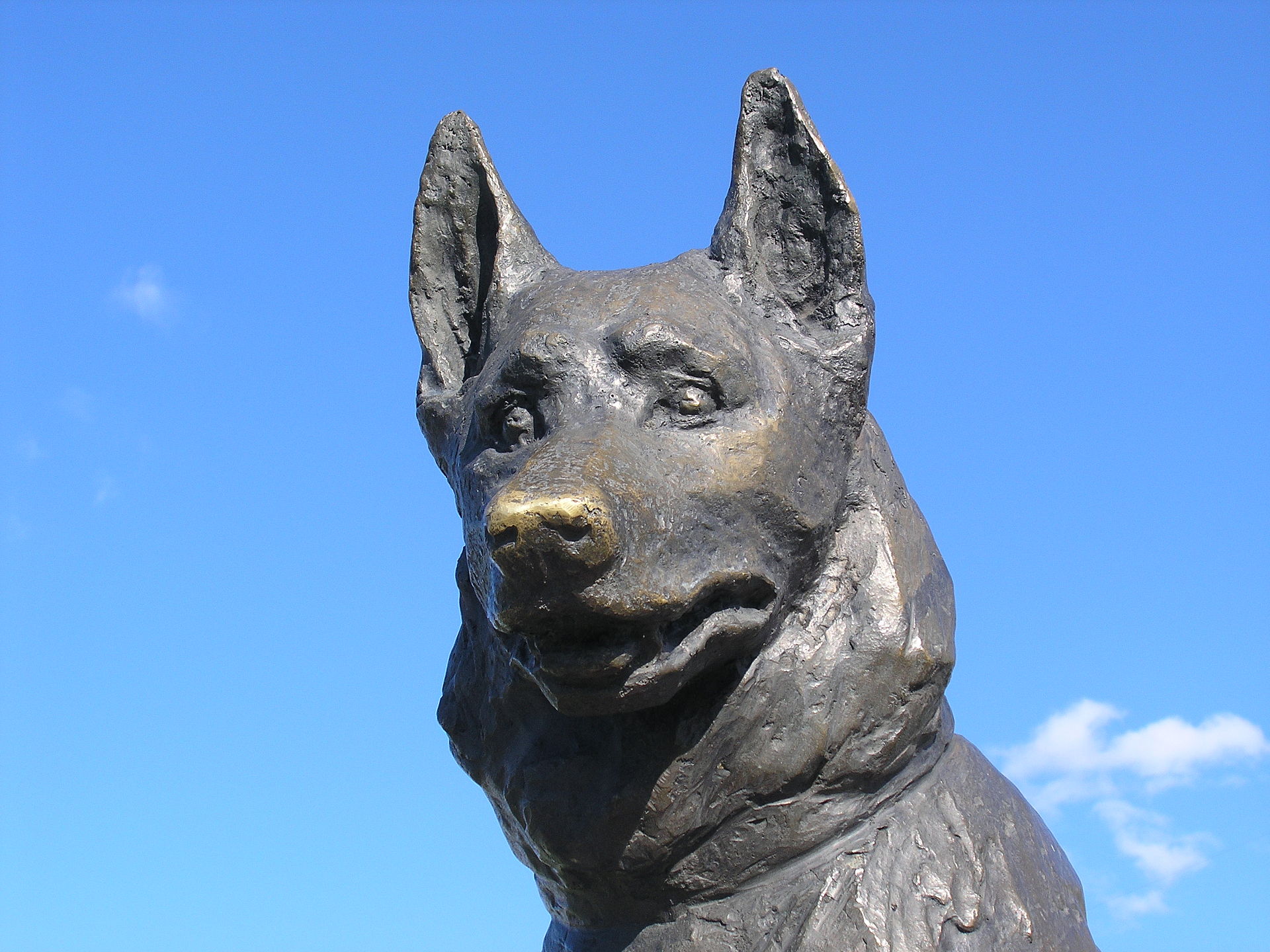
Kostya – Kostya, a German Shepherd, was riding in a car outside the Russian city of Tolyatti when the car crashed and his master was rushed to the hospital and died. Kostya paced the side of the road for seven years, searching for the return of his master and his car. Townspeople brought him food, but he refused their offers of a home. Newlyweds visit the monument to “the most loyal dog” and rub his nose to ensure their fidelity to each other.


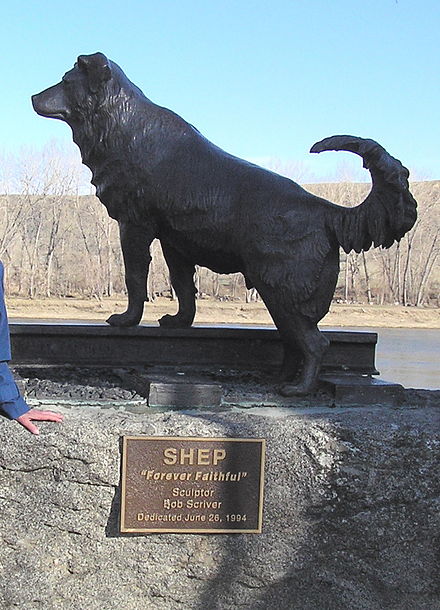
Old Shep – A sheepherder fell ill and went to Fort Benton, Montana, for treatment. He died a few days after his arrival, and his casket was shipped East to relatives. His dog, Old Shep stayed at the train station many years, greeting every train in hopes of his master’s return.


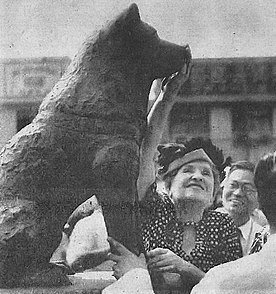
Hachiko – This dog, a Japanese Akita, would meet his owner, a professor of agriculture, each night when he arrived home from work at the Shibuya train station in Tokyo. One day, his master died at work and never returned. Hachiko went to the station every afternoon for nine years, nine months and fifteen days exactly when his train was due. A statue erected to faithful Hachiko at the station is now a popular meeting place.


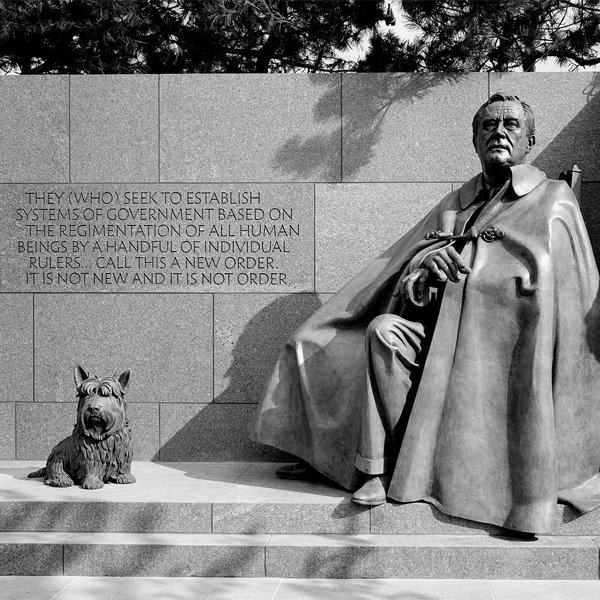
Fala – A Scottish Terrier, Fala was Franklin Delano Roosevelt’s beloved dog who lived in the White House during World War II. He was rarely apart from his master’s side and even accompanied him on ships and planes to meetings around the world. Fala was also immensely popular with the citizenry, receiving thousands of letters from the American public. A secretary was assigned to him to answer his fan mail.


0

Friends

During these pandemic times, not being able to visit friends in person is one of the biggest hardships. Family and friends are the keystones of life. How ironic that now we must show our love by our absence.

This crazy situation started me thinking about how we find friends in the first place. And then I broke out laughing. Many of my best friends hired me. Literally.

One hired me to be the art teacher at her school. Another employed me as the children’s programmer at her library. And more brought me into their libraries and schools to do programs.

The longest friendship I have had started in 8th grade and has endured all these years. My husband and I have also had the gift of good neighbors becoming good friends. More friendships resulted from my love of animals, especially the feline variety.

One day the pharmacist at our local drugstore starting chatting with me when I was picking up my cat’s prescription. We soon discovered a mutual love of cats, dogs and mid-century modern design. Two other friendships were sealed when acquaintances helped us find wonderful homes for five calico kitties we were desperate to place.

And finally, my husband and I met another lovely friend because of our sheer confusion. We were at Kinderdijk, the United Nations World Heritage site of windmills in the Netherlands. We had spent hours exploring this special place by foot and boat, and it was time to drive back to our hotel. Having lost our way several times driving down, we were staring at a large outdoor map of the site and surrounding area and laughing. We were trying to figure out a route back and knew we would probably get lost again. That is the moment when a lovely lady asked if she could help us. We then talked for an hour and a friendship was born. And her directions were perfect; we did not go astray on the drive and ferry ride back.

Friends do help us find the way…and not just with road navigation.

Kinderdijk
0

Schnecks

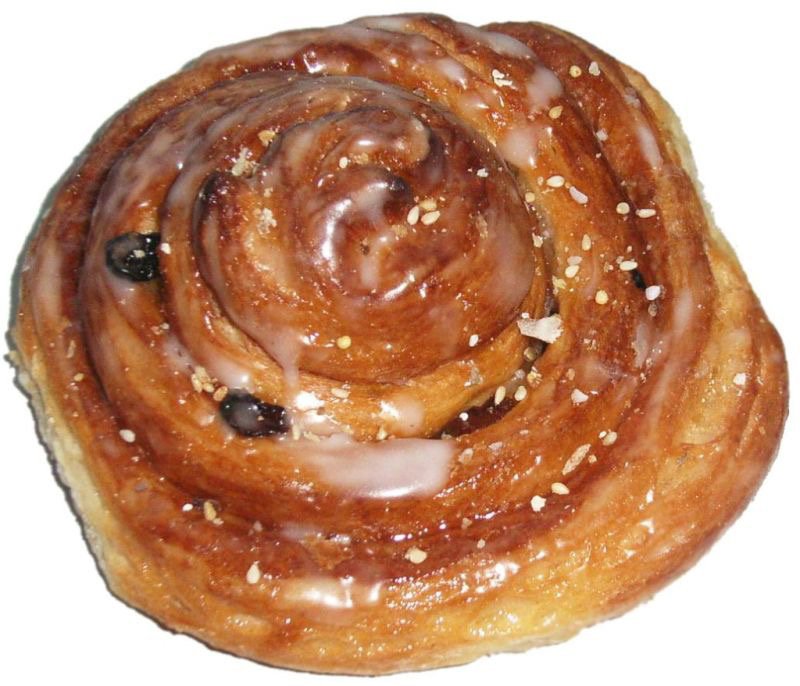
Whether you call them schnecken, schnecke or schnecks, they are delicious. These are the names Midwesterners of German origin give to what others refer to as sweet rolls or Danish.

The name schneck is most apropos. “Schnecke” is the German word for snail, and these pastries are curled up in a spiral just like giant snails. My childhood was filled with schnecks as well as many other sweet treats. Our town was dotted with home bakeries and my father had an active sweet tooth. Our family’s first stop after Sunday mass was always a bakery.

Photo: Wikipedia

Some of my friends’ parents were even more serious about having bakery security. They would get up in the wee small hours of Sunday morning to buy their breakfast treats at the back door of a bakery that started selling their products as soon as they left the oven.

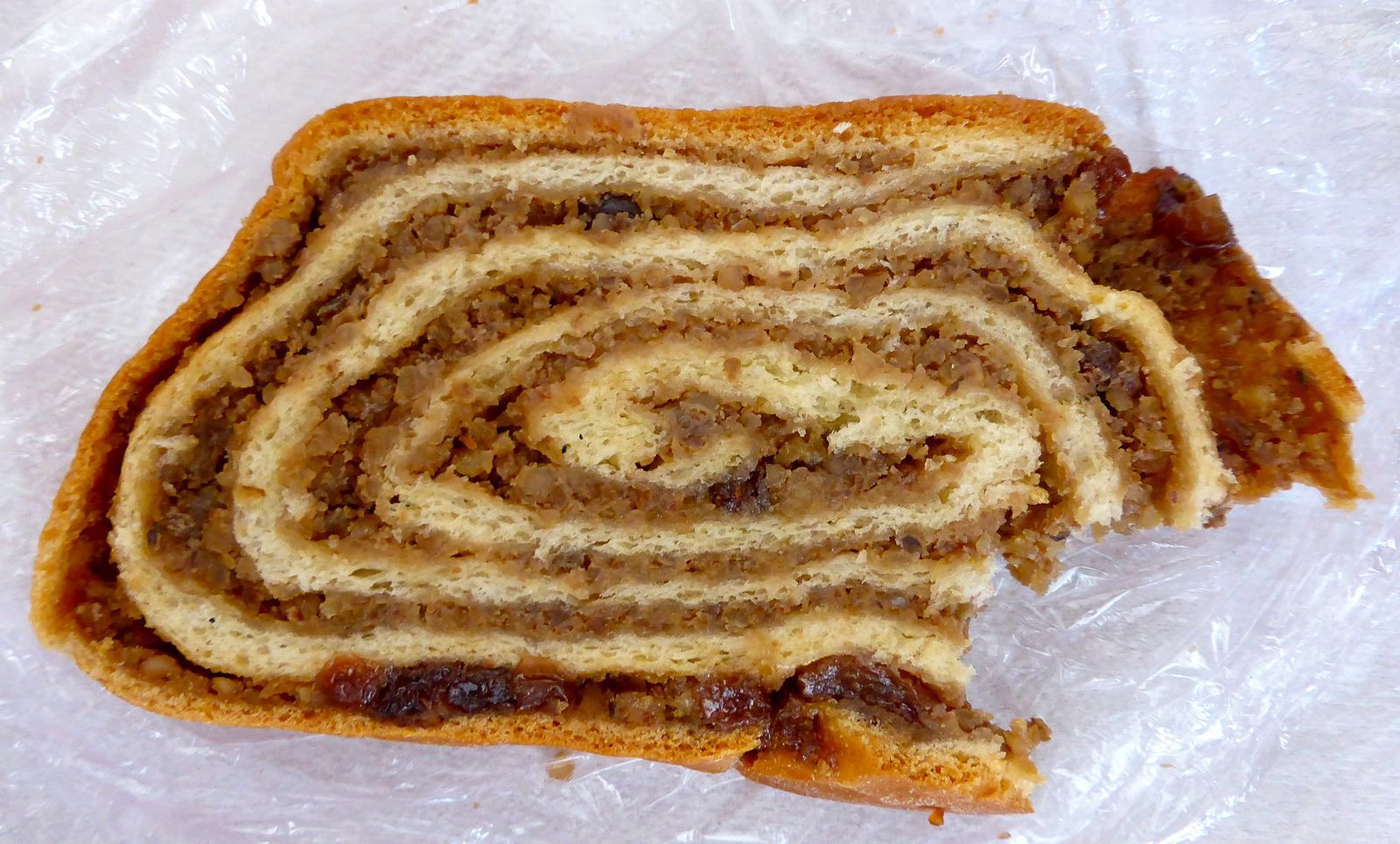
Looking back on my childhood and teen years, I was not lacking for sugar. My dad supplemented the schnecks with cream=filled, streusel=topped coffee cakes and potica (poh TEET sah), a nut and cinnamon filled roll that resembles snails when cut.

Potica. Photo: Wikipedia

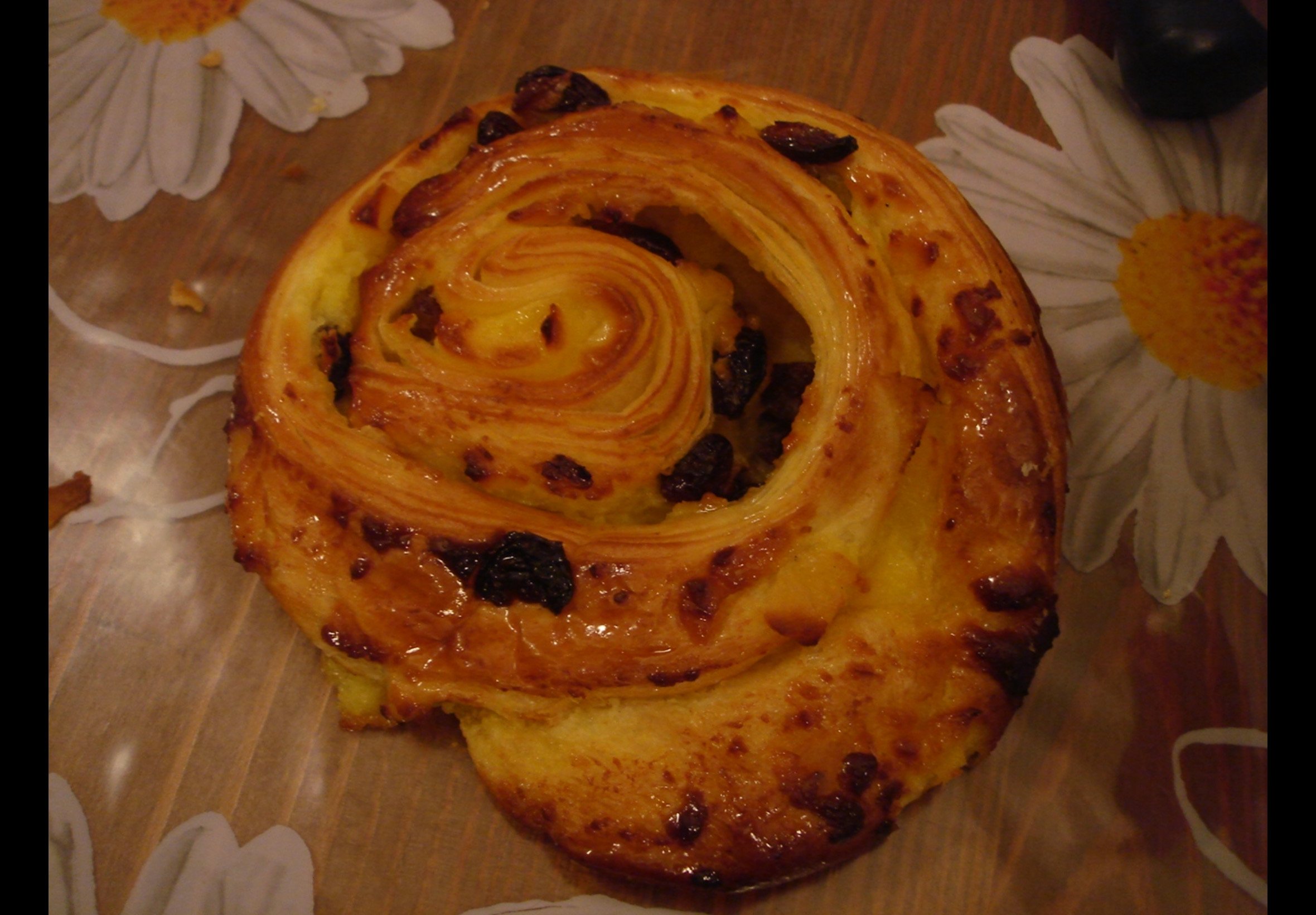
With adulthood came the realization that bakery products were not staples of the diet, essential food items. But this is not to say I don’t indulge. I do believe in the pleasures of the senses. And when I do splurge, my ultimate treat in the pastry department is no longer a schneck or a cruller (aka “crawler”). I will always pick the pain raisin, that delectable, flaky French puff pastry. It’s shaped exactly like a snail, which is why the French have a second name for it…escargot.

Photo: Wikipedia
0