Hydrate

For most of my adult life, friends and family have been telling me to “drink more”. They are not referring to wine, but H2O. I guess they fear I will dehydrate and turn two-dimensional or simply evaporate.

Their concern is gratifying, but I’ve never been able to drink my 8 daily glasses. I’ve tried, but do not like to feel like a water balloon ready to burst. So I rely on thirst as my signal to sip and am happy that science is now on my side.

Scientists have completely debunked the 8 glasses of water myth. Unless you are sick, sufficient water consumption can be achieved with one guideline, “drink when you’re thirsty.” To the chagrin of scientists, the 8 glasses rule will linger for a long time…myths don’t just instantly dry up.

So how did this popular dictum get started? Research brought me to this explanation from the doctors at McGill University:

“The actual notion of 8 glasses a day originates from a 1945 U.S. Food and Nutrition Board which recommended 2.5 litres of daily water intake. But what is generally forgotten from this recommendation is, firstly, that it was not based on research and that, secondly, the recommendation stated that most water intake could come from food sources.”

Another myth that won’t die is that all our American children are suffering from dehydration. Teachers will know exactly what I am talking about. A “scientific” study came out about ten years ago which purportedly showed that the majority of American kids weren’t getting enough water. Teachers began requiring water bottles on all desks and urged children to keep drinking. “Hydrate” became the most spoken word in classrooms. This situation naturally resulted in constant traffic to the bathrooms and constant spills all over the desks. I’ve witnessed many great art projects drowned by wayward water bottles.

The studies about the water needs of children were funded by Nestle Waters. Need I say more?

In conclusion, here are three more ideas about water consumption that are all wet.

  • Coffee doesn’t count as water. Wrong, it is a slight diuretic, but that doesn’t cancel out its value for water intake.
  • Drinking lots of water keeps the skin smooth. Wrong, you can’t drink your way out of wrinkles; skin has to be hydrated from the outside in.
  • Drinking lots of water helps you lose weight. Wrong, scientific studies prove that “drinking water and waiting for the pounds to melt away does not work.”

Science is a wonderful thing. Too bad more people don’t believe in it.

2

Quincy

It all began with an article I read about Quincy, Illinois, being a mecca for lovers of mid-century modern architecture or mid mod as it’s nicknamed.

Named after John Quincy Adams and located on the bluffs of the Mississippi River, the city has a current population of 39,652. From its earliest days as a bustling, prosperous Mississippi port, it was referred to as “a gem of a city”. To this day, the residents still advertise it as the “Gem City”.

Since my husband and I both have a fondness for the Great River Road and mid mod architecture, we set off for Adams County and Quincy. We had no idea what treasures lay in store for us.

Arriving at sunset, we immediately drove across the bridge to Missouri. We wanted to view the sunset from the top of their massive suspension bridge. The trip back to town was over another bridge; Quincy’s two distinctive bridges are both one way. Driving through the town at dusk to our hotel, we were flabbergasted…such a funny word, but the correct one.

The mid-century modern homes we had come to see turned out to be only a small part of Quincy’s architectural treasures. This town has over 3,600 structures contributing to the National Register of Historic Places, with over 30 styles represented …everything from art deco to Venetian gothic revival and everything in between.

I am sure as we drove in the dusk, our heads resembled those of owls, turning in all directions. We had stumbled into a wonderland of architecture.

The next morning we began our tour at the Visitors’ Center which is located in Villa Kathrine, a former residence built to resemble a Moorish castle. Perched on a high bluff, this eccentric building has spectacular interiors and sweeping views of the Mississippi River.

I can’t find enough words to describe the endless riches and delights to be found touring Quincy’s neighborhoods. Pictures are so much better than any words I can conjure up…see for yourself.

3

Soldiers

A store of happy memories from my childhood revolve around a place my father called “the old soldiers home”. The place was exactly that, it was built as a permanent home for Civil War Veterans who had suffered injuries. Officially named “The National Home for Disabled Veteran Soldiers”, its stated purpose was “to provide a home where subsistence quarters, clothing, religious instruction, employment when possible and amusements are provided by the Government of the United States…not a charity, but a reward to the brave and deserving.”

Milwaukee was one of the three original sites for these soldiers’ homes. The main building in Milwaukee’s complex was designed by Edward Townsend Mix in the Victorian style. The first veterans walked through the doors in 1869. Ward Memorial Hall was added in 1882 and included a theater, store, restaurant and train ticket office. A chapel and other buildings soon formed an entire complex which was set on 900 acres. Down through the decades, the Soldiers’ Home continued to house and heal veterans from America’s subsequent wars. 

Our family home was only a mile from the complex, and my  parents loved to take walks there on the many tree-lined paths. It was a green oasis in the heart of the city. I spent hours with them walking and skipping in that bucolic place. Plus, I was awed by the grandeur of those ornate Victorian buildings.

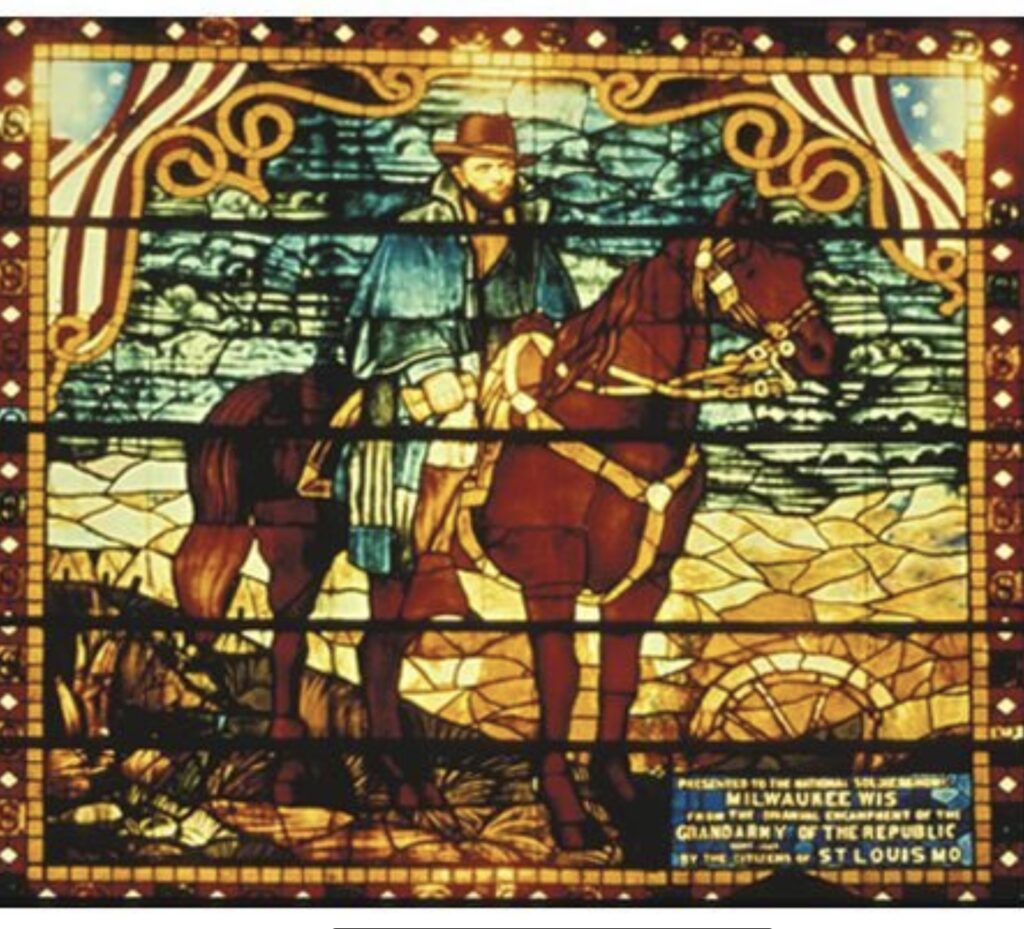
My most vivid memory, however, is of the Soldiers’ Home at night. Milwaukee has a grid pattern of streets. The shortest way for my folks to drive downtown was through the winding roads in the soldiers’ home. Whenever we came home from downtown at night, I always hoped the lights would be on at the Ward Theater. It had a gigantic stained glass window of U.S. Grant on his horse, and I thought it was incredibly beautiful. My father, on the other hand, had different thoughts. Every time we passed it, he would say, “Grant was a drunk, and it’s amazing he could stay on the horse.” Despite all the history classes I have taken since childhood, my father’s words are still entrenched in my brain. 

Those historic buildings were closed in 1989.  They soon fell into egregious disrepair and were scheduled for demolition. But, sometimes, miracles do happen. Preservation groups rallied and “Old Main” has been meticulously restored. And here is the real miracle: it was not turned into profitable luxury apartments. The building will continue to welcome veterans with its 80 apartments, a fitness center and offices for caseworkers. 

And one of these days, General Grant on his horse will also be fully restored, once again riding in glory. 

5

Plowed

It all began in Scotland in 2006. The Scottish Transport Ministry asked “wee” school children to come up with fanciful names for their snowplows. The idea was a huge success, and now every plow in the country has a moniker and all active plows (or gritters as they call them) are tracked on a wildly popular website.

The fun has now snowballed all around the world in locations that wear white for winter. If you live in a place that never needs a plow, it might be hard to understand why plow naming has become so popular. The answer is easy: you can’t survive a northern winter without a good sense of humor.

When I started looking up all the places that currently name plows and all the lists of names, I was amazed. There is a blizzard of names. From the hundreds and hundreds I found, I’ve edited it down to this list. It’s very punny.

  • SCOTLAND
    • For Your Ice
    • Gritallica
    • Lord Coldemort
    • Gritney Spears
    • Gritter Thunberg
  • CANADA
    • Sled Zeppelin
    • Flurrious George
    • School’s Not Cancelled
    • My Fair Bladey
    • Sleetwood Mac
  • VERMONT (Vermont’s grade schools were all invited to submit names.)
    • William Scrap-speare
    • Blizzard Wizzard
    • Brr-ito
    • Snowasaurus
    • Snow-manator
  • MICHIGAN
    • Aaron Brr
    • Yooper Scooper (For those not familiar with Michigan’s Upper Peninsula, Yooper is a nickname for its residents.)
    • Plowderpuff
    • Big LePlowski
    • Laker Scraper
  • MINNESOTA 122,000 votes were cast by Minnesota residents in the 2021 inaugural Name the Snowplow contest.)
    • Plow Bunyan
    • F. Salt Fitzgerald
    • Duck, Duck Orange Truck
    • Snowbi Wan Kanobi
    • Darth Blader

Even though March has arrived, our plows will not be able to rest for a while yet. We are all getting weary of winter, but laughter and cleared roads will see us through.

5

Ashley

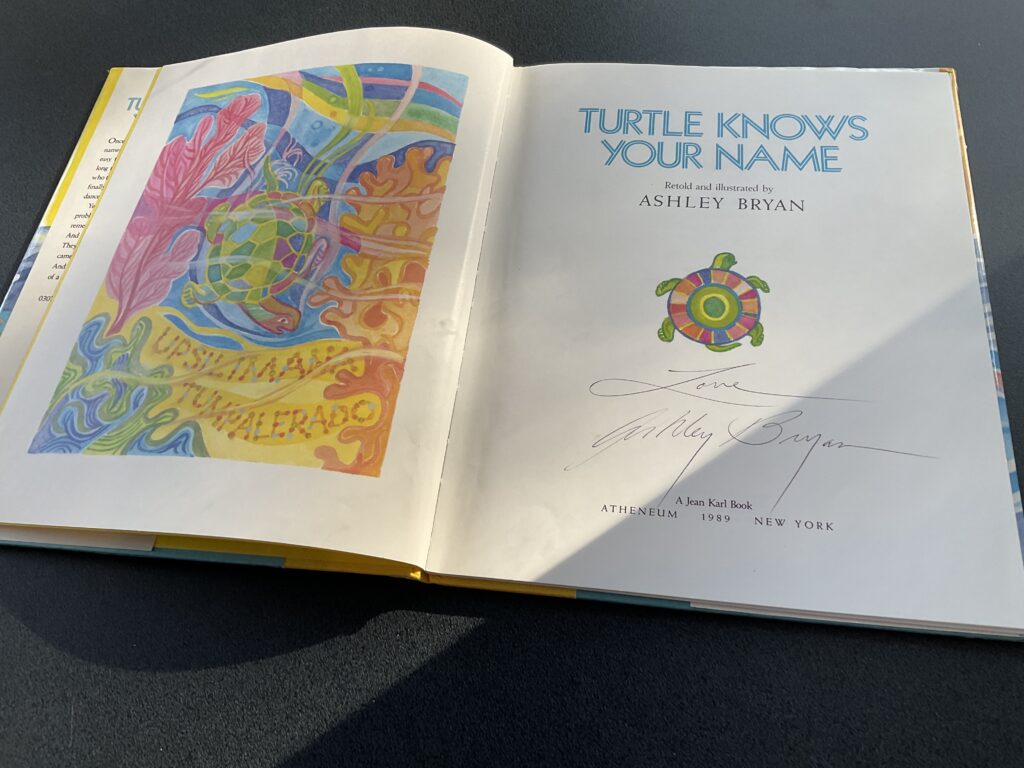
He was a poet, storyteller, children’s book author, artist, teacher, performer and puppeteer. But most of all, Ashley Bryan was an inspiration to every child and adult who knew him or his work. Mr. Bryan died last week at the age of 98. The joy he put into the world during his long life will endure for decades to come.

I had the amazing good luck to work with Ashley on two occasions called Poetry Concerts. The creation of the Milwaukee Public Library, these events consisted of a week of special poetry and art workshops in local grade schools culminating with a gala performance, or concert, featuring the week’s special guest and mentor, a nationally famous children’s book poet and writer. Without a doubt, Ashley Bryan was the most dynamic person I have ever met.

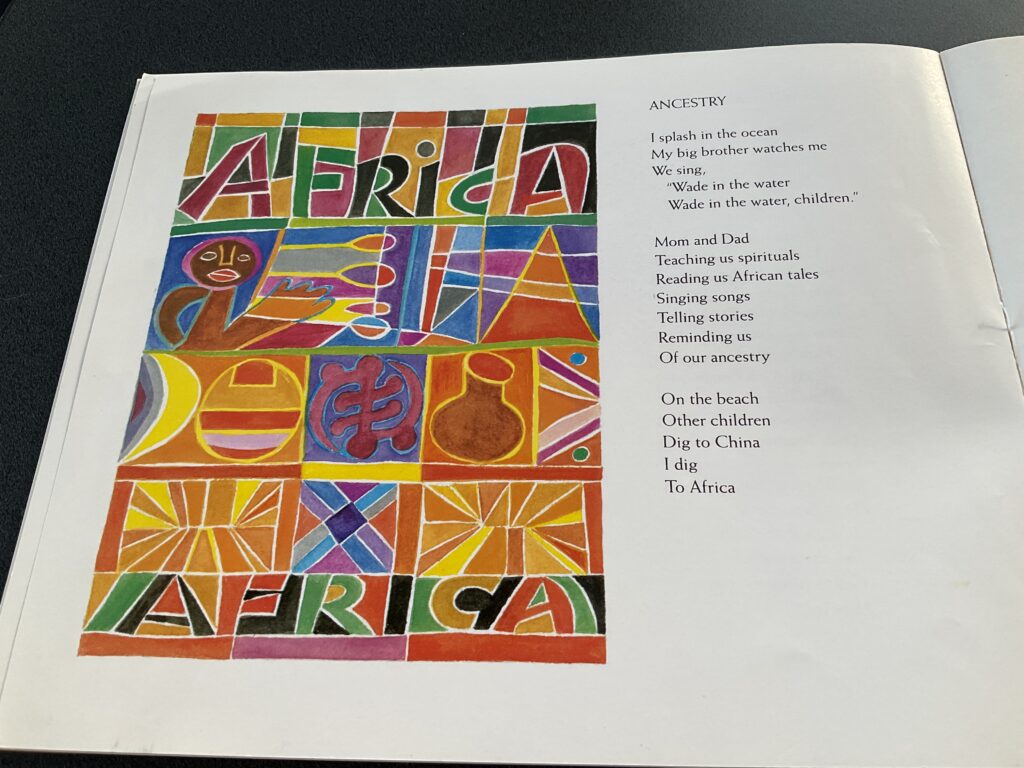
Ashley’s life was not without hardships, but he was a constant creator of joy. His parents left their sun-filled Caribbean island of Antigua for Harlem out of economic necessity. His father was a printer by trade, but could only find janitorial work when he and his future wife arrived in America. When he finally found a job as a greeting card printer, he moved his growing family to a walk-up railroad apartment in the Bronx. The family needed more room, there were six children, plus three cousins his parents adopted after their mother died.

Ashley’s description of life in that long, skinny tenement that only had windows at the front and back end tells much about the power of the human spirit. In his autobiography for children, Words To My Life’s Song, he relates how his mother loved flowers and put them wherever there was light in their apartment. And where there was no light, she and the children made crepe paper flowers to brighten up the gloom.

His father loved birds and lined the living room walls with shelves of birdcages for his beloved canaries, finches, warblers and parakeets. But those birds had competition. Ashley relates, “My mother sang from one end of the day to the other. When childhood friends visited, they would say, ‘Your mother sings!’ I thought all mothers sang.”

Ashley loved to draw from the time he was a small child, and his parents gave him his own desk to work on and good paper left over from printing orders at his father’s workplace. His childhood was filled with art including free classes provided at W.P.A. workshops.

Graduating from high school at sixteen, he needed a scholarship to go to college. When he initially submitted his portfolio, he was told that it was one of the best the interviewer had ever seen, but “it would be a waste to give a scholarship to a colored person.” He then presented his work to Cooper Union which judged the portfolios blind. He was admitted to the art school which was tuition-free.

After two years of college, he was drafted into the army to serve in World War II and was sent overseas where he took part in the invasion of Normandy. When the war ended, he continued to paint and draw, but switched his major to philosophy, feeling a compelling need for answers to the question, “Why does Man, knowing the overwhelming tragedies of war, choose war”?

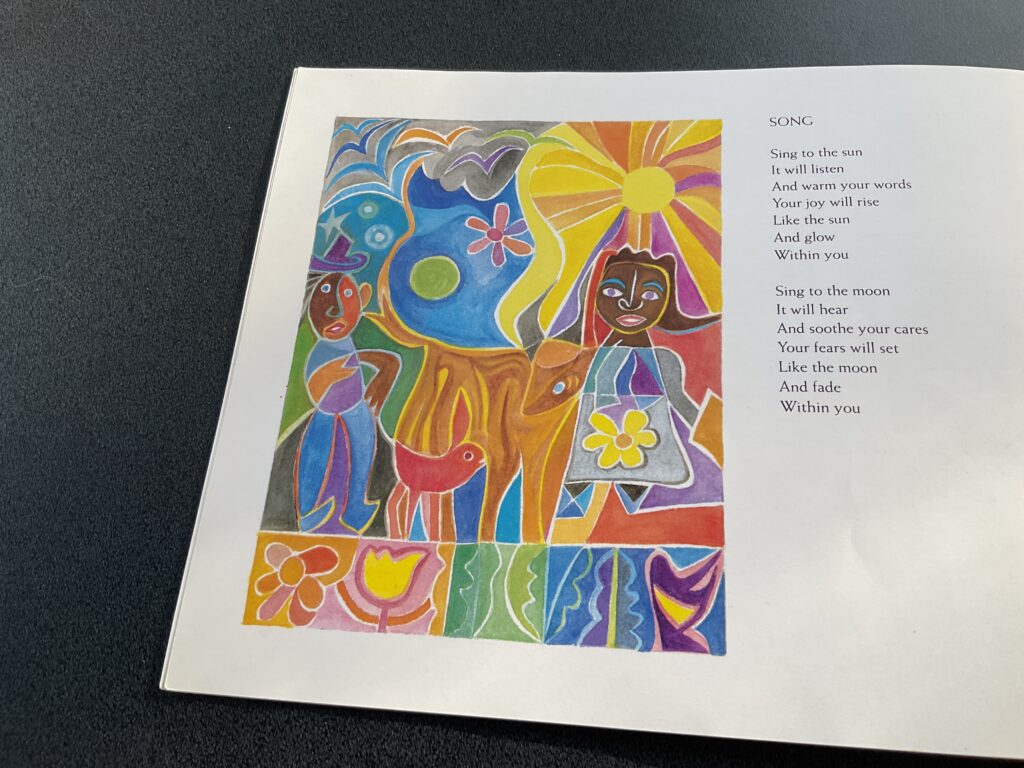
But art and writing were to be his life work. In his long and award-filled career, Ashley Bryan wrote over fifty books for children. When he went to a library as a young boy, no children’s books depicted young people who looked like him. Ashley Bryan was one of the foremost artists who changed that situation.

3