Optimist

The other day I was looking up quotes about New Years and found this gem.

“The optimist stays up until midnight to see the new year in. A pessimist stays up to make sure the old year leaves.”

These words were credited to Bill Vaughan, a writer unknown to me. That prompted a Google search where I discovered that William E. Vaughan was a syndicated columnist for the Kansas City Star from 1946 to his death in 1977. Thirty-one years of words and wit is an impressive track record.

I kept searching and found a large cache of Bill Vaughn’s quips. Here’s a selection:

“To err is human, to really foul things up requires a computer.”

“Frankly, the feeling of the adult contingent in the second house from the corner is that instead of taking down the Christmas decorations, it will be easier to move.”

“People learn every day and lots of times it’s that what they learned the day before was wrong.”

“We hope that when the insects take over the world, they will remember with gratitude how we took them along on all our picnics.”

“The groundhog is like other prophets; it delivers its prediction and then disappears.”

“Retirement, we understand, is great if you are busy, rich and healthy. But then under these conditions, work is great too.”

“Youth is when you’re allowed to stay up late on New Year’s Eve. Middle age is when you’re forced to.”

I’ll be staying up until midnight and plan to welcome in the new year as an optimist. I figure it’s always better to laugh than to cry. And I’ll be looking forward to writing another year of blogs… all on the positive side of things.

3

Evergleams

A small group of ardent collectors has transformed our town of Manitowoc, Wisconsin, into a dazzling winter wonderland. These amazing people collect trees… hundreds and hundreds of trees from all over America. Then they spend countless hours restoring the trees, branch by branch, needle by needle. The trees are made of aluminum and were a huge fad in the 1950s and 1960s, the Space Age.

Manitowoc was the epicenter of aluminum tree manufacturing. The now defunct Aluminum Specialty Company churned out thousands of these sparkly trees called Evergleams from 1959 to 1971. Sizes ranged from baby trees, a foot tall, to towering 14 foot giants.

Customers could choose from a wide variety of styles and colors. Silver was the most popular color, but green, blue, gold and pink were also offered. Styles were known as Peacock, Frosty Fountain, Pompom, True Taper and Slim Line. All the trees could be made more dazzling by the use of a color wheel.

Our collectors are striving to bring all the survivors home. Then they are restoring, assembling, displaying and lighting them in as many downtown windows as possible. It’s a month of aluminum tree paradise.

Creating this spectacle is a gargantuan task. Each tree comes in a compact box with the individual branches in protective sleeves. In some styles, every branch is the same length. But some styles are tapered with varying branch lengths, a true nightmare if the branches have been jumbled up in the box.

In addition to a spectacular window display, our local library recently hosted a fundraiser for the Evergleam collectors. Their dream is to someday have an Evergleam Museum in our town. To that end, several trees were auctioned off and the largest sold for a whomping $900.

Here’s a video we’ve made of some of this year’s window displays. It’s truly an enchanted forest, and it’s all homegrown.

1

Quake

Our planet is geologically active. Or, as I explain to kids, it rocks and rolls. Earthquakes and volcanic eruptions remind us that the rocks under our feet are constantly on the move.

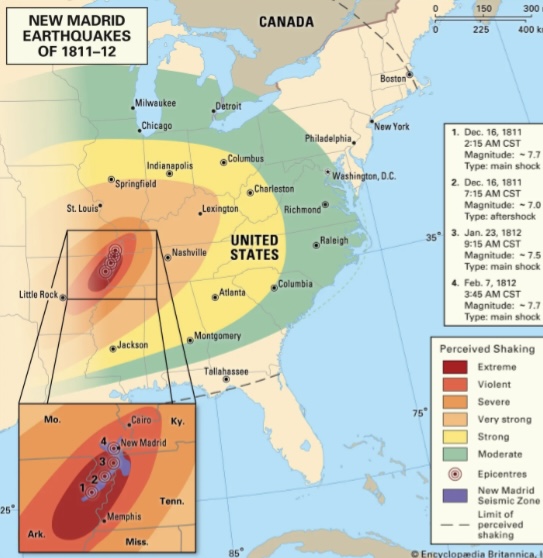
Here’s an interesting question. Where did the largest and most powerful series of earthquakes occur in America? The answer may surprise you…it was smack dab in the middle of the country and it started 211 years ago this week. During the winter of 1811-1812, three gigantic earthquakes occurred in the New Madrid seismic zone in the mid-Mississippi River Valley. Damage was reported from over 300 miles away.

The first struck on December 16, 1811, and the epicenter was in northeast Arkansas. At an estimated 8.6 magnitude, the quake was felt over the entire eastern United States and parts of Canada. President James Madison and Dolly Madison felt it in the White House. Tremors caused church bells to ring in Charleston and Boston. In Annapolis, the cupola of the statehouse swayed by several feet.

On January 23, 1812, the second quake of 8.4 magnitude began, causing damage over 232,000 square miles. The epicenter was near New Madrid, Missouri. But it was the third on February 7, 1812, at 8.7 that was the largest of the quakes. It entirely wiped out the town of New Madrid, caused the Mississippi River to flood and formed Reelfoot Lake in Tennessee. Boatsmen reported that the Mississippi River flowed backwards for several hours and waterfalls popped up in the river.

Ironically, the first steamboat ever to ply the Mississippi was caught in the quakes. The passengers woke one morning to find the island they were moored to had disappeared. But somehow the boat miraculously did complete its harrowing journey to New Orleans.

In addition to the three major quakes, about 2,000 aftershocks rocked the area. They created large fissures in the land, caused river banks to collapse, felled massive numbers of trees and toppled or tilted dwellings.

Other phenomena of the quakes were sand boils or vast patches of sand that suddenly appeared in the middle of fields and lights flashing up from the ground from quartz being squeezed. The sky turned dark, the air was hard to breathe and smelled foul. Understandably, many people thought the world was ending. Some even blamed the disaster on the steamboat.

Fortunately, in 1811, the population in the central United States was sparse. Only about 5,700 people were in the St. Louis area. Today the St. Louis-Memphis region is home to around 12 million people.

The New Madrid seismic zone remains the most active in America east of the Rockies registering about 200 earthquakes every year. Luckily, most are too small to be felt and all is peaceful in downtown New Madrid.

3

Cherished

Every thrift store has them, a large bin or long shelf overflowing with what I call the “unloved”, discarded plush toys. They are all waiting to be adopted and usually sell for the lowly price of 99 cents.

But I have observed that no matter how many stuffed toys a child may have, one is often singled out. It becomes a beloved friend, companion and security object.

Our parents, grandparents and great-grandparents had fewer toys and these were also much beloved. Many families are lucky to be their caretakers. Here are some of our family’s very special toys that have survived years of love.

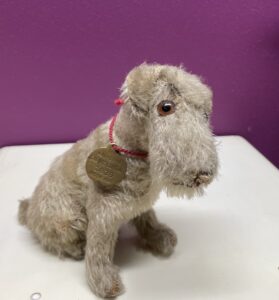
David was a gift given to my mother by my father when he was courting her. One day, my mother was taking a walk and found a lost dog tag. She put it on David where it remains. The date on his dog tag is 1924.

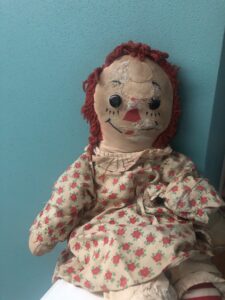
This is our daughter’s much loved Raggedy Ann. All the facial surgeries were performed by my husband’s mother. Our daughter says that Raggedy Ann is now “living her best life with Paddington Bear.”

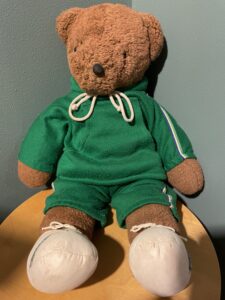
When our son was a runner in high school, he received Albert the Running Bear. After being a good mascot, Albert moved on to the next generation. Calamity struck when the family dog mistook Albert for a dog toy. I performed the surgery including a complete rhinoplasty (nose reconstruction) and eye transplants. He has made a splendid recovery and has just met his next generation.

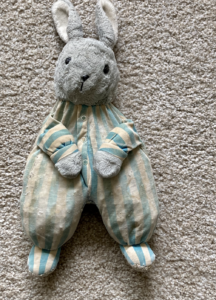
Goodnight Moon Bunny was our granddaughter’s beloved toy. Bunny went everywhere with her, even to college. Although scarred from stitches and very thin, Bunny now happily lives in Los Angeles.

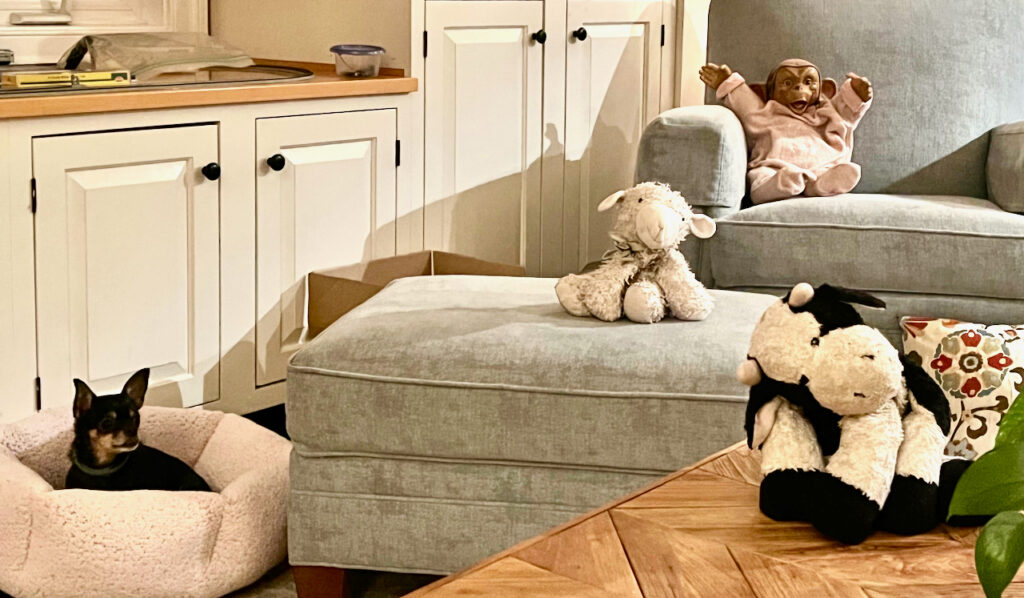
Here’s a family portrait and a who’s who. Lamby is our great-niece’s very, very special friend. Lamby was once accidentally left behind in an RV museum and was recovered after a long trip back and a search through many campers. The happy cow was her brother’s favorite. And then there is “Monk” our niece’s adored childhood toy that was passed down from her mother. When Monk was given to our great-niece, she flung it out her bedroom door. It did not send love vibrations to her. ( P.S. Lucy, the chihuahua is very real.)

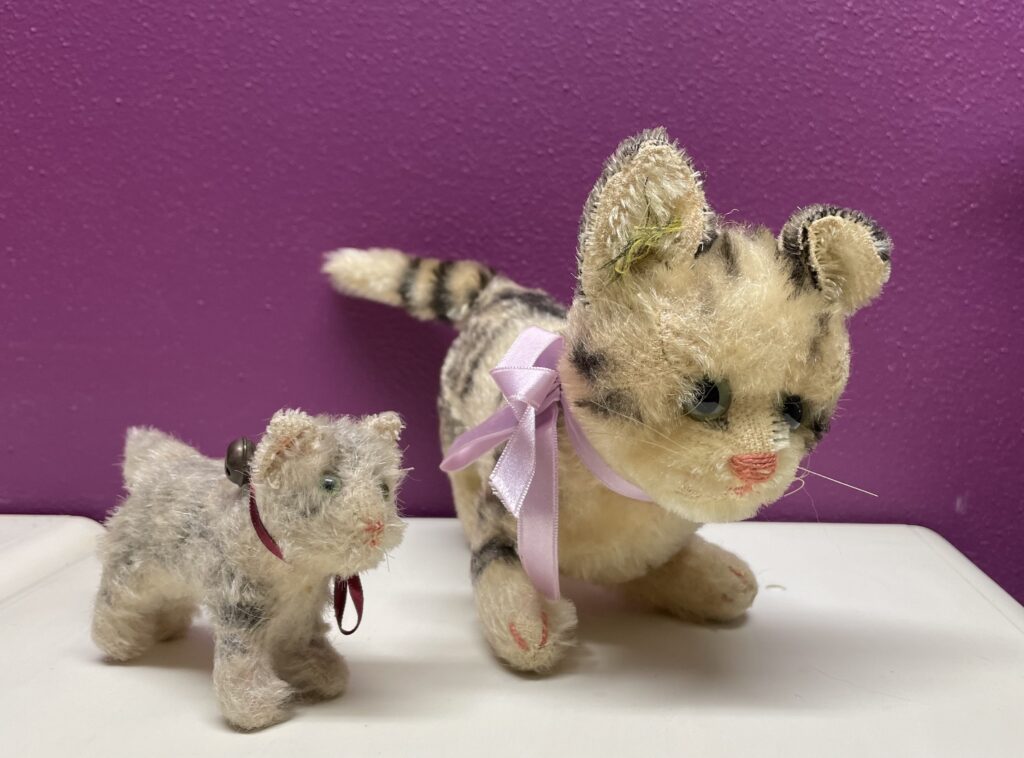
Little Kitty and Big Kitty are both from the famous German toymaker, Steiff. Little Kitty was a gift to my mother from her sister. Big Kitty was a birthday gift to me from my husband before we were married. Little did he know that we would end up living with nine cats.

5

Purrrrrr

It’s one of the most lovely sounds in the world…the low, soothing rumbling of a cat’s purr. I love this description of the purr supplied by Katherine J. Wu in The Atlantic.

“A purr is a warm tea and fresh-out-of-the-oven cookies, all rolled in a fleece lined hug; it is the auditory salve of a babbling brook; it is coffee brewing at dawn.”

From a scientific standpoint, the purr is not fully understood. What is known is the cat’s brain sends messages to the laryngeal muscles, causing them to twitch at a rate of 25 to 150 vibrations per second. This causes the vocal cords to separate when the cat inhales and exhales resulting in a purr.

Purring occurs when a cat is relaxed and content. However, cats may also purr when they are frightened, threatened, hungry or hurt. In these cases, animal behavioralists speculate that the cat might be trying to soothe itself.

Purring begins when kittens are still blind and deaf. Their mother purrs a lullaby and the tiny kittens purr to say, “I’m here, mom, and I want some food.”

Purring is a feature of the smaller cats and not just our house cats. Bobcats, ocelots, lynxes, cougars and others can purr. The ability to purr, not size or behavior, is one of the major distinctions between the two classifications (genera) of cats, Felis and Panthera. The big cats, Panthera, which includes lions, tigers, leopards and jaguars can roar but are physically unable to purr.

And then there is the oddball. Cheetahs have a genus all their own, Acinonyx. They can purr but cannot roar. They also have claws that can never fully retract.

Our beautiful, orange tabby, Neko, had a super loud purr, and he loved to sleep right next to our heads. But his purr could not compete with this cheetah’s purr. Check it out below.

1