Ignorance

“…it is always advisable to perceive clearly our ignorance.”

I recently came across this Charles Darwin quote in an article celebrating the 200th anniversary of his birth. These nine simple words should be enshrined in every classroom.

I present educational programs for thousands of children every year. Before I begin, I always say one reassuring thing: “If you raise your hand, and I call on you, and you answer wrong, don’t feel badly. Not even the smartest people in the world know all the answers.”

I would love to add that the smartest people are often the first to admit they don’t know everything, but that observation is a bit esoteric for grade-schoolers.

Here are more thoughts on ignorance from some extremely enlightened individuals.

“The older we grow the greater becomes our wonder at how much ignorance one can contain without bursting ones clothes.” Mark Twain

“Ignorance, when voluntary, is criminal.” Samuel Johnson

“Science alone of all the subjects contains within itself the lesson of the danger of belief in the infallibility of the greatest teachers of the preceding generations.” Richard Feynman

“You have the right to your own opinions, but not to your own facts.” unknown

0

Tractors

My childhood was defined by tractors. Since I grew up in a city, that statement may sound strange. But my hometown was West Allis, Wisconsin, named after the famous, orange Allis-Chalmers tractor.

Growing up in a blue collar, manufacturing town was not a bad way to start life. I certainly will never have any delusions of grandeur. As a child, I would lie in bed at night and listen to the reverberating thud of the drop forge hammer from nine blocks away. That sound and the slight quaking under my feet became familiar presences. The hot metal smells the plants emitted signaled that something scary, big and powerful was going on in those hulking, soot covered brick buildings.

Although my father worked in a steel company warehouse, Allis-Chalmers permeated all our lives. Acres and acres of downtown was devoted to the tractor shops. Classmates suffered and school fees were waived when Allis-Chalmers workers were on strike. The high school proms were always held in the Allis-Chalmers Clubhouse.

I grew up, but the tractors weren’t finished with me. My fiance, a native of northern Wisconsin, got his first job thus making our marriage possible. His employer was Allis-Chalmers; he worked in their fledgling computer department for eleven years. The computer filled an entire room. Since we only had one car, the kids and I took our breadwinner to the tractor works every morning and picked him up every afternoon.

My husband left Allis-Chalmers when he knew the demise of the plant was near. Most of the huge complex remains to this day, but it has been converted to smaller offices, businesses and a low-end mall. Nothing remains of the manufacturing might of my hometown.

A wave of nostalgia hits both of us when we see an ancient, orange tractor laboring through a field. And then there is the arrival of our one and only pension check. Without mentioning a dollar figure, I’ll just note that I thank the tractors for three big bags of groceries every month.

0

Hometown

My husband grew up in Lake Wobegon. Of course, the name of his hometown was different, and it lacked a lake, but in every other respect, his birthplace was the quintessential Midwestern, small country town.

The most distinguishing feature of my husband’s town was dirt. Other states have state cookies (biscochitos in New Mexico) or state insects (nine-spotted lady bug in New York), but Wisconsin has an official state soil, and that is what my guy’s hometown stands on – Antigo Silt Loam.

Flat fields surround the town and one crop, potatoes, predominates. Most everyone who is born on this land remains a potato-eater for life. My mother-in-law, for instance, always carried a ten pound sack of potatoes in the trunk of her car when she took cross-country trips.

When my husband was growing up, “downtown” featured a Chatterbox Cafe (aka The Dixie Lunch) which still has homemade kolaches on Friday and Sunday mornings, Gunkel’s Bakery (also going strong after 95 years) and a Montgomery Wards. If you also grew up in a Lake Wobegon, you will recall that the later was referred to as “Monkey Wards” and that Friday night was the big night to come to town for shopping, banking and socializing.

My husband’s hometown has another significant claim to fame: it has a long established independent, daily newspaper. Many little towns had local papers generations ago, but now such independent publications are rare. The Antigo Daily Journal is one of three left in our entire state today.

Another important product of this rural enclave will come as no surprise. Cheese rules in Wisconsin. Antigo’s cheese prowess is firmly established by the excellent hard Italian style cheeses it produces; Romano, Parmesan, Asiago, Fontina and Stravecchio Parmesan. If you have ample potatoes, bread, cheese and a daily newspaper, life is good.

I only have one complaint. Many of the older people in town refer to my husband as “little Russ”. Since he is not short and is also retired, this moniker appears nonsensical. But when you are the youngest of three brothers, I guess your position in a small town is fixed for life.

What makes your hometown memorable?

0

Redux

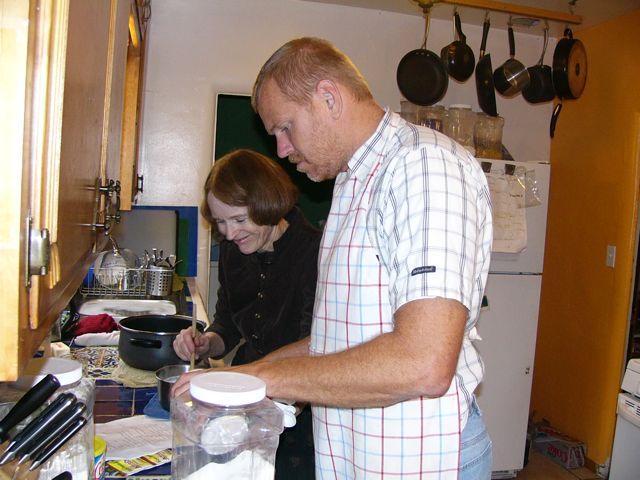
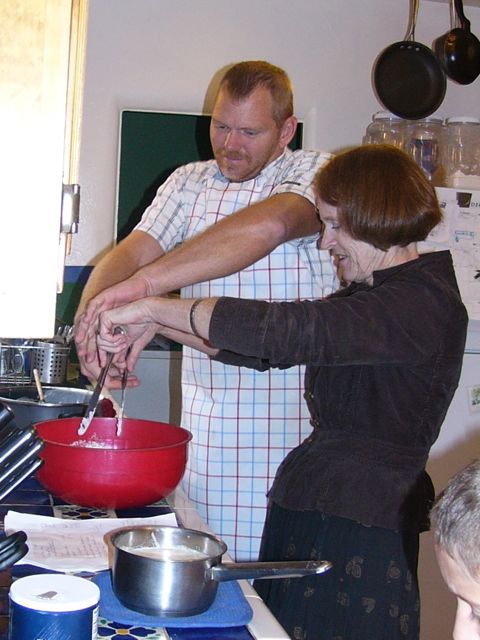
My son is not a competitive person. He’s highly creative and mainly focused on what his multiple muses are chattering about. But he is concerned with upholding his honor, in this case, his position as the yeast baker in our family. He is famous for his home made pizza crusts which rival those found in fine pizzerias. His dinner rolls are also notable.

On a recent visit to Southern California, I asked him what was on the agenda.

“We are definitely baking kolaches tomorrow,” was his reply.

“Terrific,” I said, knowing that I need all the group practice I can get before attempting a solo run.

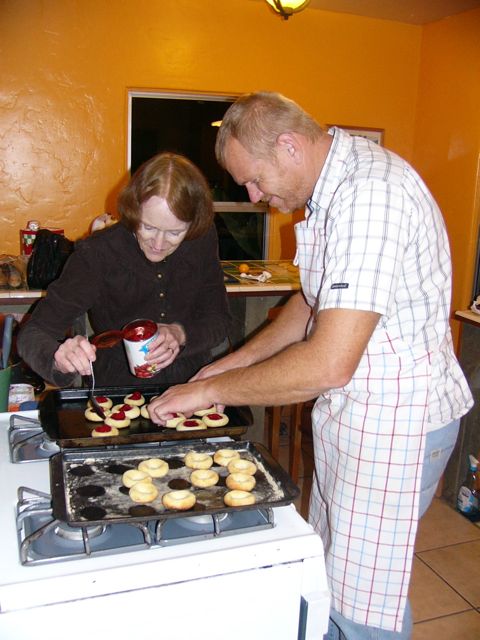
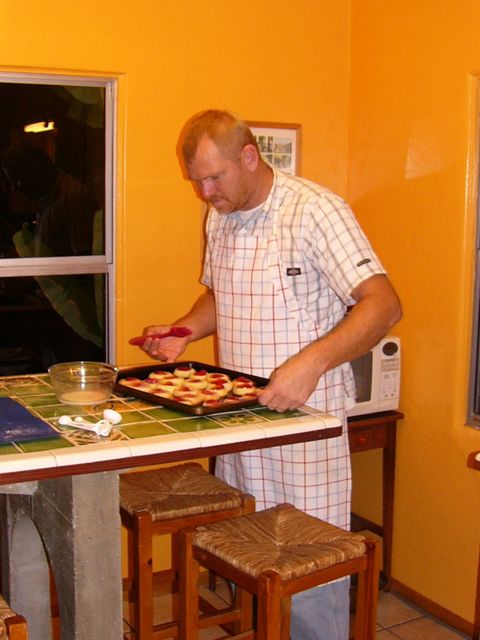
A discussion on fillings revealed some strong aversions to prunes from several family members. I volunteered to go shopping for canned fillings. Three grocery stores later, I concluded that my son’s wonderfully diverse neighborhood is not populated by any eastern Europeans. Not only were there no cans of poppyseed or almond fillings, one store carried just pumpkin. I settled for cherry and blueberry.

The next challenge was the temperature. We were not having a poster day for California climate… it was downright chilly and rainy. Our son’s house does have a furnace, but it hasn’t been turned on in a decade or so. Before we began baking, we fired up the stove, shut all the windows and waited for a semblance of warmth to fill the kitchen.

The whole baking process went smoothly except for several trays of kolaches which balked at doing their second rising – a protest against the untropical kitchen temperatures, no doubt. The pans were moved to the top of the range, and the kolaches immediately began cooperating.

As lovely smells began drifting from the oven, children began flowing into the kitchen. They were followed by a large black dog. All needed to be convinced that waiting for the kolaches to be filled was mandatory.

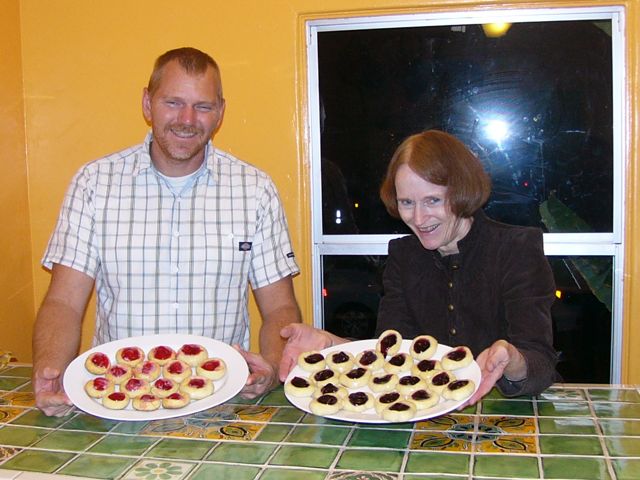
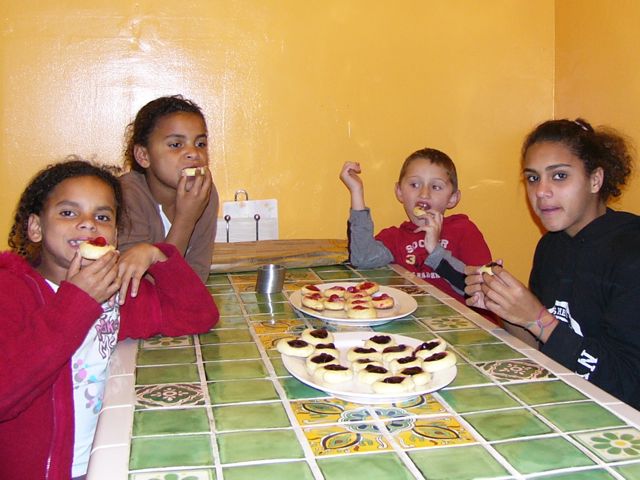
When we pronounced that the time to eat had arrived, an amazing thing happened. Sixty kolaches were reduced to twenty in less than thirty minutes. The survivors were removed to a room behind the garage. At 2:45pm the following day, no traces of kolaches, not even a crumb, were in sight.

0

Joy

Thoughts on happiness seem appropriate for the end of the year. Recent science theories are raising the possibility that happiness may be hard-wired into certain people and absent in others. I offer no opinions here: I’m simply grateful to find myself in the happy camp.

Buddhists put huge store in happiness. The Dalai Lama and Thich Nhat Hanh teach that “all people want happiness.” As much as I want to believe this, we’ve all seen people jettison any chance for happiness to get more power, prestige or money.

For those genuinely pursuing happiness (as guaranteed in our Constitution), the bookstores are brimming with self help books on the topic. I do have a hunch, however, that the contents of these books can be reduced to one index card:

  1. Figure out what you like, excluding items that are destructive to self and others. (Three hot fudge sundaes per day, for example, are probably not conducive to lasting feelings of well-being.)
  2. Do the things you like.
  3. Be oblivious to how others judge your choices.

My Aunt Jane was a life long tomboy who hated shopping and fashion. She happily resolved her wardrobe needs by getting out a mail order catalogue and buying 15 identically styled blouses and 15 identically styled slacks in a rainbow of colors. Every day she grabbed one of each item and never had to think about fashion again. Her fashionista sister reacted with pure sartorial horror to this brilliant and colorful pursuit of happiness. To which dear Aunt Jane replied, “I don’t care. It works for me.”

0