Do not show this blog to your dog. There’s a big, new trend called barkitecture. Designers vie to create the most elaborate, ingenious or downright decadent doghouses. Some are auctioned off to raise funds for shelters and rescue groups.
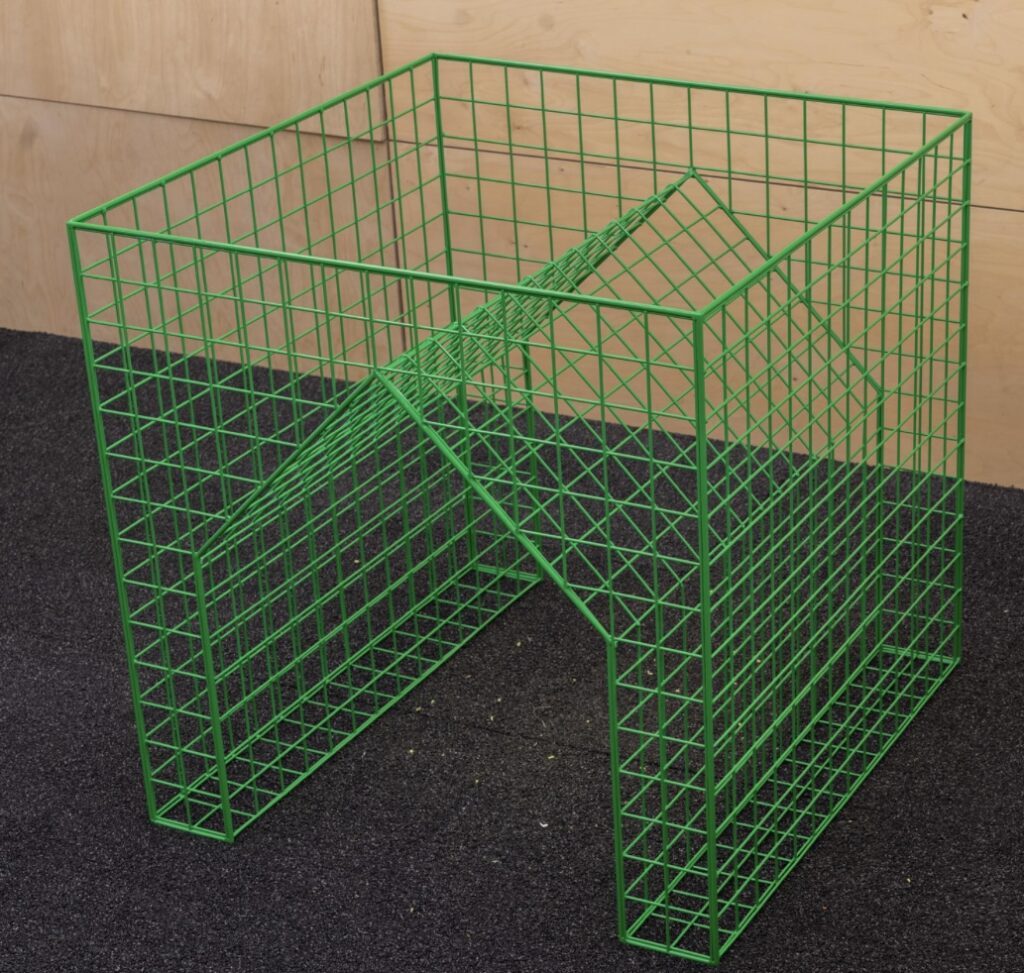
I became aware of architecture going to the dogs from an article in Dezeen. A London architecture studio created a doghouse for their studio dog named Lucky. Lucky is indeed lucky. His custom designed digs is called Fetch. The architects used gabion, which is a mesh basket, to form the kennel. Gabions are usually filled with rocks to create walls in landscapes. In a humorous twist, Lucky’s doghouse is filled with balls, hundreds of tennis balls. It’s a dog’s ultimate fantasy come true.
The architects plan on entering their playful doghouse at Goodwoof, an annual dog event at the Goodwood estate in England. I checked out the trailer for Goodwoof, and it is truly something to bark about. It would be a ball (pun intended) to go to Goodwoof even without a dog.
Click Here and then click the “Watch Trailer” button.
Parrots are incredible birds, which is a good reason to never have one for a pet. They live up to eighty years and are among the smartest of birds right up there with the Corvids (ravens, crows, magpies and jays).
Having a pet parrot is like living with an intelligent and noisy six or seven-year-old child for seven or eight decades. This is a commitment few of us humans are ready to make.
In addition, parrots are social birds who crave companionship and enrichment. Lacking others of their kind, pet parrots often bond with one person in a household. If that person leaves, feathers may fly. The abandoned bird will pluck out their own feathers in dismay.
A researcher from the University of Glasgow recently teamed up with two others at Northeastern University in Boston in a most unusual study. They took eighteen pet parrots and tried to discover if video calls with other parrots could help fulfill the birds’ social needs.
Here’s how the experiment worked. If a parrot rang a bell, a tablet was brought out and images of one or two parrots would appear on a screen. The parrot could use its beak or tongue to point to its favored bird for a video chat.
See for yourself the delightful results of this study. Click here
When I scan the business pages of the New York Times, I seldom have reason to laugh. But a recent item was so nonsensical that I did just that. Beer drinkers, however, would not have been amused.
The article concerns a noble idea of the Europeans that went a bit astray. Wishing to protect unique food and beverage items produced in specific regions, extreme penalties are placed on fake products. For example, Kalamata Olive Oil can only be labeled as such if it is from the Kalamata region of Greece and made from olives grown there. Pecorino Romano cheese must be made on the islands of Sardinia or Lazio or the Tuscan province of Grosseto.
Here is how an American product got seized for imitating a protected European drink, Champagne, from the Champagne region of France.
We must go back to 1903 and the Frederick Miller Brewing Company in Milwaukee, Wisconsin. Back then, bottled beer was a rarity. Most beer was drunk in taverns or taken home in wooden or metal pails.
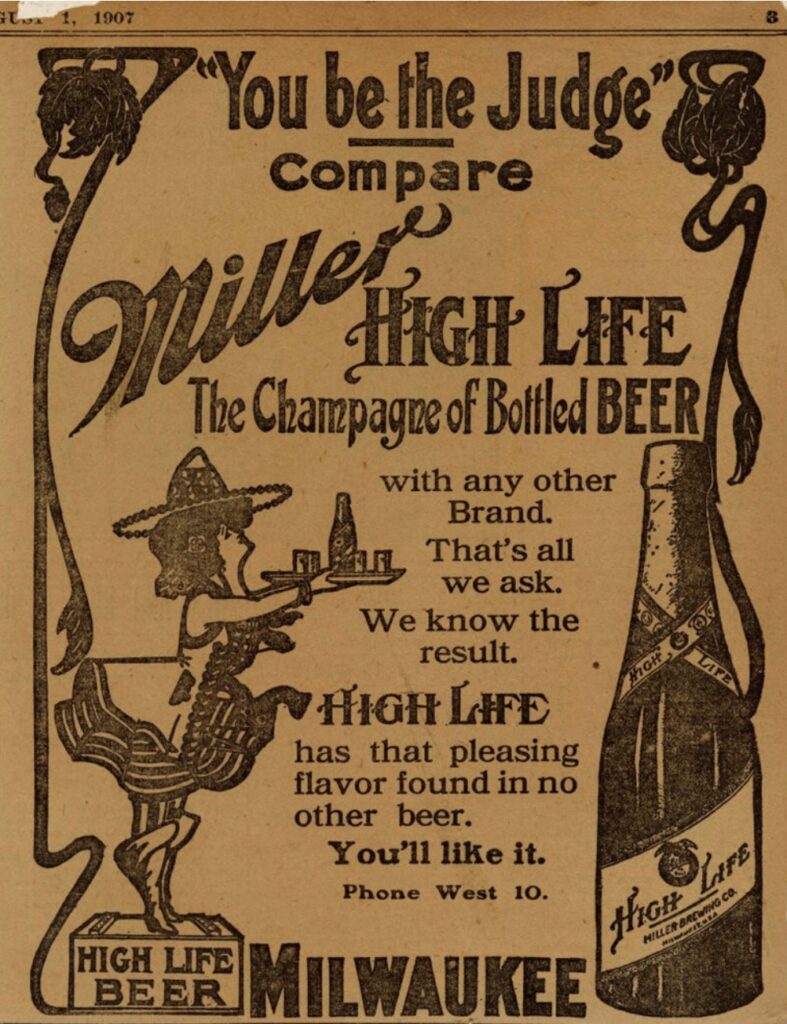
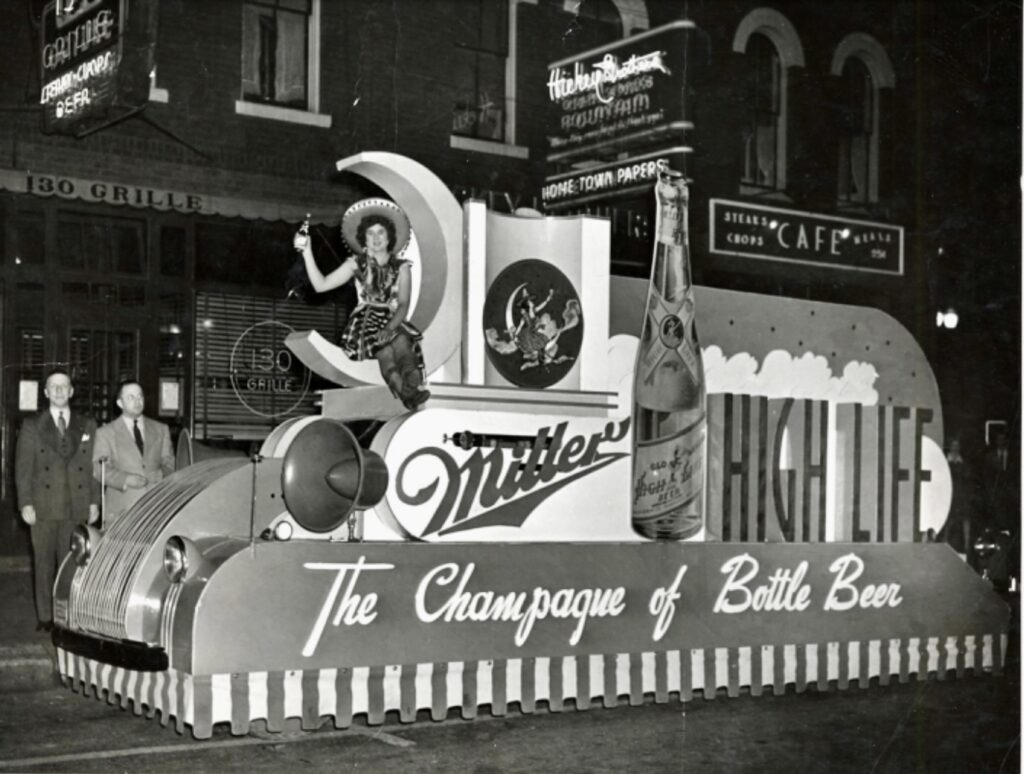
On New Year’s Eve, 1903, Miller debuted clear glass bottles to showcase his beer’s clarity. The bottles had long necks modeled after champagne bottles. In 1906, the company adopted the slogan, “The Champagne of Bottled Beer”. The nickname stuck to this day and is on every bottle or can. (The word “bottled” was dropped in 1969.)
This past February, a shipment of 2,352 cans of Miller High Life was seized at the port of Antwerp, Belgium. Molson Coors Beverage Company, which now owns the Miller brand, does not export the beer to Europe. The shipment was destined for one unnamed individual in Germany.
The French Committee for the Protection of Champagne ordered the seizure of the beer as “counterfeit Champagne”. The Belgium customs officials complied, and the buyer did not contest the order. All the beer went down the drain and the cans were crushed.
Molson Coors said it “respects local restrictions”. They added this caveat, “… we remain proud of Miller High Life, its nickname and its Milwaukee, Wisconsin provenance. We invite our friends in Europe to the U.S. any time to toast the High Life together.”
Here’s to both Champagne, beer and we Americans who can tell the difference.
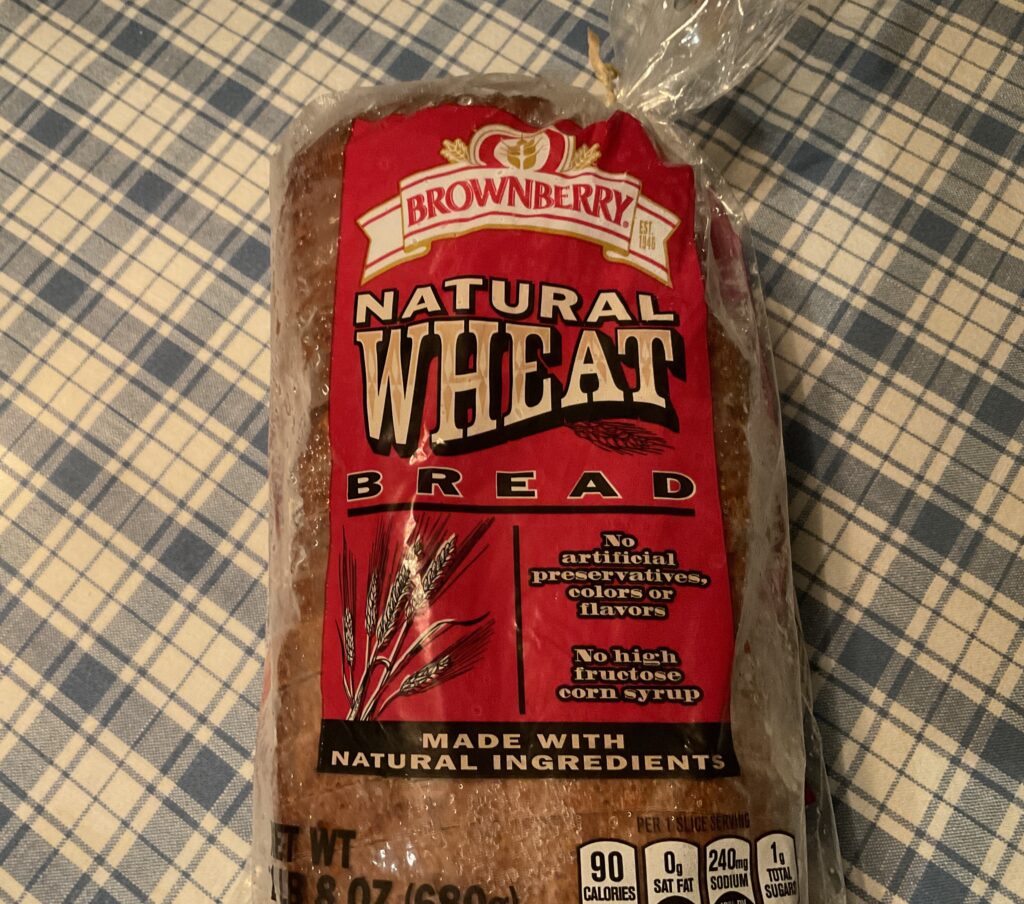
I’ve been eating the “Little Red Brick” since the age of five. However, I only recently heard it referred to by that whimsical name.
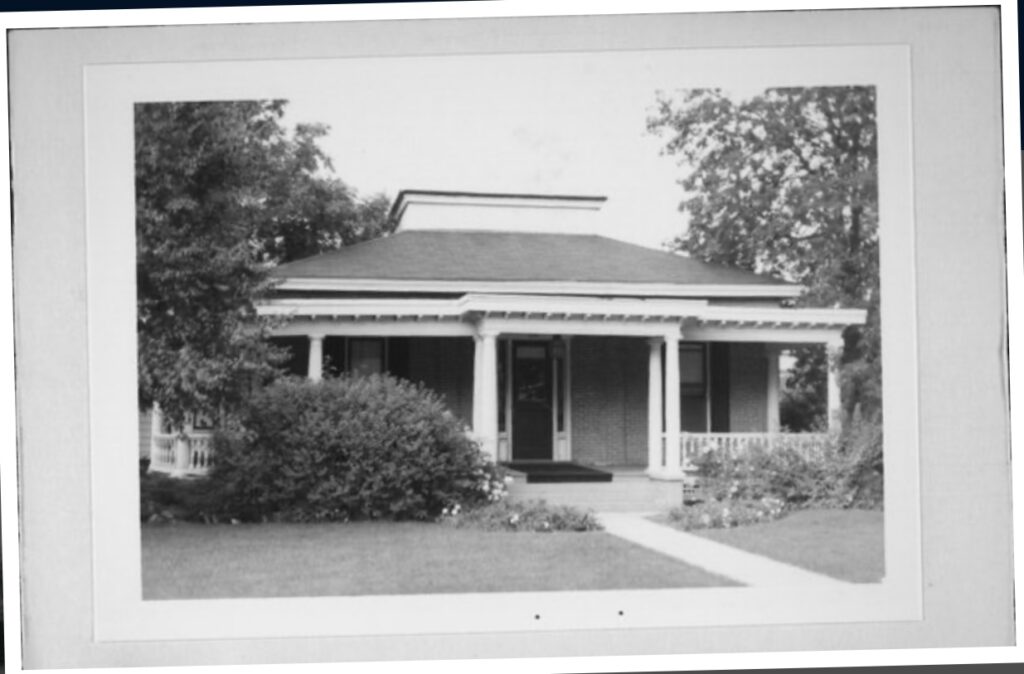
This story begins in 1946 when Catherine Clark of Oconomowoc, Wisconsin, took out a $7,000 mortgage on her house and spent the cash to buy a mixer, an ancient delivery truck and a grocery store to use as a bakery. She was a believer in whole grains and had developed a unique wheat bread in her home kitchen. When she shared her bread with neighbors, they urged her to make more and more. Mrs. Clark named her fledgling business “Brownberry Ovens” because the loaves came out of the oven “brown as a berry”.
Her sales the first year were $23,000 with a net profit of $86. Within a few decades, sales were sixteen million and distribution reached 40 states. In a time when men dominated the business world, Catherine Clark believed that women had a “sixth sense” about her products and hired mostly women workers in her multiple factories.
In 1973, she sold her company for 146 million. Brownberry Ovens is now owned by Arnold Bakeries. They tried to change the recipe a few years after acquiring the rights to the product but were deluged with complaints from loyal customers. They quickly reverted to Mrs. Clark’s original recipe and have kept it to this day.
This wonderful bread is available in several stores near my house, but it is hard to get. Not many loaves are delivered, and it sells out rapidly. So I have been eager to catch a delivery driver in my grocery store and ask how I can get a more reliable supply.
The other day I got lucky and turned into the bread aisle as the driver was stocking all the Arnold Bakery products. When I asked him about my favorite bread, he cheerfully said, “Oh, you mean the little red brick.” I laughed but was happy to find out where he stocked the most loaves.
Few good products endure for a person’s lifetime, but Brownberry Ovens Natural Wheat Bread is one that has for me. And I must thank my parents who loved the little town of Oconomowoc and were some of Catherine Clark’s first customers.
In 16 years of blogs, I have never written one about bananas. Therefore, it’s time to correct this oversight and go bananas.
Here’s the lowdown on America’s favorite fruit.
Bananas originated about 10,000 years ago in Southeast Asia. Today more than 1,000 varieties are grown in over 150 countries.
The original wild bananas were not edible. They had large, hard seeds and thick pulp. Edible bananas were developed in Africa around 650 AD.
European missionaries introduced bananas to the Americas in the 16th century.
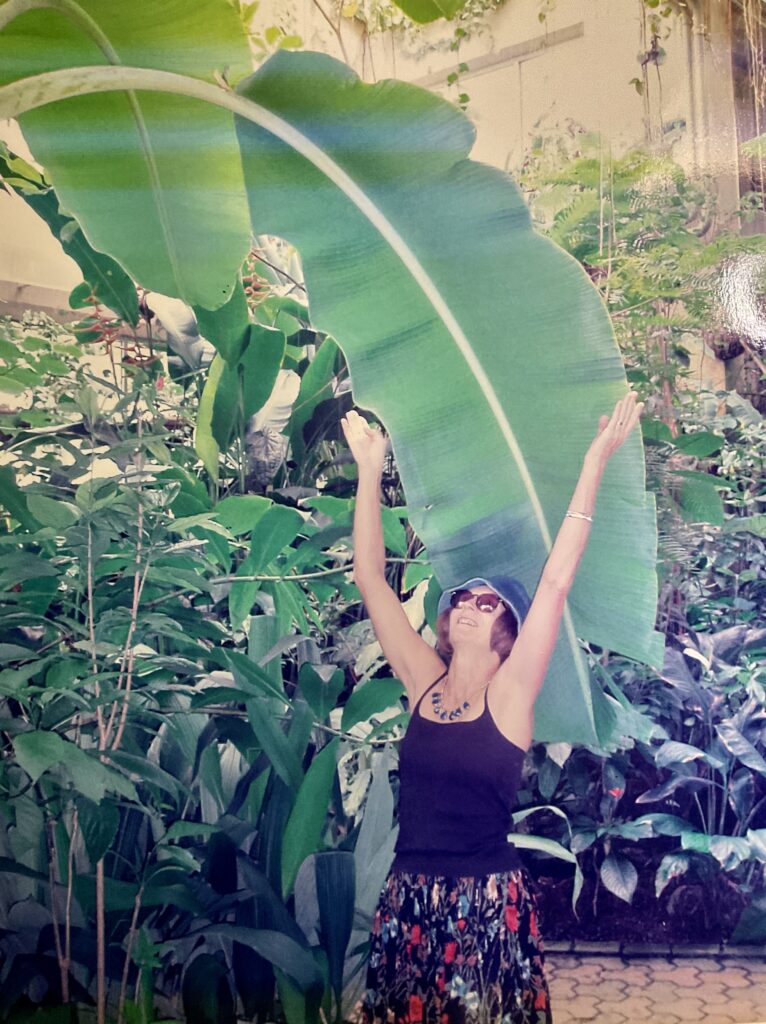
Bananas do not grow on trees. The banana plant is the largest flowering HERB in the world. The plant reaches its full height of 30 feet in a year.
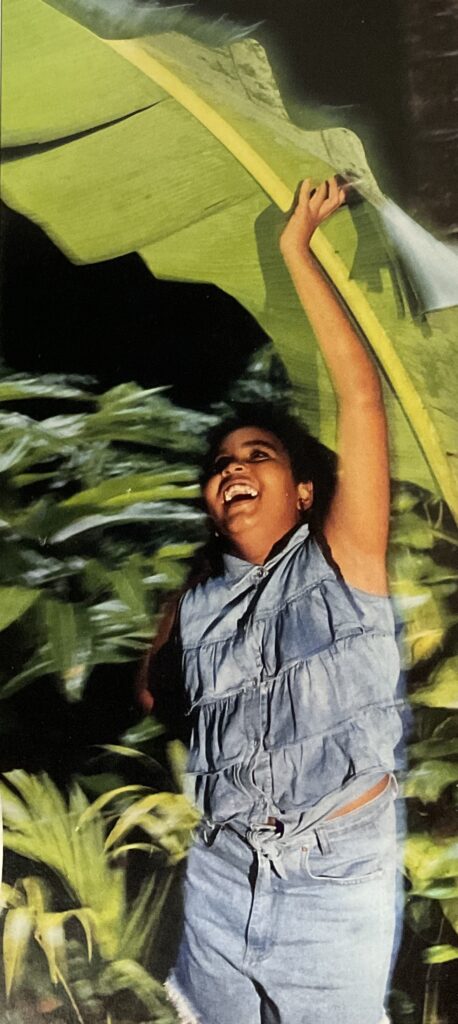
A single banana leaf can be 12 feet in length. People in the tropics often use the leaves as disposable umbrellas.
Banana plants produce large purplish-red flowers that hang down on a stem. The flower results in a hand of bananas; the fruit grows pointing up. A single banana is called a finger. The word banana comes from the Arabic word Banan meaning finger.
After the bananas are harvested, the plant is cut down. A new plant grows back as bananas are perennials.
The big, yellow bananas in our American supermarkets are the Cavendish variety which was developed in an English greenhouse in 1834. They account for 47% of global banana production. Unlike wild bananas, the Cavendish have no sex life; the seeds are sterile and cannot reproduce.
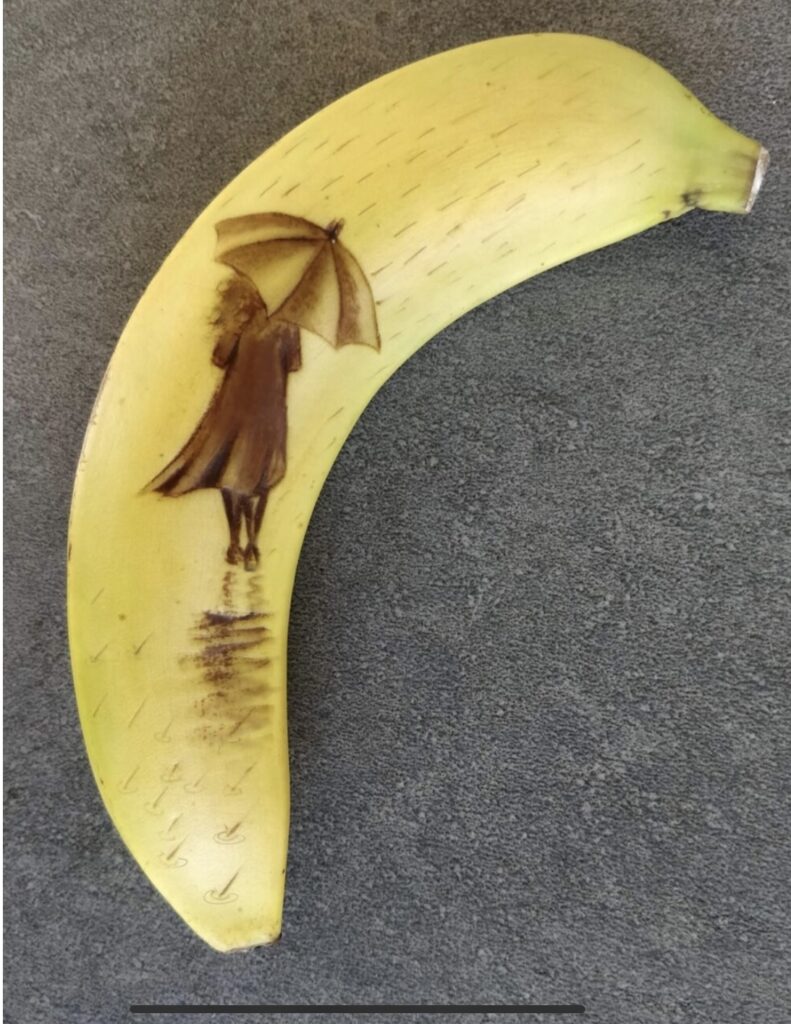
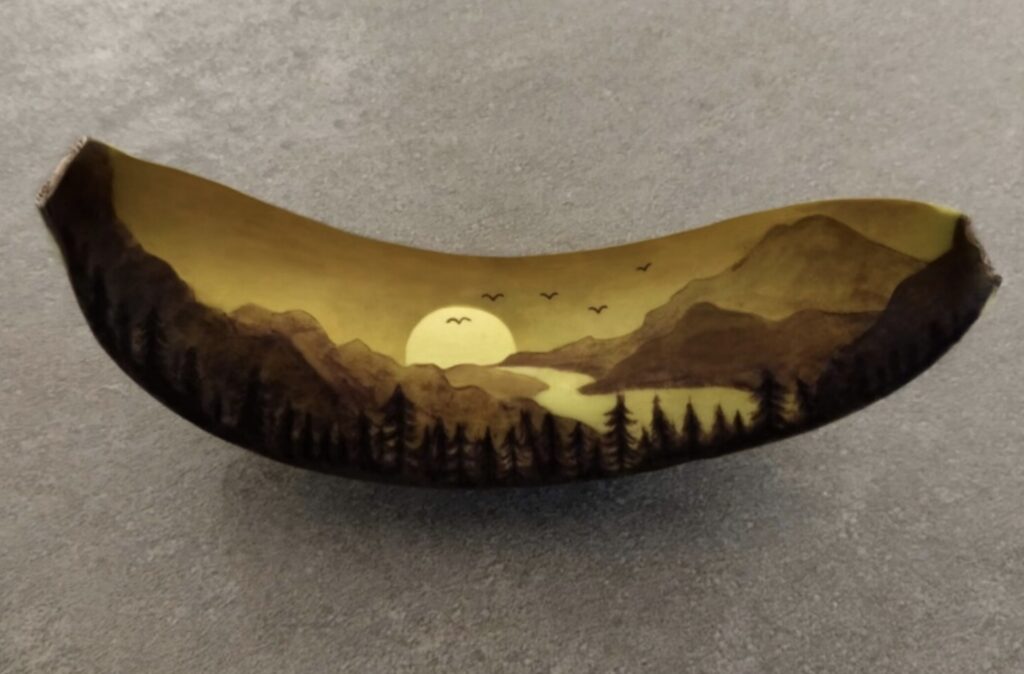
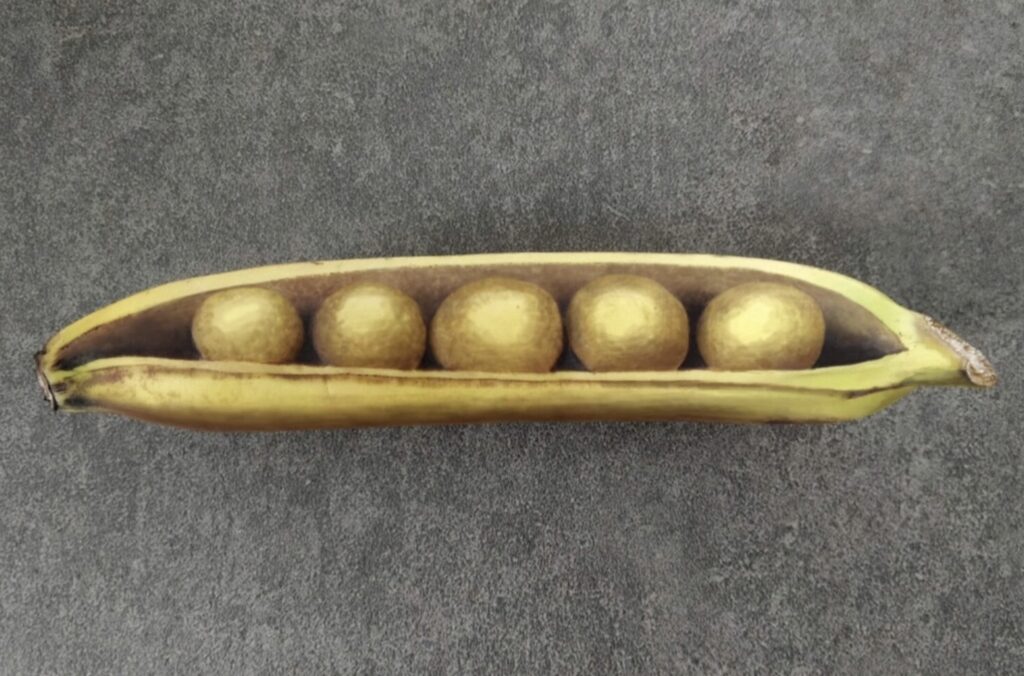
The idea for this blog began when my husband showed me an article about a woman named Anna Chojnicka who got bored during her Covid quarantine. She subsequently developed “banana art” by selectively bruising the skin of bananas. The results follow along with a delightful video of her in action.