Fill’er-up

No one in America views gas stations as exotic places. Filling up the gas tank is about as mundane as tasks get. This, however, was not always the case.

When the century turned from 1899 to 1900, horses ruled the roads and the newly invented automobiles were regarded as novelties. But these horse replacements still had to be fed. Early drivers bought gasoline in cans from blacksmith shops or from lone gas pumps which starting appearing curbside. It took the popularity of the Model T to put the concept of a filling station in motion. An organized network of gas stations needed to be established, and architects had no prototypes for these buildings.

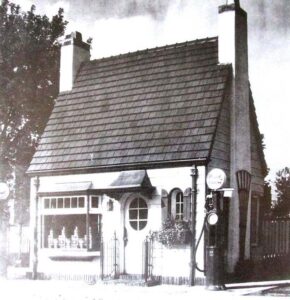
Between 1917 and 1930, the distinguished Milwaukee architect, Alexander Eschweiler, designed more than 100 Oriental style gas stations for the Wadham’s Oil and Grease Company. Each building had a unique design, but all were topped with a pagoda-style roof of metal tiles. Some even had lanterns dangling from the upturned corners of the roofs.
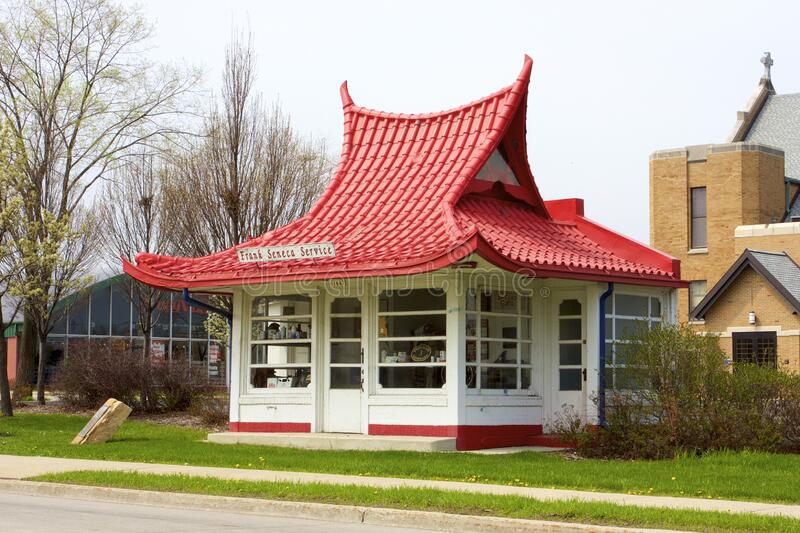
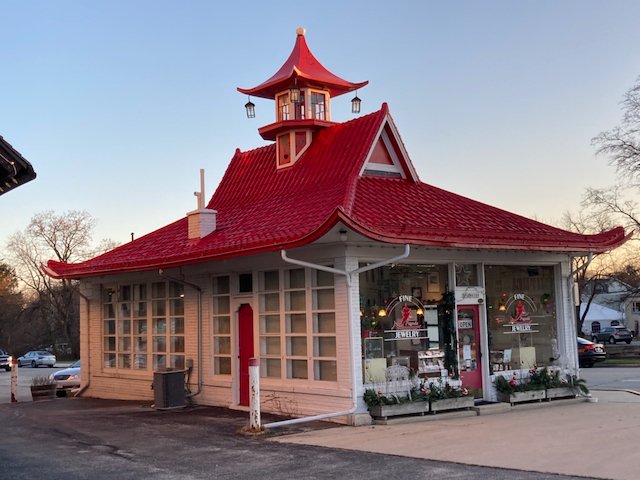
Photo – dreamstime.com
Photo – Mary Tooley

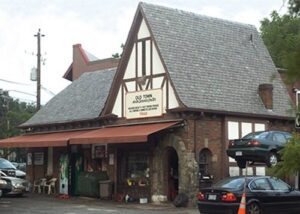
Other historic styles also were employed to create this new group of buildings. Pure Oil stations mimicked quaint English cottages with white stucco walls and blue tile roofs. Tudor revival stations popped up in many residential neighborhoods, and the Eastern seaboard saw the rise of miniature lighthouses to beckon drivers to the pumps.
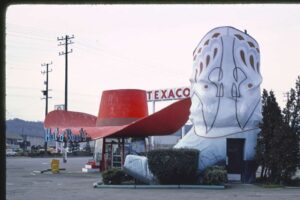
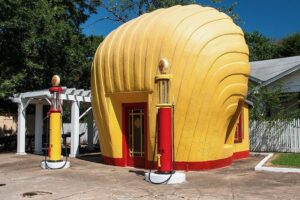
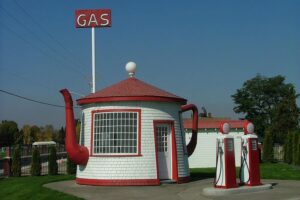
More unique and imaginative designs soon followed. Shell Oil built eight stations shaped like, you guessed it, giant seashells. Only one remains today in Winston-Salem, North Carolina. Other oddities include stations shaped like a teapot and cowboy hat and boots.
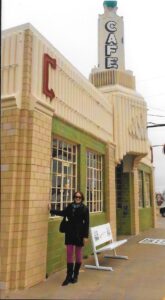
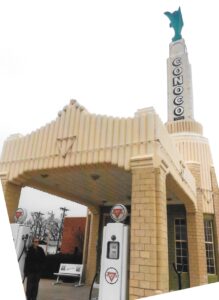
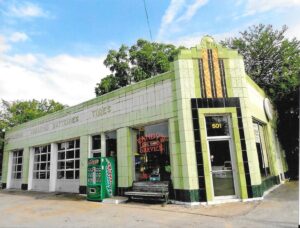
Art Deco stations proliferated in the 1930s, and they were elegant. This beauty in Traverse City, Michigan, is still operative. The Conoco Tower, in Shamrock, Texas, on Route 66, is fully restored, but as an architectural landmark, not an operative gas station and cafe.
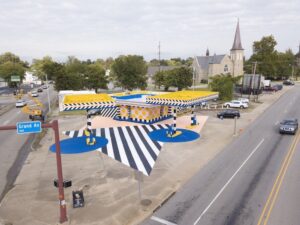
All of these exotic, quaint, quirky and decorative stations make our current ones seem totally uninspired. However, I have found one exception. Camille Walala, a much-in-demand French artist, has done a makeover of an abandoned 1950s filling station in Fort Smith, Arkansas. It’s a giant art installation, sans working gas pumps.  Alas, what fun it would be to fill’er-up here.


0
Wishbone

It’s hard not to love Pop Art, that genre that began in the mid-50s and extended until the late 70s. Ordinary, popular objects and images were painted and sculpted, often at a massive scale. Pop artist Jim Dine defined the movement as “the American Dream, optimistic, generous and naive.”

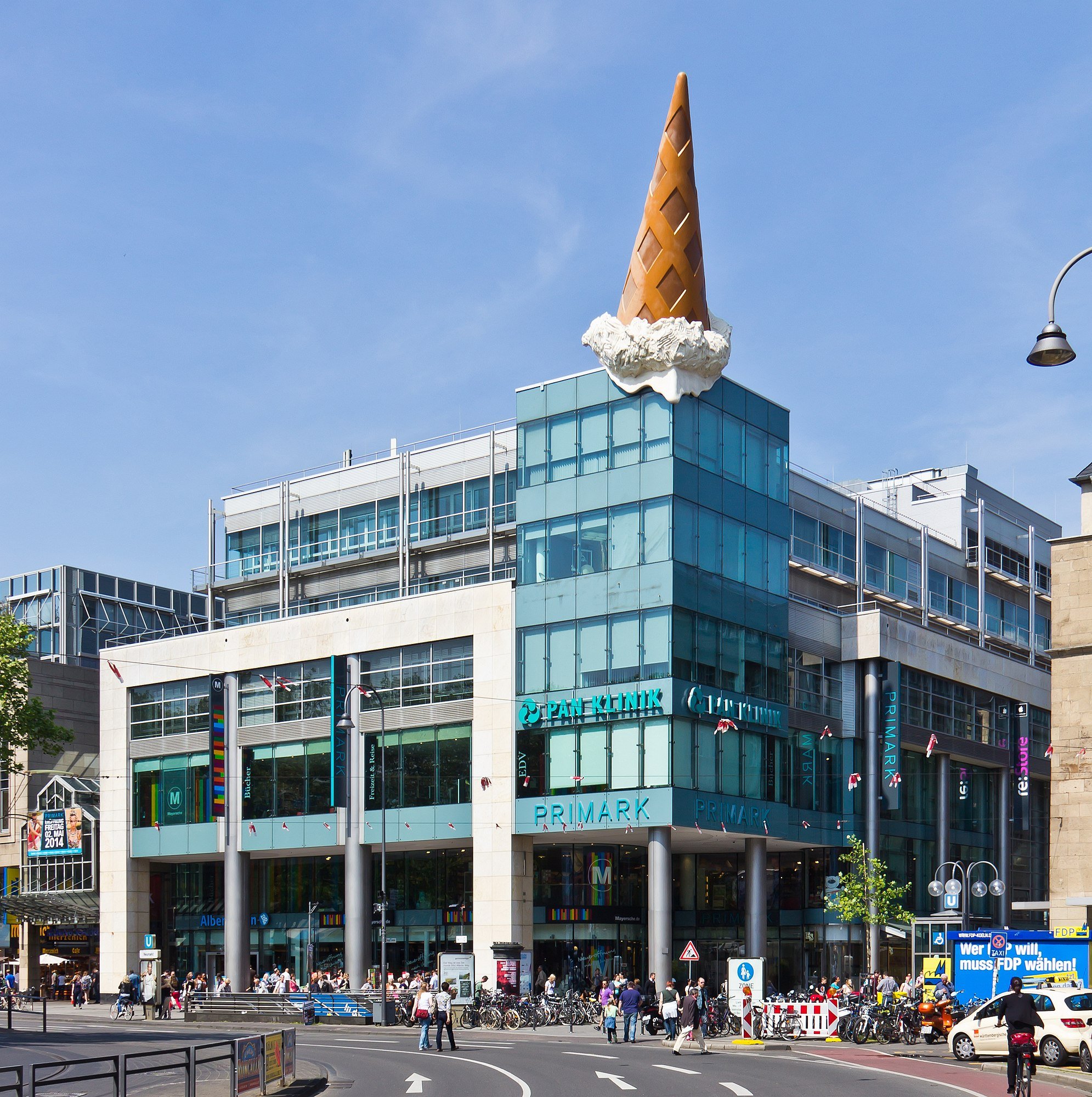
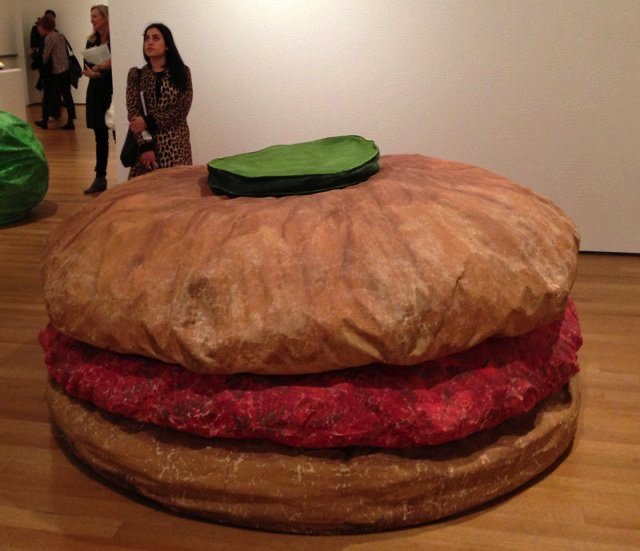
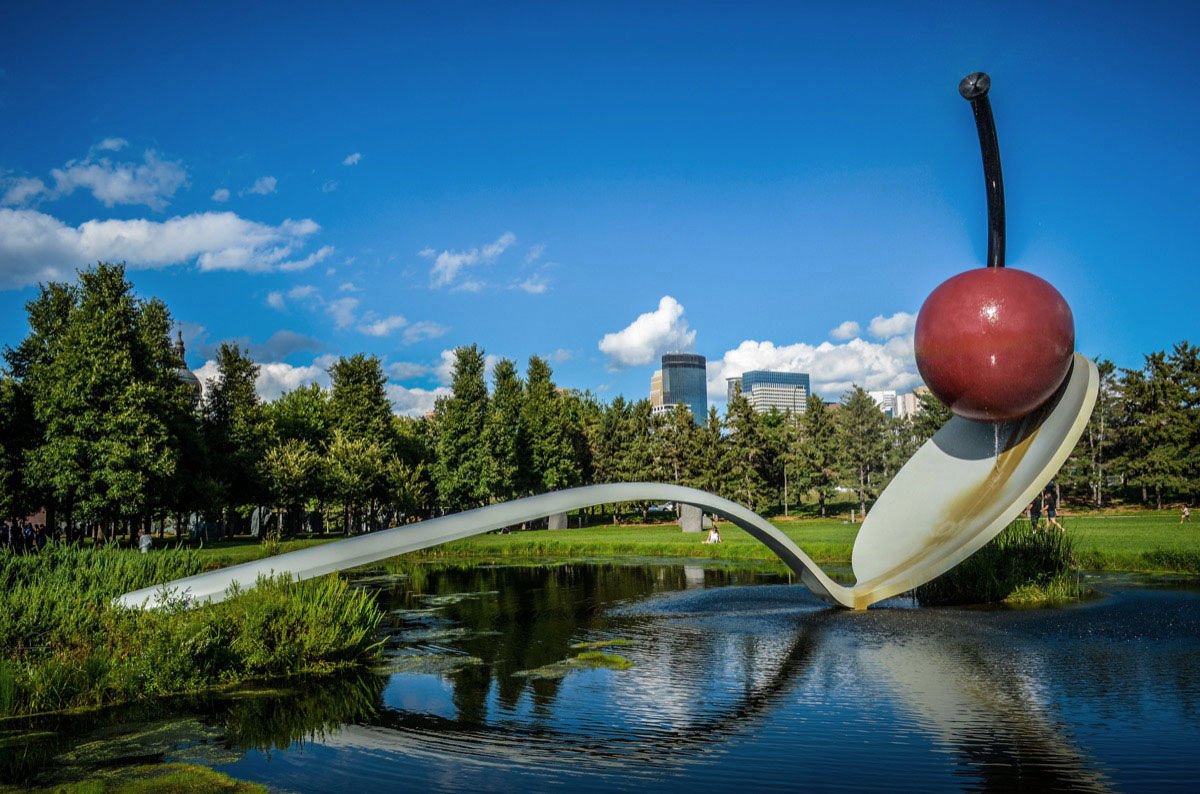
I always have been particularly delighted by the “big food” Pop Art sculptures. It’s hard not to smile when encountering a giant spoon holding a cherry, a massive, melting ice cream cone plopped down atop a building or a Paul Bunyan size hamburger. Credit for these whimsical creations goes to Claes Oldenburg and Coosje van Bruggen.


Pop Art is defined as a fine art, sells for exorbitant sums and can be found in museums and public spaces worldwide. However, another group of big foods exists that seems identical in nature, but without the fine art pedigree. I’m equally fond of these objects known as roadside attractions. If any of them were relocated to the lawn of an art museum, I think they would immediately be “transformed” into fine art.

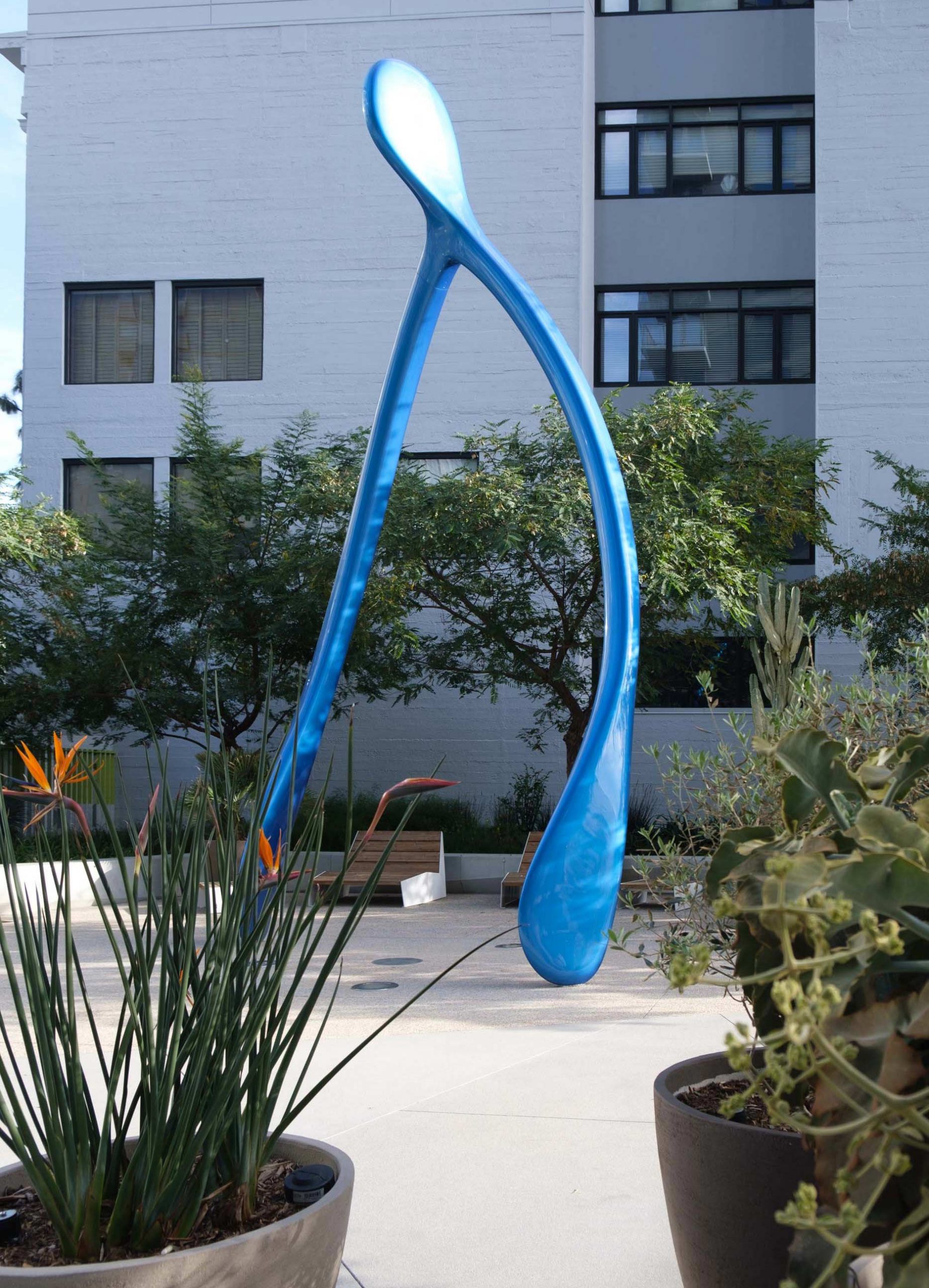
A newly minted, 24-foot tall, food sculpture recently came on the scene in downtown LA. Entitled Lucky Break by American artist Jonathan Paul, it is extremely apropos for this week. You can decide for yourself if it’s fine art or another roadside attraction. Good Luck!

Metropolis Magazine
0

Natives

Our fields are full of world travelers. A person attempting to eat plants native to his or her own continent would be facing a severely depleted dinner plate. Seeds like to take journeys.

I’ve long been fascinated with origins, and that includes the ancient origins of food. Many of the most common foods have taken incredible journeys before ending up in American fields and gardens.

See if you can guess the origins of these six plants: peanuts, potatoes, tomatoes, rice, blueberries and carrots. Don’t feel bad if you don’t score 100%, most answers are not obvious.

Peanuts, a legume of the pea family, originated in Peru or Brazil. Explorers introduced peanuts to Spain and Portugal and from there more Spanish explorers and traders took peanuts to Asia and Africa. In the 1700s, peanuts returned to the Western Hemisphere when African slaves brought them to North America and the Caribbean.

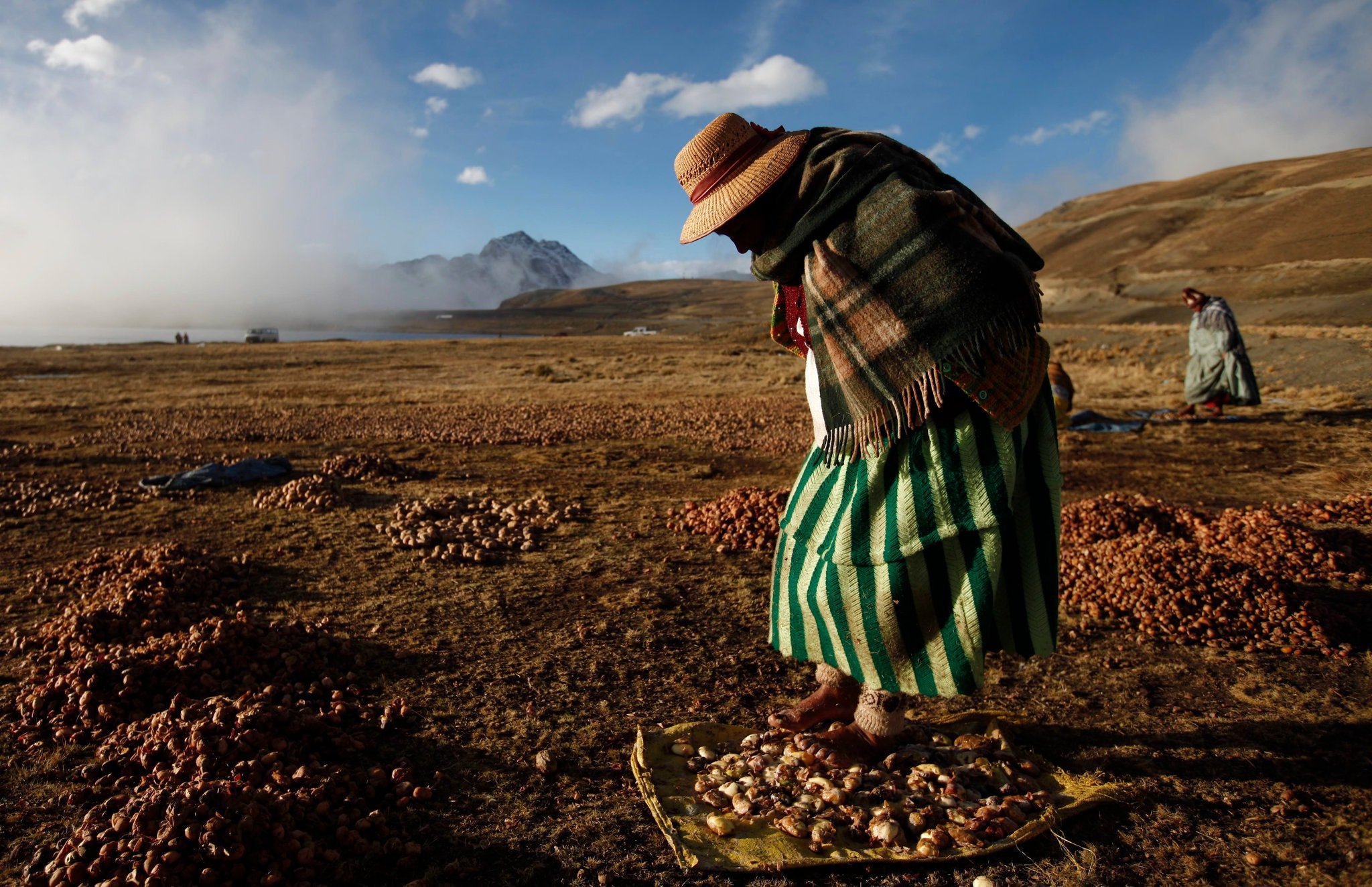
Potatoes are native to the Andes Mountains in Peru and Bolivia where they have been cultivated for thousands of years. The Incas discovered how to preserve their spuds by piling them outside on freezing mountain nights and then stomping on them with their feet to dehydrate and mash them. These “freeze dried” potatoes are called Chuño which is eaten in Peru to this day.

Tomatoes also originated in the Andes Mountains in what is now Peru, Bolivia, Ecuador and Chile. The Incas cultivated them as early as 700 AD. Tomatoes came to Europe in the 16th century but were used only as an ornamental plant as the tomatoes were thought to be poisonous. It was not until the aristocrats stopped eating off their pewter plates that tomatoes were exonerated. The high acid content in the tomatoes leached the lead out of the pewter and, voila, lead poisoning.

Blueberries are one of the few fruit species that are North American natives. Therefore, the saying “As American as apple pie” should be retired. Apple trees originated in Central Asia. “As American as blueberry pie” is true blue.

Carrots originated in the hot, dry lands of Iran and Afghanistan around 3,000 BC. In ancient times they were yellow, white or purple. Our familiar orange carrots were bred in the Netherlands in the 17th century and this may have been in tribute to William of Orange who led the struggle for Dutch independence.

Rice, which feeds more people than any food in the world, is from Asia. Current research indicates that it was first domesticated in the Yangtze River Valley in China. It is interesting to note that American wild rice is a native of North America. However, it is an annual aquatic grass, not a grain, and in a separate genus from true rice.

Happy eating!

Ramona Bustos walking barefoot on potatoes to create chuño, a freeze-dried Andean staple, near La Paz, Bolivia, in 2013.Credit… NYT/Juan Karita/Associated Press
0

Stove

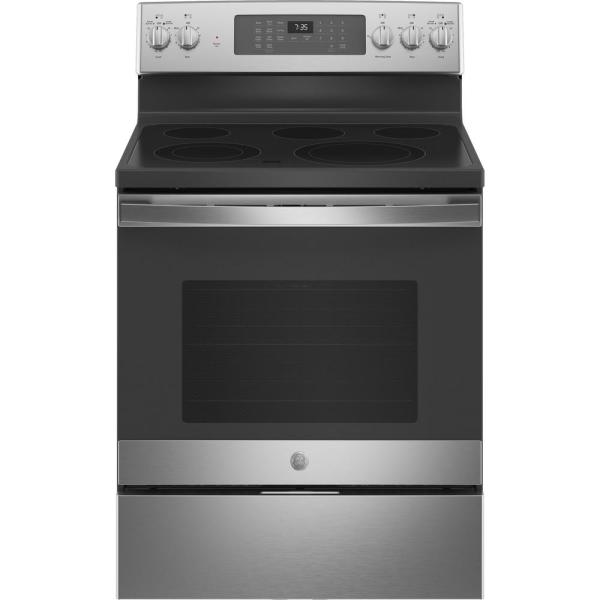
We had a little explosion here a few weeks ago. I was standing beside my stove making dinner when there was a huge pop followed by smoke. The repairman was called, but we had to wait a week for his arrival. His diagnosis was not good: “This stove might kill you if you try to use it.”

So I found myself completely stressed out not only by the election but also by a range that wanted to electrocute me. Things got worse when the repairman explained he could replace the burned-out parts in the oven to the tune of $450, but that might not fix the problem. He could plug it back in after the repairs only to have it short out and explode again, taking our $450 with it. Note that this is the advantage of having a repair person who does not work for a store that sells appliances. He was not trying to sell us a new stove; he was simply telling us the truth.

In less than 24 hours we managed to check out product reviews online and visit all the appliance stores within a 30 mile radius of our house. Here is what we learned:

Stoves are in short supply at the moment. Some are back ordered  for as much as five months.

Almost all flat-topped stove elements are manufactured by one supplier and are thus identical no matter how much the range costs.

Stoves have a short life span. I learned this when complaining to a salesperson that my stove was a mere ten years old at the time of its demise. “You actually got lucky,” he said, “they are designed to last seven years.”

And, finally, here is something I learned when I bought my previous electric range ten years ago. None of them come with electric cords. If you want to plug your stove in, the store will sell you a power cord for $30 extra.

Our new stove is arriving this week. I am feeling lucky that we are able to afford this unexpected purchase and I’m not waiting five months to get it. But I’m not feeling so lucky that I will be out buying another new range again in seven years.

My mother had a stove that lasted her entire married life…almost sixty years. These are rip-off times that we live in.

0

Presidential

Since today’s momentous election is on everyone’s minds, I thought it might be a good time for some interesting, funny and weird facts on past Presidents. The historical data is copious, and I have done careful fact-checking while compiling this list. For example, contrary to a wildly popular legend, William Taft did not get stuck in the White House bathtub.

  • America has had 45 Presidential elections. Thus far, it’s an all-male club.
  • Only two future Presidents were signers of the Constitution, George Washington and James Madison.
  • James Madison was the shortest President at 5 feet 4 inches. Abraham Lincoln and Lyndon B. Johnson tie for the tallest at 6 feet 4 inches.
  • Three Presidents died on the 4th of July. John Adams and Thomas Jefferson both died on July 4th, 1826. James Monroe died on July 4th, 1831.
  • Martin Van Buren, the 8th President, was the first President born a citizen of the United States of America. He is also the only President to speak English as a second language. His first language was Dutch.
  • The 9th President, William Henry Harrison, died 32 days after he came into office. His grandson, Benjamin Harrison, was the 23rd President and served one term.
  • America’s 10th President, John Tyler, had 15 children, 8 by his first wife and 7 by his second spouse.
  • Franklin Pierce, the 14th President, was arrested for running over a woman with his horse. He was not convicted because of insufficient evidence. President Pierce was known to have a drinking problem.
  • Abraham Lincoln enjoyed frequent wrestling matches as a young man and he almost always won. His love of the sport is recognized at the Wrestling Hall of Fame and Museum in Stillwater, Oklahoma.
  • President Grover Cleveland is the only President to serve two non-consecutive terms in the White House making him the 22nd and the 24th President. He is also the only President to have been married in the White House. In addition, his 21-year-old bride, Frances Folsom Cleveland, was the youngest First Lady in history.
  • Woodrow Wilson, the 28th President, was the only President with a Ph.D.
  • Warren G. Harding, President number 29, gambled away a set of White House China at one of his twice-weekly poker games. His group was nicknamed “The Poker Cabinet”.
  • The 31st President, Herbert Hoover, spoke fluent Mandarin Chinese and often did so with his wife while living in the White House. Before becoming President, he was a mining engineer in China.
  • Theodore Roosevelt and Franklin D. Roosevelt, Presidents 26 and 32,  were 5th cousins. Plus, Franklin D. Roosevelt and his wife Eleanor were 5th cousins once removed.
  • The “S.” Initial In Harry S. Truman is an initial but is not a middle name. His parents used the middle initial as a tribute to both his grandfathers, Anderson Shipp Truman and Solomon Young.
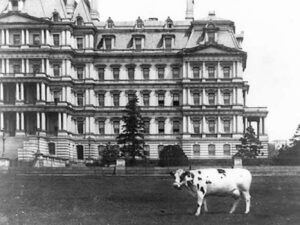
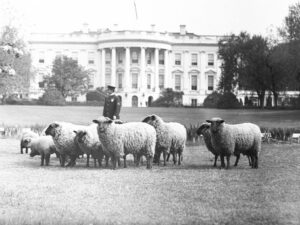
  • The majority of Presidents had pets at the White House, with dogs being the most numerous. But there were others!


0