Pink

The New York Times recently ran a rosy hued obituary. Don Featherstone, the man who invented the pink flamingo lawn ornament, died this summer at 79.

Mr. Featherstone, who called his creation Phoenicopterus ruber plasticus, was a graduate of the Worcester Art Museum school. Plastic was taking over the world in those days. So immediately after graduation in 1957, he took a job at Union Products, a firm in Leominster, Massachusetts, that made plastic lawn ornaments. He remained there for the next 43 years, eventually becoming president and part owner.

His first assignment was to make a 3D duck. He bought a real duck, named it Charlie, studied it for six weeks and sculpted the product. The duck lawn ornament was a hit, so his bosses suggested another bird assignment……flamingos. This time Mr. Featherstone relied on National Geographic photos for models. The finished product sold in the Sears Catalog for  $2.76 a pair and came with instructions: “Place in garden, lawn, to beautify landscape.” The rest is history.

His iconic birds have won many honors. In 1996, Mr. Featherstone was presented an Ig Noble Award, an annual prize honoring unusual achievements. And in 2009, the Madison, Wisconsin, City Council made the pink plastic flamingo the city’s official bird. ( This action came shortly after 1,ooo of the birds mysteriously appeared on the University’s Bascom Hill one morning.)

Don Featherstone led a happy, humble and zany life. He and his wife, Ruth, kept a flock of 57 plastic flamingos in their yard each summer. For the last 37 years, he and Ruth have worn matching, themed clothes each day, all sewn by Ruth.

On the event of the flamingos’ golden anniversary, Mr Featherstone quipped,”We sold tropical elegance in a box for less than $10. Before that, only the wealthy could afford to have bad taste.”

pink

0

Beatrix

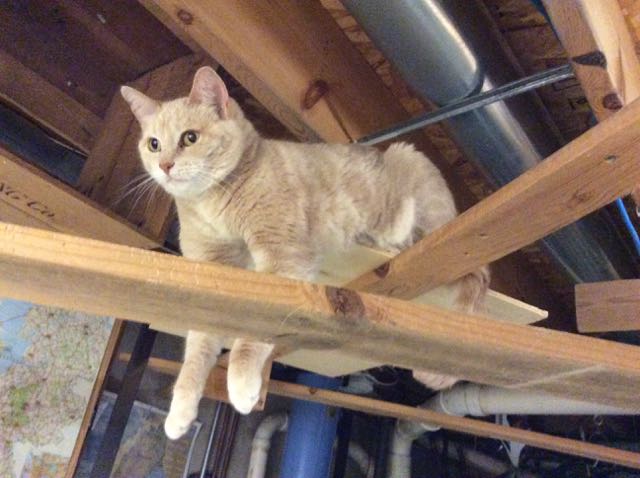
Our cat, Beatrix, had a ride in a tow truck last week. The main cause of her adventure was my car. It has had three engines in the last three weeks.

Beatrix was also partly responsible for ending up in the wrecker. She had refused to cooperate when my husband tried to give her a booster shot which our vet said could be administered at home. My husband doesn’t give second chances. He put the girl in her carrier and drove 30 miles to the vet clinic where the vet tech showed her who was boss. The deed was done in a second, and cat and husband were heading home when the car’s overheated engine light flashed on.

Three weeks earlier, my car’s original engine had died, apparently wanting to end its life at 200,000 miles. We opted to do the reycle thing and had a used, low mileage engine installed by our local Hyundai dealer. This replacement engine expired a week later, the dealer gave us another loaner car and put in yet another used engine.

My guy didn’t miss a beat when he found himself stalled on the Interstate with a miffed feline. He called the dealer immediately. A tow truck was dispatched, and both cat and husband got to ride up high in the front seat like road warriors. They were given the same loaner car to get home, and I believe we may have squatter’s rights to it.

IMG_1978

0

Intruders

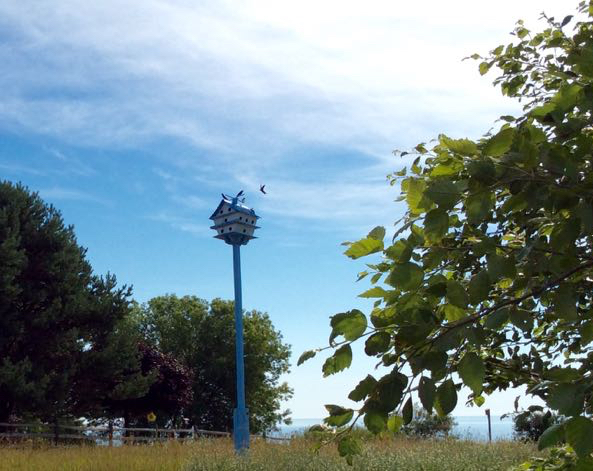
Last Monday we woke up to silence. Our tenants had left on their long southern journey. No longer would our yard and sky be filled with rich, trilling songs.

Anyone who has ever hosted purple martins understands our love for these mesmerizing birds.

We eagerly await the arrival of the scouts in April. When our apartments are chosen, we revel in our good fortune. Once again, our martins arrived right on schedule.

This spring was going well for about three weeks. Then I spotted a starling on the roof of one of our Martin houses. My heart sunk. Starlings are more aggressive and larger than martins. They can take over the martin houses and drive away the martins and kill their babies.

I immediately called a local nature center for advice on how to prevent an invasion. “Starlings aren’t a protected bird,” the naturalist informed me. “Get out a pellet gun and shoot it.”

“I don’t own a pellet gun, and if I did, I would probably hit a martin or shoot out my neighbor’s windows,” was my reply.

I hung up and called Cornell University, America’s leading bird researchers. “We do not recommend shooting the starlings,” was the immediate response. “Unintended bad consequences often occur. Let nature take its course and hope you get lucky.”

Doing nothing is tough advice. We watched a pair of starlings build a nest in one of the upper apartments. The only thing we could do was remove all the suet from our bird feeding station. Starlings love suet, and we didn’t want to put out an invitation for more to come.

The weeks of summer sped by. No more starlings arrived, and our martin flock remained. By late July, little heads were poking out of the house openings and clamoring to be fed. Martins were swooping and singing in our skies from dawn to dusk delivering insects to their youngsters.

Now our flock is on its long migration to Central America or Brazil. Since many more birds left our apartment complex than arrived in spring, we are rejoicing in the birds’ successful parenting.

This winter my husband will have a large carpentry project. Both bird experts suggested building “excluders” for the apartments’ entry holes. These make the holes too small for starlings, but a perfect fit for the more svelte martins.

We are trying hard to be good landlords.

martins

0

Dragonflies

They are a bug that is easy to love. Dragonflies are sensational little drones, and they recently took over our lakeshore.

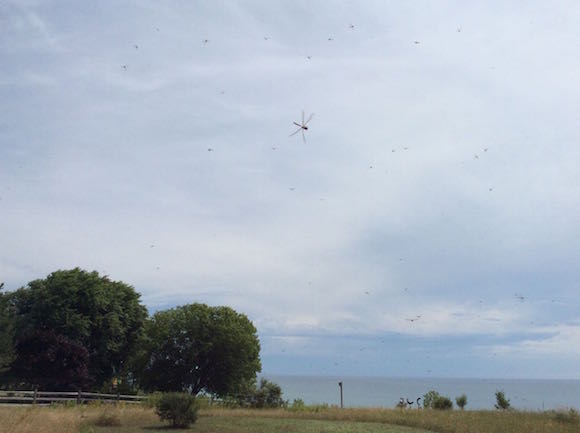
We woke up one morning last week to a yard alive with hundreds of these aerodynamic insects. Not being an entomologist, I can’t identify which of the 5,ooo species we are hosting. But I do know they are huge and clearly visible in the below photo of our front yard.

DF_MT

For a week, our yard resembled an air show. These creatures are amazing aviators who can mimic a helicopter and more. Dragonflies can fly straight up, down, backwards, hover and change direction quickly. And all the while they are grabbing prey with their feet and filling their mouths. One dragonfly can gorge on hundreds of mosquitoes a day.

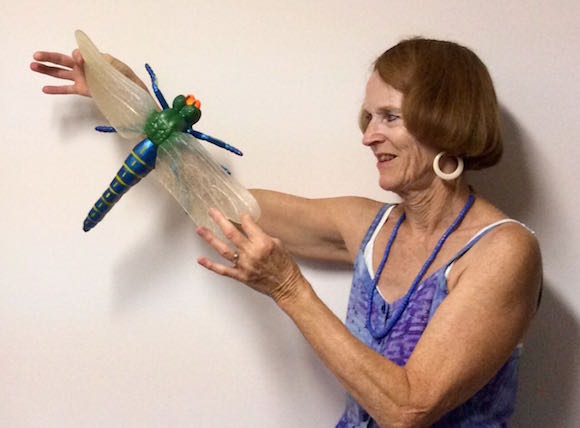
Dragonflies, one of the first winged species, existed before dinosaurs, evolving over 300 million years ago. The fossil record shows that their wingspans in the Paleozoic era reached a whooping two and a half feet. Our modern dragonflies’ wings measure two to five inches.

DF_Fun

Belonging to the order Odonata, these fliers undergo incomplete metamorphosis, in other words, they skip the pupa stage. The larva, which have gills, live solely in water for several years and eat aquatic insects, tadpoles and small fish. When the time to grow up arrives, the larva crawls out of the water and gulps air to expand. The outer skin splits and the adult dragonfly crawls out. After drying its wings, the newly minted dragonfly darts off. Most live less than a month.

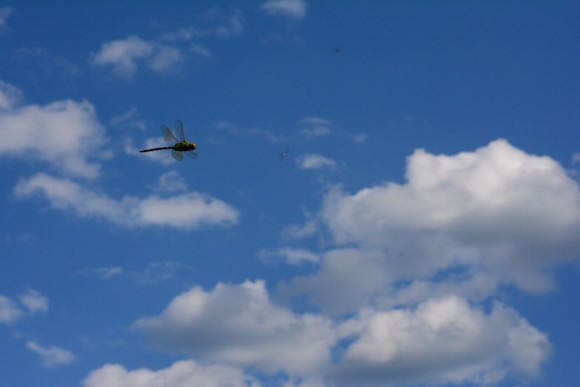
One of our neighbors spent hours with his camera and tele photo lens and captured this image…not an easy feat when the subject matter is zig zagging at thirty miles per hour.

DF_Joe


0

House

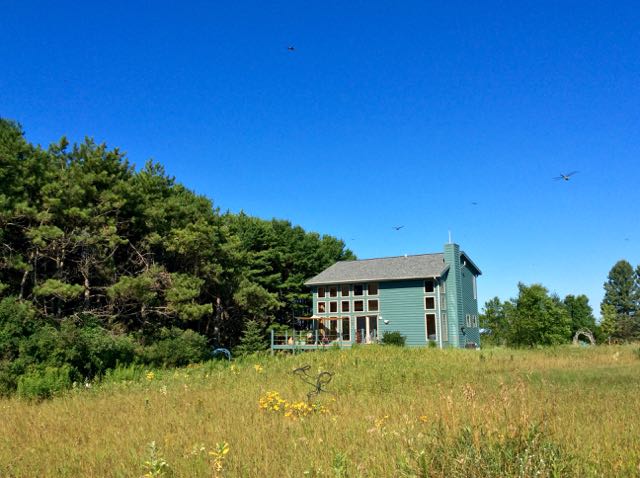
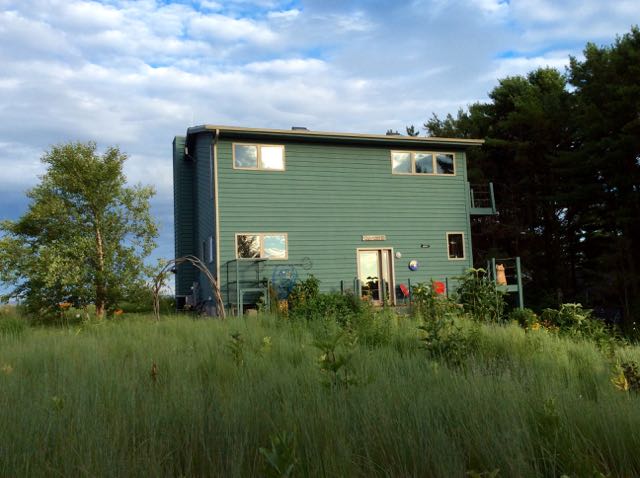
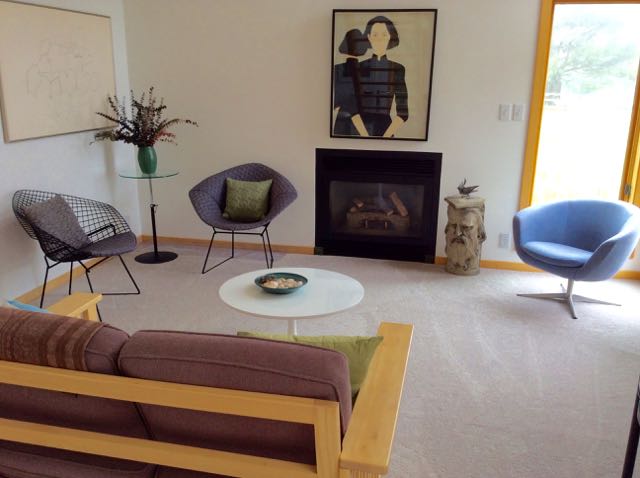
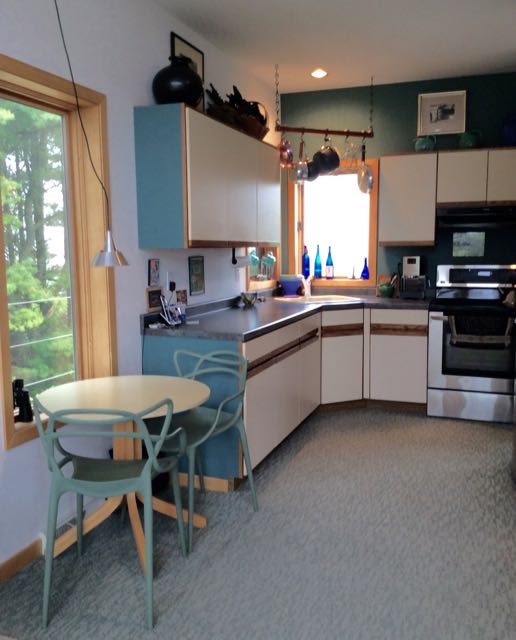
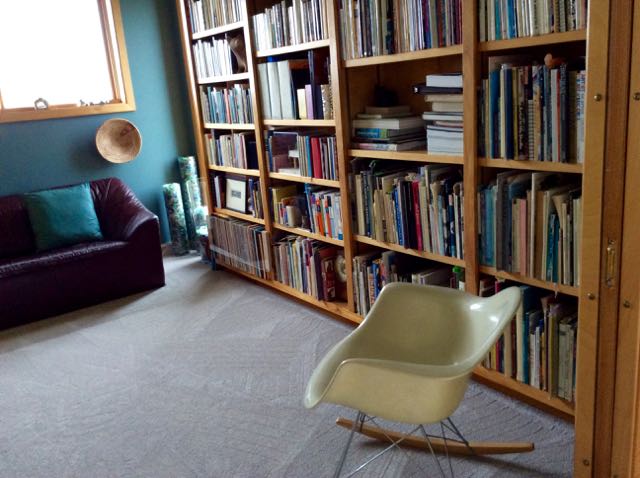
Twenty years ago, I embarked on the largest art project in my life. My husband and I collaborated to design our house. We challenged ourselves to plan a small (1,2oo square feet) well proportioned, easy to maintain and affordable house. In addition, we wanted the design to compliment the furniture we bought in the early years of our marriage. And finally, we wanted to enjoy the process and still be best friends when we moved in.

Before we began, two friends, one an architect professor and one a building contractor gave us brilliant advice. The professor told us, “On your budget, you can only build right angles; i.e., a box.” The contractor said, “On your budget, you can’t have anything custom made, all components have to be standard, ready made sizes.”

We do believe in listening to people who know more than we. Dreams of curved walls, odd shaped windows, exotic materials and unique built-ins were quickly scuttled.

Our first sketch was done on a napkin in a spaghetti restaurant. The elevations and floor plans were done on my husband’s Mac. We had a structural engineer check our final drawings to make sure our lovely design wouldn’t fall down on our heads.

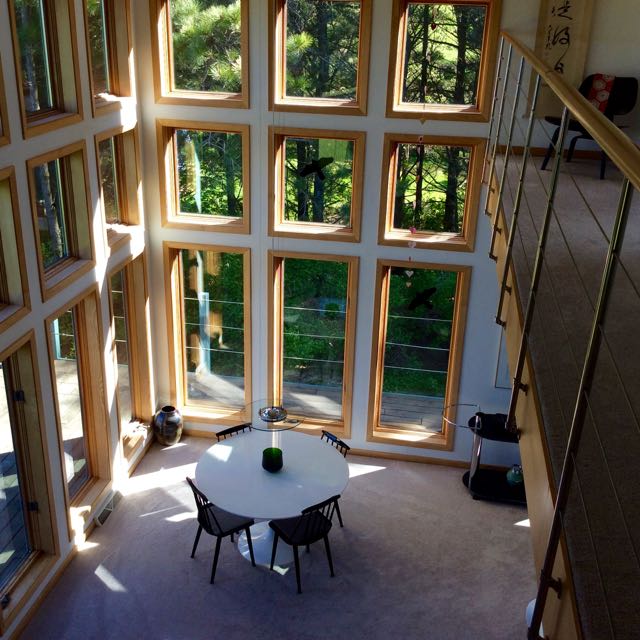
The hardest part of the design process was thinking in 3D. We resorted to standing on a ladder in the framed house in an attempt to get the correct sight lines for the windows. I still do not understand stairwells, but, fortunately, my husband could visualize them correctly.

We have begun the twentieth year in our home, and every day we are still amazed that we have the good fortune to be here.

0