Pasta

My paternal grandmother knew how to multipurpose her kitchen chairs. She hung her pasta to dry over the chair backs. Being thoroughly German, grandmother made noodles. The noodles were used mainly for her wonderful homemade chicken soup. Leftover noodles were fried in butter for a quick, easy supper.

I never learned how to make pasta from her, and my mother was strictly a Creamettes woman. My lack of ability in the homemade pasta department, however, does not disqualify me as a member in good standing in the pasta fan club. A week without pasta is a sad week and a two pasta week is not excessive.

Pasta in its multiple shapes and sizes is the ultimate comfort food. Even the names of pastas are delightful….

Conchiglioni- large shells
Farfalle- butterflies
Orecchiette- little ears
Radiatore- radiators
Rotelle- little wheels
Mostaccioli- mustaches
Vermicelli- little worms

Turning pasta into a delicious, anticipated meal can take fifteen minutes or be a major production. Cooks of all ability levels can get satisfaction from creating a homemade pasta dinner. Boxed or frozen pasta entrees seem superfluous.

Pasta also gets stars for being an economical entree. Pasta, baby peas, a dollop of butter, fresh basil, lemon rind and a sprinkle of grated Italian cheese is a feast which costs little to concoct. The leftover money can be spent on wine.

One of my favorite children’s books is “More Spaghetti, I Say”, by Rita Golden Gelman. The main character, a monkey named Minnie, has a spaghetti fixation:

“I need more. More spaghetti, I say. I love it. I love it so much!
I love it on pancakes with ice cream and ham. With pickles and cookies, bananas and jam. I love it with mustard and marshmallow stuff. I eat it all day. I just can’t get enough.”

My sentiments exactly.
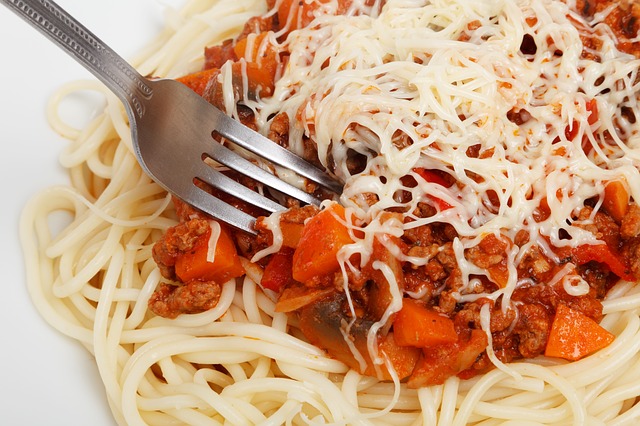
0

Wrapped

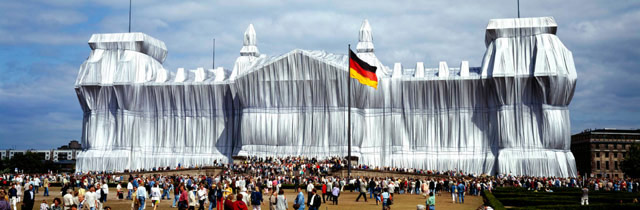
Christo and his late wife, Jeanne-Claude, are internationally famous installation artists who wrap things up. Whereas we ordinary people wrap packages and presents, this couple thinks more monumentally. They have wrapped the German Reichstag, an ancient Roman wall, a Spoleto fountain, a medieval tower, the Chicago Museum of Contemporary Art, a coast in Australia, a park of trees and the Pont Neuf Bridge in Paris.

When not wrapping, the pair has surrounded eleven Florida islands in shocking pink fabric, erected 1,340 blue umbrellas in Japan and 1,760 yellow umbrellas in California. Millions of visitors viewed their 7,503 orange fabric gates in Central Park.

Christo and Jeanne-Claude were born on the same day, June 13, 1935, he in Gabrovo, Bulgaria and she in Casablanca, Morocco of French parents. The two met in Paris in 1958 when Christo painted a portrait of Jeanne-Claude’s mother. They began collaborating on art projects in Europe, moved to America in 1964 and made New York their home base. Both became American citizens. Years of teamwork ended in 2009 when Jeanne-Claude died from a brain aneurysm.

According to the couple, the purpose of their gigantic constructions is to create works of art for joy and beauty. They financed their works entirely through selling the preparatory drawings and collages for the projects. No licensing deals were ever entered into, and all workers on their installations were paid. The locales where their artworks were constructed reaped huge windfalls of tourist dollars.

Although all of their works took years or decades to come to fruition, none exist at the moment. They were all created to be temporal; some existed only a fortnight.

Until last week, Christo was working on the final stages of his largest project, a silvery, 42 mile canopy floating over the Arkansas River in Colorado. He has invested over 20 years and 15 million of his own dollars into “Over the River”. The artist now has cancelled the project.

An excerpt from an interview of Christo by a New York Times reporter follows:

“Christo said the Job-like patience required in seeking approval for his projects has always been an element of the spirit of the projects themselves. He needs to feel passion about them, in the same way a more traditional painter and sculptor does, he added. But in this case, ‘that pleasure is gone because of the nature of the new administration. I am not excited about the project anymore’, he said. ‘Why should I spend more money on something I don’t want to do?’ “

Perhaps Christo could become interested in wrapping The Statue of Liberty. That would be apropos of the moment.

Christo and Jeanne-Claude Wrapped Reichstag, Berlin 1971-95 Photo- A. Kasimir Ciesielski C1995 Christo | by www.admsp.org
0

Nuts

One of our best Christmas presents was a fifty pound bag of peanuts. Two people and a herd of cats obviously cannot eat an almost unliftable bag of nuts. The squirrels in the Tooley Café, however, are in an elevated state of bliss.

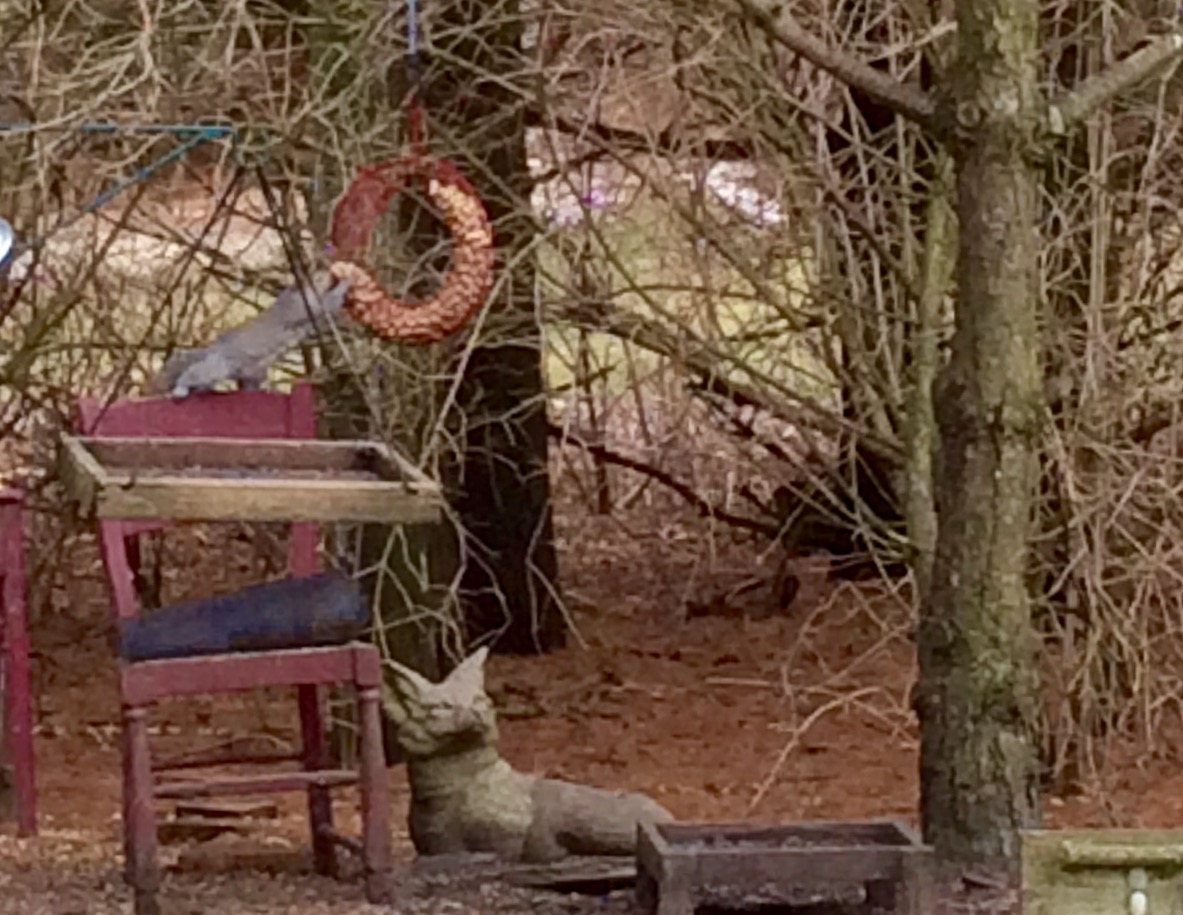
The peanuts came with a red, metal, doughnut-shaped dispenser. Minutes after we hung the contraption from a branch in our Café the squirrels arrived, both the big grays and the little reds.

They use two methods to get at the treasure within; the top down approach via branches and the bottom up approach. The Tooley Café chair (which washed up on the beach one day) is used for the later.

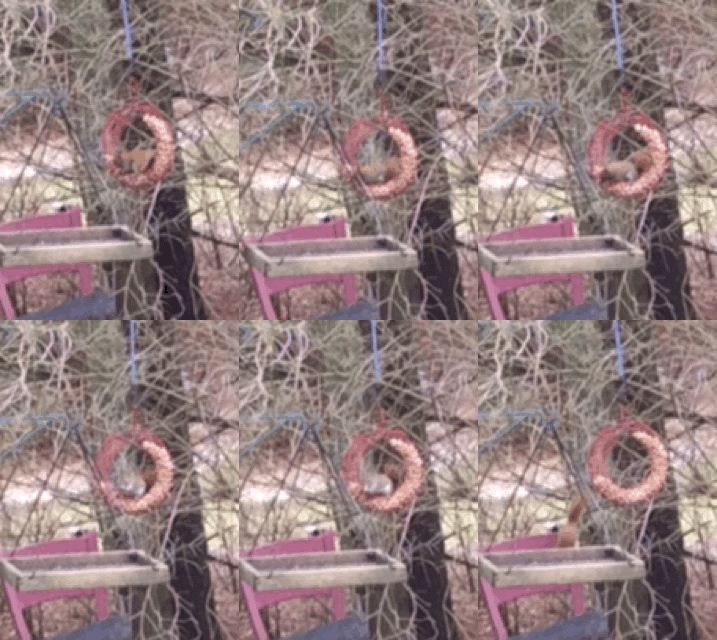
The squirrels take turns pulling out the nuts, racing away with the nuts in their mouths and shortly returning for more. We deduce there is a lot of caching going on here. Either that or our squirrels just like to eat in privacy, and we’ll soon have the fattest squirrels in the neighborhood.

The squirrels do have some competition. Our resident family of five blue jays loves the peanuts. They wait patiently on a branch a few feet above the feeder for a squirrel to leave. Then they jump down to extract a nut before a squirrel returns. They have to work hard to free a nut from the metal cage; beaks apparently aren’t as skilled at this task as squirrel paws. After scoring the peanuts, the jays fly up onto a higher branch and bang the nuts on the branch until they open.

Thus far, despite the flurry of activity, harmony reigns around the feeder, with one exception. One jay finds it easier to grab the peanut out of his friend’s beak than to do the work of extricating it from the cage.

There has been a new development the last several mornings. The squirrel feeder is missing when we wake up. My husband has to go searching for it in the woods. This has all the earmarks, or paw marks, of raccoons. Apparently, there have been some big peanut parties in the woods at night lately. The squirrel feeder now has a curfew… it goes into the garage when night falls.

0

Wintry

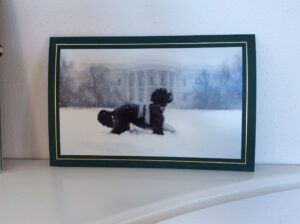
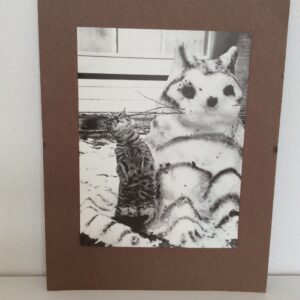
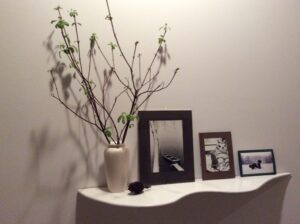
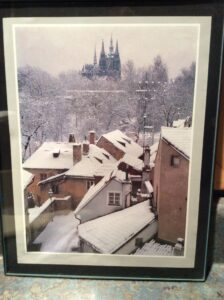
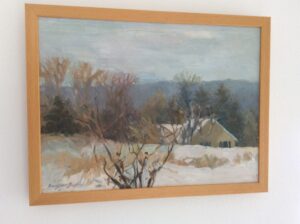
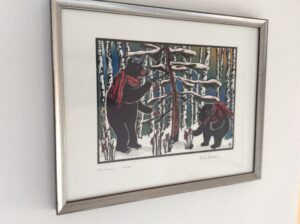
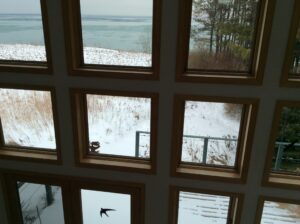
About three week ago, I got winter out of the closet. Ever since studying Japanese art in college, I have followed the Japanese concept of living with artworks in tune with the seasons. So when the first heavy snowfall covered the ground, the time had come to bring out the winter pictures.

Over the years I have gathered a collection of art and ephemera from multiple sources. I have bought wonderful art in galleries, but also from thrift stores. Many of our artworks have been gifts from artists, others are pictures I’ve cut out of magazines and discarded library books. I am also a devotee of affiche…..I’ve been known to remove posters from walls, but only after the event advertised on them has past.

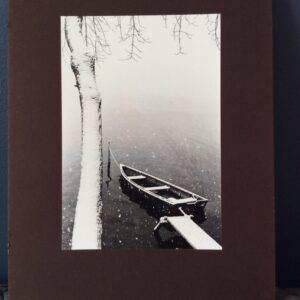
Our art is displayed throughout the house. We do not have a tokonoma, a Japanese alcove for displaying seasonal art, but our white wavy shelf serves that purpose. Here is our winter gallery, provenance included.


0

Zamboni

I’ve noticed an uptick in news from Canada lately, perhaps because Americans are suddenly more aware that a nice country exists above us. Personally, I like the fact that if I left my house after breakfast, I could drive to Canada for dinner. It’s a comforting thought that good neighbors are nearby.

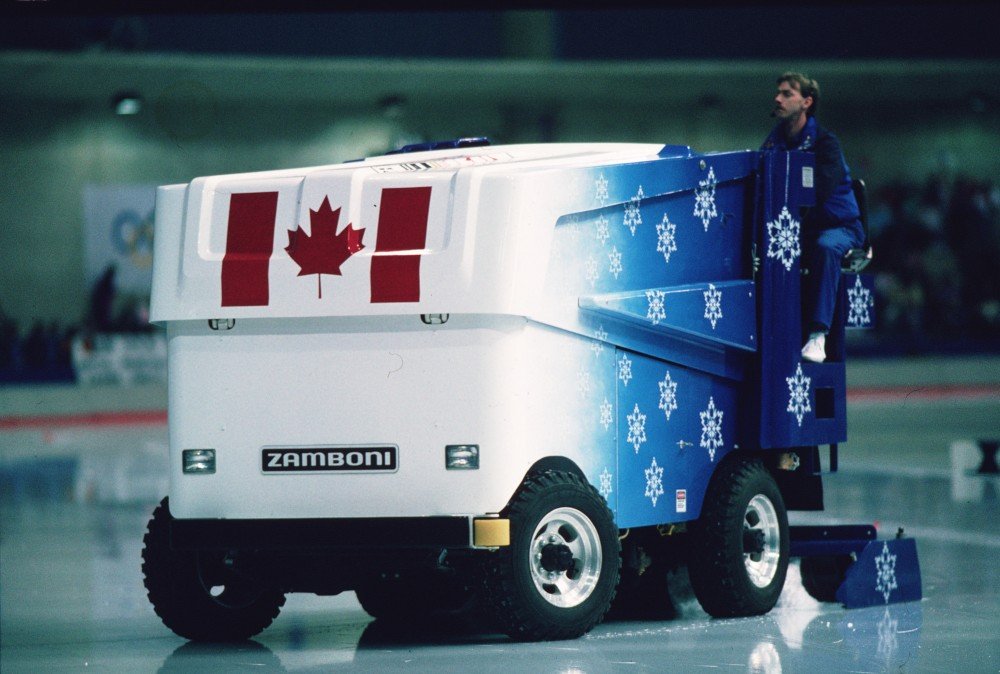
A hot, or perhaps I should say cold, news item from Canada recently reported about a man and his Zamboni. Jesse Myshak of Alberta purchased a Zamboni to care for his backyard rink. The ice surfacing machine needed some repairs so he worked on it at his shop over a mile from his residence. When the work was completed, he decided to drive it home which elicited some good natured ribbing from the guys at his shop. They suggested he drive it to Tim Hortons, that most iconic of Canadian institutions. And that is exactly what he did, down the city streets at a slow crawl to the drive in window where he got a hot chocolate. The lady in front of him even paid for his drink. His short jaunt produced much laughter and an outpouring of Canadian pride from his townspeople.

The previous year, three other Canadian guys made Zamboni news. They wanted to have glassy, manicured ice for their neighborhood rink but could not afford the six figure price of a genuine Zamboni. So they got together in a garage one afternoon, started tinkering around and built their own.

One of the team explains, “It’s built mostly out of PVC piping, and there’s a big tank that goes on the back of a side-by-side, and some valves and other stuff from the local hardware store.” A spout sprays warm water on the ice and a large beach towel attached to a mechanical arm buffs the ice. Their contraption is a resounding success.

Americans aren’t the only ones with ingenuity.

www.industrytap.com/how-zamboni-became-the-most-famous-name-on-ice/8844
0