Obituary

I do not make a habit of reading the obituaries. But when the obituary is on the front page of the New York Times and is for a person I’ve never heard of, my curiosity is aroused.

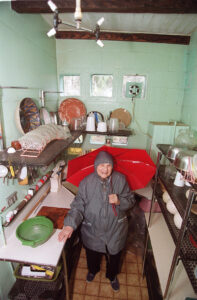
Frances Gabe died at the age of 101 in Newberg, Oregon, her longtime home. The photo accompanying the article shows Mrs. Gabe in full rain gear and open umbrella standing in her kitchen. That’s because her claim to fame was designing and building the world’s only self-cleaning house.

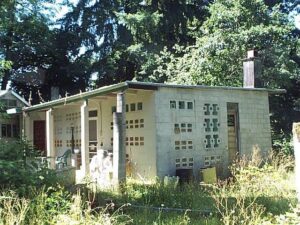
The cinder block bungalow took decades to plan and 10 years to build. Completed in the 1980’s, the 1,000 square foot house cost $15,000 and was patented.

She credits her children and jam as her inspiration. One day her kids got fig jam all over a wall and, in frustration, she hosed it down.

Most mothers of young children have had similar experiences. I recall looking at my son’s high chair after he ate spaghetti for the first time by himself and wondering if I would survive all the messes ahead. After that spaghetti-eating boy grew up and was a father himself, he once threatened to stick a garden hose in the kitchen window and hose the whole room out.

Mrs. Gabe simply made our fantasies come true…..she turned the entire interior of her home into a car wash or gigantic dishwasher. Ceiling jets sprayed down, suds flew, fans dried and water exited via floor drains out through the doghouse. Clothes on hangars were washed in a tightly sealed cabinet and mechanically transported back to a closet. The patent on the house consisted of 68 individual inventions.

In fascination, I’ve read numerous articles and watched videos (click here) about the house and its unique inventor.

Here’s the sad news. One article reported that “Ambitious as it was, it didn’t really seem to work, video clips of the home in action are more like blooper reels.”

Here’s my take on the house from my minimalist viewpoint. It’s probably easier to get out the bucket, scrub brush and vacuum than deal with 68 different gadgets which will inevitably need constant maintenance and repair.

The new owner of the house has removed all the cleaning gadgets. That’s also sad, the house should have been turned into a museum to the eccentric spirit.
0

Door

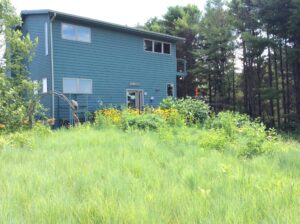
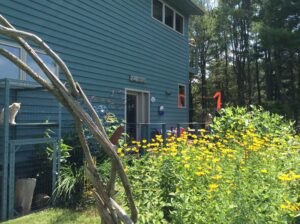
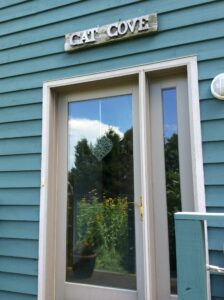
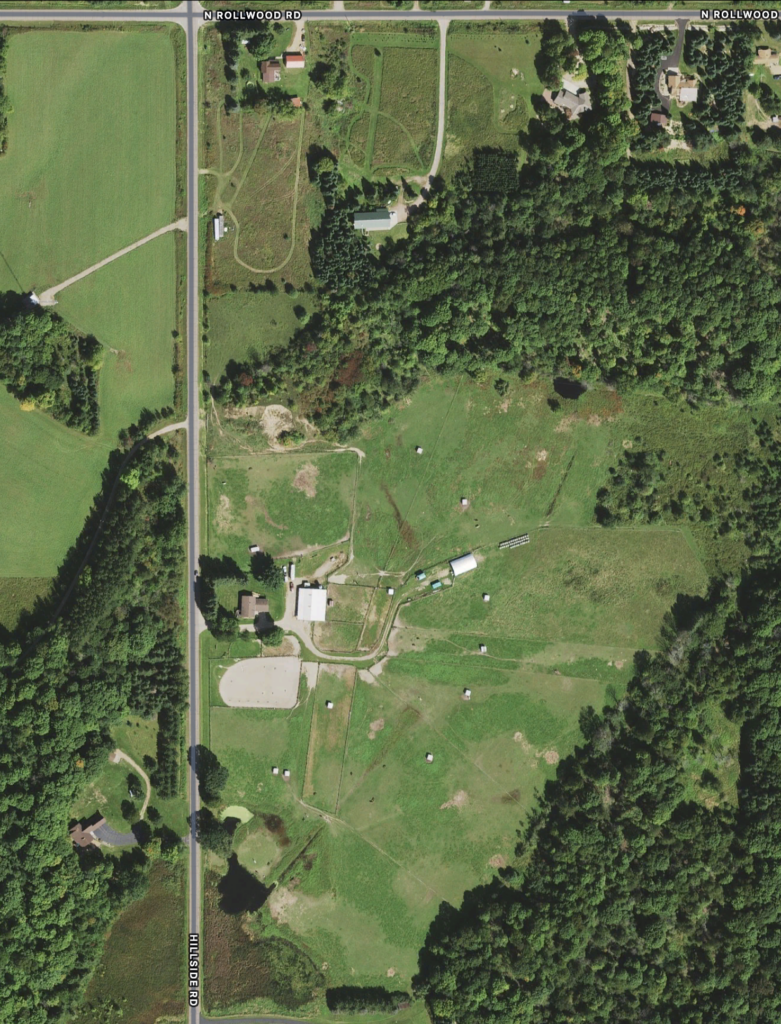
If you visit our house, please do not attempt to use our front door. Thanks to the consequences of our gardening efforts, our front door is no longer accessible. We did not intend to make this door private, but sometimes nature just takes charge.

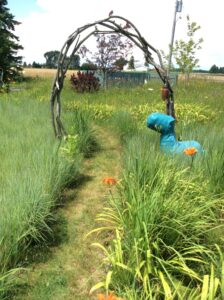
For the past 21 years, my husband and I have been striving to create a prairie that extends from the front of our house almost to the road. Growing little blue stem prairie grass from seed turned out to be a daunting challenge. To give the grass every chance to thrive and not get trampled on, we created a path from the far end of our driveway around the periphery of the blue stem up to the front door. The path is ordinary grass and clover and is marked by three driftwood arches.

To shelter our prairie grass and flowers, we planted little pines and Cleveland pear trees between the road and the prairie to make a wind block. The westerly winds that blow in over the open fields across from us are mighty.

Years passed and the little trees became big trees, their branches and boughs extending over one entire side of our path. Of course, we could get out the pruning shears and severely cut back the trees, or we could create a new path by mowing down the little blue stem. But neither of us have the heart to do this. We worked hard to help these plants thrive and we are happy they like living with us.

Fortunately, we have a side door right next to the end of our driveway. It’s our main door now and visitors can come in and upstairs to our home. Once inside, the front door leads to the deck and a lovely view of the prairie which is currently in full bloom. And the path under the arches remains …..all the way to a dead end. We wonder what nature has in store for us next.


0

Sandy

Say the word “sand” and most of us think of beaches, deserts or sandboxes. We don’t think of the word “scarce”. So I was surprised to come across a New Yorker article entitled, “The End of Sand”.

Living on top of a sandbox with a beach at the end of the yard, I thought I was fairly well versed about these teensy, tiny rocks. It appears I have much to learn.

For example, geologists define sand not by composition, but by size, the grains being between 0.0625  and 2 millimeters across. Next above it on the scale is gravel and below it is silt.

Sand is mostly quartz, the commonest form of silica, but ocean sand will have lots of shell pieces mixed in. The White Sands in New Mexico are gypsum and black sands are from volcanic rocks.

Rocks go through a rock cycle (the universe being crazy for circles) and one geologist notes that “perhaps half of all sand grains have been through six cycles in the mill, liberated, buried, exposed and liberated again”. We do live on a geologically active planet or, as I explain to my younger students, earth really does rock and roll.

According to National Geographic, deserts cover more than one fifth of Earth’s land. However, the majority of these deserts are not sand. Only about 10 to 20 per cent of deserts are sandy. The rest are made of gravels, boulders and various soils such as clay.

Now for the real surprise. As improbable as it sounds, the planet, or more correctly, the human species, is running out of sand. According to a United Nations report, “sand and gravel (aggregates) are the largest volume of raw material used on earth after water. Formed by erosive processes over thousands of years, they are now being extracted at a rate far greater than their renewal.”

How can this be possible?  An American Geological Society report states that the typical American house requires a hundred tons of  sand, gravel and crushed stone for the basement, garage and driveway, and more than two hundred tons if you include the street that runs in front of it. A mile long section of a single lane of an American interstate highway requires 38,000 tons. And we aren’t the only ones on the planet who are digging and dredging. China hopes to complete 165,000 miles of new roads by 2030…..that’s three and a half times the  length of our Interstates.

There is a conclusion to be reached here: go to the beach before it gets turned into a skyscraper, interstate, computer chip, fracking fill or artificial dune in front of some threatened oceanfront McMansion.

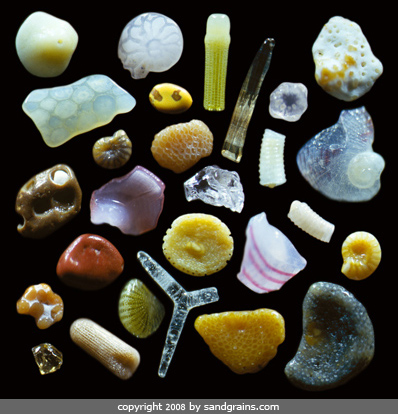
Magnified grains of sand.
Magnified grains of sand – Source http://sandgrains.com
0

Free

Last week, I was driving  home through a small town and spotted a little red and green plaid, upholstered couch curbside in front of a house. A hand lettered sign was propped up on the cushions:

FREE
NO BUGS

That brought a smile to my face. No highly paid  copy editor, I thought, could have expressed it more concisely.

Since I was not in need of a couch, even one sans vermin, I keep on driving. I’m sure our cats would have loved the sofa for cuddling and scratching purposes, but they will have to do without.

The funny sign got me thinking of things that are free. America is a place where a price is put on almost everything, including the space where you put your feet in an airplane or the air you put in your tires. Sometimes it seems like we are only free to be ripped off.

So I love a bargain, and getting something that is genuinely free is the ultimate bargain. But I am also somewhat of a minimalist and I don’t take free stuff if I don’t have a need for it.

Our home has many useful and beautiful things which have come without price tags. For example, I rescued my wonderful wooden palette and paint chest from a New York garbage can. Our beach glass collection is getting so heavy, I fear for the floor. A starfish sofa pillow washed up on the beach one night, and all our beach toys were gifts from the lake. I must add, however, that the waves recently took back all the beach toys.

One of my favorite things to get free are books. Every Saturday when we take our recyclables (and garbage) to the town’s recycle center, I get something in return. Our recycle lady selectively retrieves books that people toss in the paper recycle dumpster and has created an interesting little free library.

Perhaps my father is responsible for teaching me to find joy in the ultimate free things. I remember him often singing one of his favorite songs, The Best Things in Life are Free, which was written in 1927 for a musical called Good News. Click here for the Jo Stanford version.

0

Heroes

It’s the Fourth of July, and many of us are not in a celebratory mood. We are too consumed by fear that the precious remains of our Democracy are slipping away. But instead of expounding on our national nightmare, I would like to think of the greatness that remains in our country.

Heroes these days tend to be superheroes, fictitious characters that  swoop in and miraculously, and often violently, fix all problems. Real heroes, on the other hand, have strong moral compasses, incredible work ethics, unglamorous lives and the usual human failings.

The patriots I have in mind live in a modest mid century ranch house and were thrilled when a Dollar General store moved into their tiny rural town. They sleep in a Murphy bed when they visit their other place…The Carter Center in Atlanta, Georgia.

After leaving the White House in 1981, Jimmy and Rosalynn Carter went home to Plains, Georgia. Wishing to give purpose to their remaining years, they conceived the idea for the Carter Center. A nongovernmental organization, the Carter Center has three objectives: waging peace, fighting disease, and building hope.

I will site only one of their many achievements. The health initiative focuses on neglected and life-destroying tropical diseases. When the Center started working to eliminate Guinea worm disease, there were 3.5 million cases in 21 countries. In 2017, only 25 cases were reported worldwide……eradication is clearly in sight. This was accomplished with a small staff and a modest budget compared to other “charities”.

The two people who have done so much to improve the lives of millions worldwide are utterly human. Rosalynn was a teenager when she married Jimmy on July 7, 1946. She was a navy wife for the first seven years of their marriage and her husband was a nuclear physicist working on submarines. Then Carter’s father died and Jimmy decided to return to Georgia as there was no one else to run the family peanut farm business. Rosalynn loved the Navy life.

I must note that what I retell next I heard first hand from the Carters at a Carter Center meeting.

It seems that Jimmy Carter unilaterally made the decision to retire from the Navy and go home to Plains. Rosalynn was furious that she was not included in the decision making process. Being a true Steel Magnolia, she took action, or I should say, inaction. The long drive from Schenectady to Plains was a silent one……..she refused to speak to her spouse for days. President Carter now publicly acknowledges that he did not take the high or fair road in this situation.

In 2009, Jimmy Carter wrote an open letter to his church of 60 years, the Southern Baptist Convention, severing his ties because of the second class status they accord women. He has since been a champion of women’s rights stating that, “The most serious violation of human rights on earth is the abuse of women and girls.”

Many more heroes will emerge as the American story continues. My ardent wish is that the majority of Americans recognize them when they appear.

0