Table

As a new school year starts, here is a true story about a little boy named Christopher who sat under the art room table. For readers who know me personally, note that this Christopher is not my son of that name.

For twenty years, I was the art teacher at a Montessori and Creative Arts school. We had morning and afternoon programs starting for children 2 1/2 years old and continuing through age 7 or kindergarten.

The school had a large room with Montessori equipment, a music and creative play room, a practical life room (where kids prepared their snacks and cleaned up after themselves) and an art room. The children were free to choose the areas they worked in. Most did a round robin of all the areas during their three hour school day.

Remembering the joy I found in color as a child, I painted my art room walls with vibrant colors and filled them with exciting art objects. Our art activities were equally colorful and intriguing…painting, sculpture, wood building, clay, print making and more.

Most of the children came bounding into the art room eager to try out the art materials. But, Christopher, age 2 1/2, would shyly poke his head around our open door and then retreat to the safety of a little rug and solitary work with the Montessori equipment such as the red rods, pink tower or sandpaper letters.

Then, after several weeks, Christopher ventured all the way into my art room, crawled under our big work table and sat down on the floor. He would stay there for 15 or 20 minutes and then silently leave.

At parent conferences my report on Christopher’s artistic activities was extremely concise…..”Christopher is taking in the art room from under the table.” His parents were loving and patient people and adopted a “let it be” attitude.

By the last parent conference in May, my report was identical to the first. Christopher remained an observer, not a participant, for the entire year. And no one panicked that he would never get into Harvard.

When school resumed in fall, Christopher was back. He immediately strolled into the art room, sat down on a chair and began drawing and painting delightful pictures and trying every project offered.

I recently ran into an acquaintance from those long ago days and inquired if she knew how Christopher was doing. “He’s thriving”, was her reply.

I’m not surprised. That little boy was given the time and space he needed to figure things out in his own way. A scenario like this would be hard to find in today’s world. All the little ones are kept too busy getting ready for their testing.

0

Crepuscular

My mother was a librarian who loved books and language. She never spoke down to me when I was young, thus giving me the gift of many words. I distinctly remember her explaining to me what she meant when tossing out the statement,”I love the crepuscular hour.”

“Crepuscular” is a beautiful word to say, and I share my mother’s pleasure in its meaning as well. So I was delighted to come across the following passage in Martin Walker’s book Fatal Pursuit. The author lives in rural France and his series features Bruno, the police chief of a small French village. Martin admits many of his characters bear a remarkable resemblance to his fellow villagers.

The scene begins as a group of friends is sitting down outside to share wine and a summer dinner:

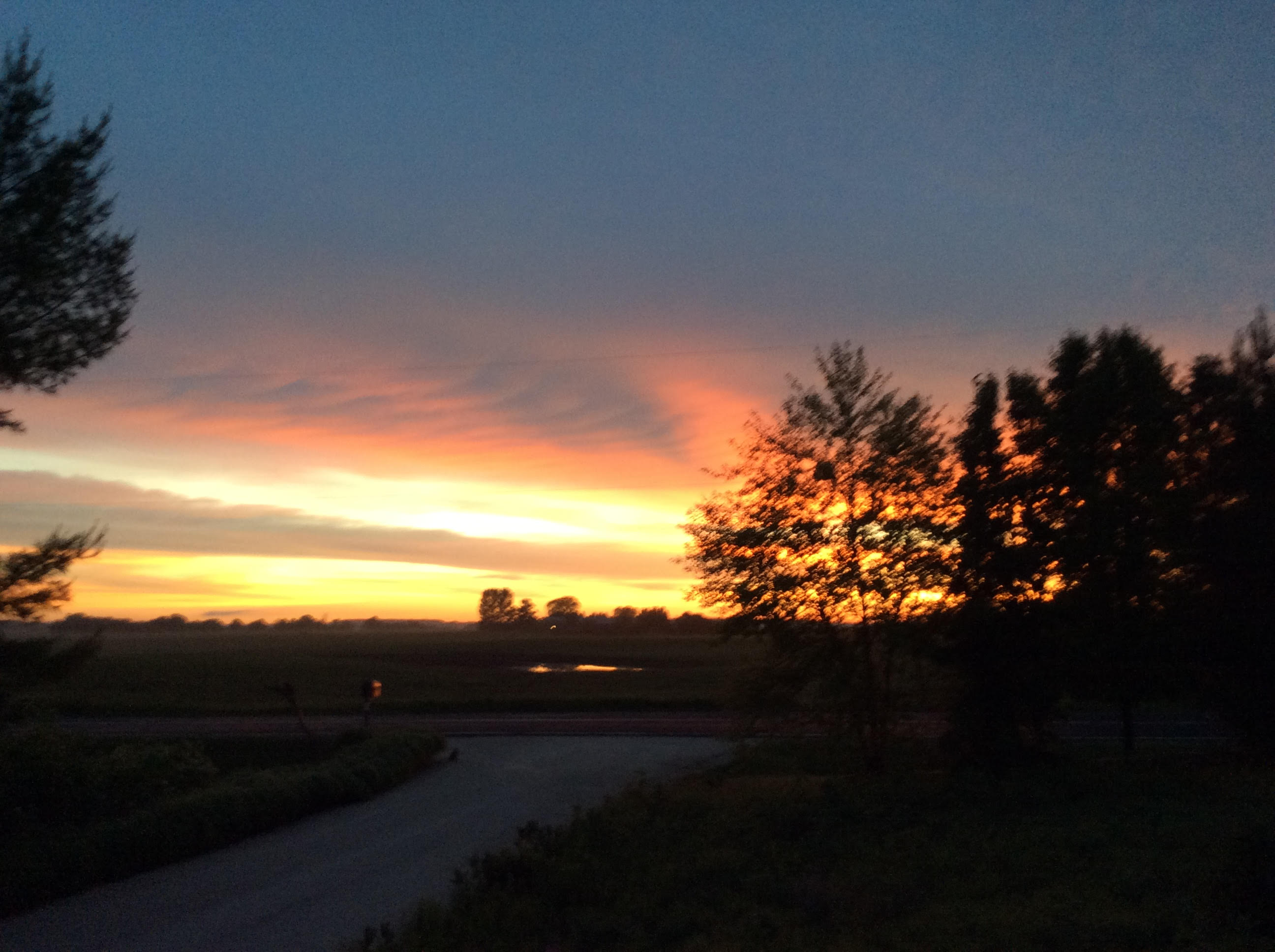
The sun was setting, streaks of rosy pink and red alternating with scattered lines of cloud, and the old stone of the mairie (town hall) had turned into a rich gold. It was that brief moment of twilight before someone turned on the lamps over the diners, and Bruno murmured to himself one of his favorite words.

“Crepuscule”, he said as he looked at the red sheen of the setting sun on the bend of the river, not aware that he had spoken aloud until the baron repeated it back to him.

“Crepuscule” one of the loveliest words in our language, for one of the loveliest times of the day just as it gives way to night,” the baron said softly, gazing at the shifting planes of red and crimson light on the river. “Sitting here, with wine and food and surrounded by friends as generations must have done before us in this very place, makes all the world’s troubles seem very far away. Sometimes I imagine prehistoric people sitting here on the riverbank, sharing their roast mammoth or whatever it was, and watching the sun go down just like us.”

He raised his glass. “I drink to them, whoever they were.”

Summer is on the wane, and now the nights are numbered when we will be able to eat dinner outside and luxuriate in the crepuscular moments. We intend to savor every one.

0

Eclipsed

Yesterday was the solar eclipse and we were duly eclipsed. Unfortunately, it was a low cloud cover doing the eclipsing resulting in a non-event in southern and central Wisconsin.

My husband and I are life long residents of the Badger state, and we must admit that we did not have high hopes that we would witness the solar sky show. Anyone who has spent time here realizes that planning outdoor weddings, family picnics or concerts on the lawn has a high statistical chance of facing disappointment. Stuff like clouds, rain, sleet and golf ball size hail falls out of our skies with great regularity.

However, we did harbor a slight glimmer of hope as we spent all day Sunday and Monday morning in Chicago. Perhaps, we thought, Chicago would have sunshine and we could hang around for a while and take in the big sky show. Alas, no such luck.

As we headed back to Wisconsin, we listened to Chicago’s top, all news radio station broadcasting live updates on the eclipse from reporters all over the city. Here is our favorite report during the actual eclipse:

“I’m reporting from the special solar eclipse cruise boat in the harbor, and we are all looking at the thousands of people on shore staring up at the sky.”

In other words, a great enactment of the Second Coming, but nothing else for that highly priced boat ticket. Which brings us to another point. Since we were in a hotel room that morning, we turned on the television, a rare event for us as we haven’t owned a TV for over 30 years.

That is how we discovered that the eclipse, THE MOST DEMOCRATIC OF ALL EVENTS, was being hyped for profit like a rock concert or a blockbuster movie release. A helicopter tour company in Oregon was offering an exclusive viewing site on the side of a mountain for $80,000. The price included a freshly brewed cup of coffee.

I’m all for hyping the event, but my pitch would be as follows:

Don’t forget to catch the eclipse, folks. It’s called science and it is really real. And if you are clouded out, don’t worry. Nature is putting on great shows every day all around us. P.S. Nature is part of science, too.

In lieu of seeing the eclipse this video had to suffice for us.

0

Puppetry

My list of museums to visit just got two new additions; the new Center for Puppetry Arts in Atlanta and the Museum of the Moving Image in Queens.

I visited the Atlanta museum when it was in its old building. My husband and I were driving in downtown Atlanta and serendipitously spotted a sign for it. The museum was housed in an old, musty building with dim lighting and puppets from around the world in glass fronted cabinets. In one of the small galleries we found ourselves alone and surrounded on three sides by these frozen figures. And then, after we had been in the room studying the puppets for some time, we detected slight movements. It was positively uncanny….slowly and subtly, the puppets appeared to be coming alive.

The museum has moved to a new, larger building and houses a substantial portion of Jim Henson’s archive. During his lifetime he was a major supporter of the museum.

The bulk of the Henson archive, however, was donated four years ago by his family to the Museum of the Moving Image in Queens. New galleries were built to display this treasure trove and have recently opened. Fittingly, Sesame Street is just around the corner at the Kaufman Astoria Studios.

Visiting would be like meeting old friends; Kermit, Miss Piggy, Cookie Monster, Elmo, Bert and Ernie, in total 40 Muppets all of whom have been lovingly restored. Being a stay at home mom when our children were little, I had the fun of getting to know the Muppets well. Mr. Henson knew that puppetry was not only for children, and the muppets always had some quips that only adults could appreciate.

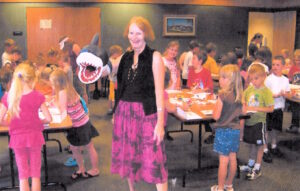
In addition to loving good puppetry, I also get to use puppets in many of my natural science programs for children. We have over 40 puppets living in our house with us. Most are Folkmanis puppets all of which are extremely realistic animals. Judy Folkmanis started her business in her home and it has grown to be one of the largest suppliers of quality hand puppets in the world. I have not given her puppets names or personalities…..they are props to help me explain the features of the real animals they  resemble.

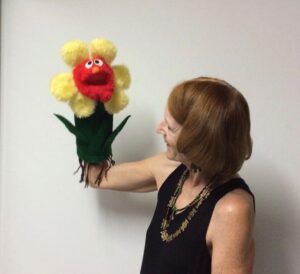
But then there is Flora. She is not a Folkmanis puppet, and I can’t even remember where I found her. Flora helps me do my plant science program for very young children. She has been such a hit with kids that she wore out and had to have a complete body transplant, right down to her roots. Flora always upstages me. Funny how a few pieces of felt and fake fur can have such an outsize personality.

0

Queen

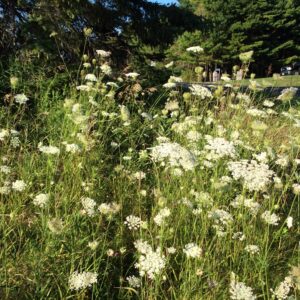
The Queen was reigning along all the roadsides and meadows as we were driving to Madison last week. Despite low, gray skies and a deluge of rain, the trip was a visual delight thanks to her beauty.

A prolific wildflower (some would say weed) Queen Anne’s lace blooms in August, often alongside her shorter consort, blue chicory. It’s a heavenly match.

Queen Anne’s lace, officially known as Daucus carota, is a wild carrot. Originating in Europe and Asia, it was brought to America by European settlers.

Genetic evidence establishes wild carrots as the direct progenitors of our orange cultivated carrots. Check this out by crushing any part of Queen Anne’s Lace, especially the taproot, and it smells exactly like a carrot. BUT DON’T EAT IT!

Queen Anne’s lace is a member of the Apiaceae or Parsley Family along with caraway, fennel, coriander, celery, anise root and poison hemlock. Since the hemlock is a dead-ringer for Queen Anne’s Lace (which does have edible parts), it is best not to make a deadly mistake and nibble the wrong plant. Remember Socrates.

The use of wild carrots goes back 5,000 years and these carrots came in a variety of colors including white, yellow, purple, red and black. Most cultivated carrots up until the 16th century were purple. Then breeders in the Netherlands developed orange carrots, perhaps in tribute to their rulers known as the Royal House of Orange.

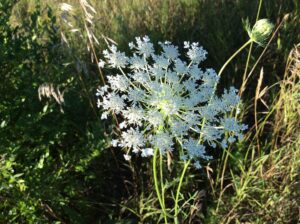
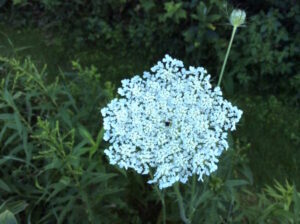
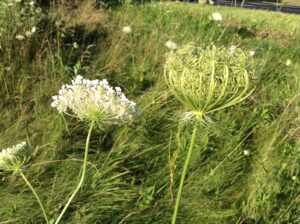
Queen Anne’s Lace is a biennial, low leaves and taproot develop the first year, stalk, flowers and seeds the second. The flowerhead or umbel can reach 5 inches across and is made up of many tiny flowers each of which will produce two seeds. When the seeds ripen, their delicate stalks turn inward and the flower head resembles a small bird’s nest.

Look closely at the umbel and you may see one minute cluster of purple flowers slightly off center amidst the lacy white froth. Botanists suspect that these sterile blossoms might be practicing plant mimicry. The small cluster resembles a bug sitting on the flower. Perhaps the fake bug attracts real insects which would help pollinate the plant. Scientists admit that the purple spot remains a “mystery” spot requiring more research.

It is also a mystery exactly which Queen Anne the plant was named after, and there are several contenders. Whichever  Queen it was, a beloved myth is that she pricked her finger when making lace and her dot of blood is the purple floret. One thing seems to be certain…….Queen Anne’s Lace is a fascinating carrot.


0