Blackbirds

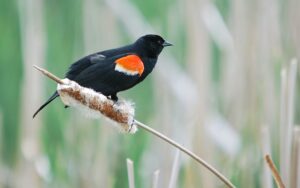
Red-winged Blackbirds are one of the first birds to return north from their winter vacations. Their cheerful oak-a-lee songs can be heard when snow is still lingering on the ground.

Starting early this spring, our yard has been exceptionally graced with huge flocks of blackbirds and the air is filled with their vocalizing. On a recent morning we looked out our window to see more than the nursery rhyme’s “four and twenty blackbirds” enjoying the seeds in our bird cafe. I counted 27 redwings, but that might be too low. All the birds were males, and that set me to thinking.

I know that male Red-winged Blackbirds are extremely territorial. Each guy stakes out a territory, sits on a reed or stalk, fluffs out his red epaulets and sings like crazy. Multiple females, who resemble brown sparrows, will heed the call and nest in the male’s kingdom. So why did we have a flock of guys happily having a breakfast meeting?

A search revealed the answer from the bird specialists at Cornell University. “Even during the height of the breeding season, the males forage in flocks in neutral territory.” To keep things peaceful, they hide their red epaulets leaving only a thin yellow line.

On the same day of the blackbird breakfast, we were eating dinner and listening to Radio Swiss Jazz. The song “Blackbird” started playing, and I remarked to my husband how much I liked the song. Since Radio Swiss Jazz is listener programmed, I also commented that many others must be fans of the song as well…it is played several times each week.

My musical knowledge being very limited, I decided to look up the song’s history and got a big surprise. “Blackbird” is a Beatles song written in 1968 by Paul McCartney. Here is how he explains the lyrics:

“I was in Scotland playing my guitar and I remembered this whole idea of ‘you are only waiting for this moment to arise’, was about, you know, the black people’s struggle in the southern states and I was using the symbolism of a blackbird.”

Sir Paul also admits purloining the idea for the melody from J.S. Bach’s Bourree In E minor.

I feel it fair to note that our backyard Red-winged Blackbirds’ songs are all original material.

Click here to hear a lovely version of the song. It’s a message for our times.
0

Accelerate

I am not a daredevil or risk-taker. I have all the points on my driver’s license intact. But everyone who likes to drive should drive 100 mph a few times in his or her lifetime.

The first time I hit 100 was in northern New Mexico in the high plains. I was on a straight as an arrow road with 100% visibility in all directions and not a car or person in sight. What a thrill to put the pedal to the floor and watch the distant mountains ahead loom larger. This experiment in speed only lasted a few minutes.

My second triple-digit experience occurred in West Texas. I had just passed a sign reading “Watch Out For Wild Pigs”. Other than my husband napping in the passenger seat, I could spot no living things in the vast flat landscape.  I hit 102 before sanity returned.

But driving over 100 is not always a pleasure. Take, for example, the German Autobahn, which is emphatically not for the faint-hearted. The Audi’s, Mercedes’ and BMW’s are going well over 100mph while constantly zigzagging between lanes. At the same time, older, smaller vehicles in the traffic mix are struggling to maintain 50 mph. In between these extremes are the type of cars we always rent, four-cylinder compacts such as Fiat 500s and Opels.

Autobahn driving is driving on steroids…hands white-knuckled on the steering wheel, senses on full alert. Despite my best efforts to keep up, I would glance in the rearview mirror to see an Audi or its ilk on my rear bumper, its driver fuming to pass.

The best part of driving the Autobahn is seeing signs for the approaching Netherlands or Danish borders where driving sanity will instantly return. I’m truly not an adrenaline junkie.

0

Lucy

Elephants do not usually morph into Airbnbs. But this recently occurred in New Jersey, a place of much wonderful weirdness.

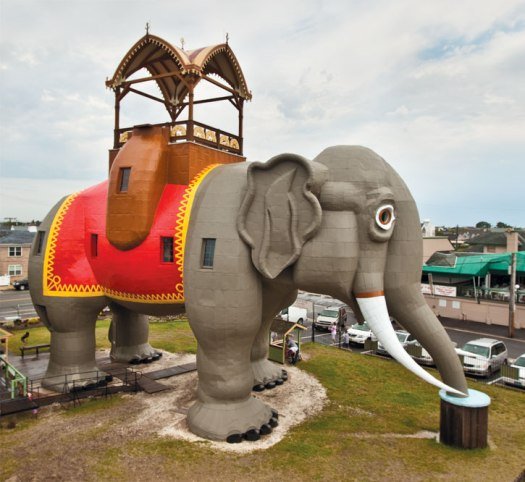
I have been a fan of Lucy, the Margate, New Jersey elephant for many decades. Having spent 28 years as a Historic Preservation Commissioner, I believe in saving the best of our past…and that includes buildings shaped like elephants.

Lucy is a centenarian. She was the brainchild of real estate speculator, James V. Lafferty, who built her as an advertising gimmick to sell his lots along the Jersey Shore just south of Atlantic City.

Construction of this 65 foot high, 60 foot long pachyderm was begun in 1881 and cost over $25,000. Lucy was constructed from almost one million pieces of wood, 200 kegs of nails, 4 tons of bolts and iron bars and 12,000 feet of tin for her “skin”.

Down through the years, Lucy has served as a restaurant, tavern, business office and rentable summer cottage. And then, for many years, she stood alone by the ocean falling victim to the ravages of winds and weather. By the 1960s, she was marked for demolition.

Luckily, outraged citizens of Margate formed a “Save Lucy Committee”, raised money for her restoration and promised to move the girl to a new lot on Atlantic Avenue. On July 20, 1970, the 90 ton refurbished Lucy made her move on a trailer pulled by a truck. Every year since, the town has a birthday party for her on the Saturday closest to July 20th.

Lucy still graces the beach, receiving over 132,000 visitors a year. They enter through a door in her left hind foot and ascend a narrow spiral staircase to her belly. In addition, Lucy is now listed as an Airbnb. She was to have welcomed her first overnight guests since 1902 this past St. Patrick’s Day. Unfortunately, the Coronavirus caused those plans to be canceled. But any girl who has survived 138 years will weather this storm as well.

Save up 138 dollars, if you would like to sleep inside an elephant.

0

Kitchens

Like most little girls and many big ones, I love the color pink. A quick check of my closet will confirm this, many of my clothes have rosy hues from pale pink to deep magenta. My fondness for pink, however, does not extend to interior decorating.

All design, fashion and decorating trends go around on a giant carousel through time. I have recently become aware that a stalwart of mid-century kitchen design, the pink kitchen, is making a return appearance.

This phenomenon became apparent when I spotted five new hot (pun intended) pink kitchens in various design magazines in the past month. Pink is in. Personally, I cannot see myself cooking in a kitchen that resembles a baby’s nursery or the inside of a giant conch shell. But I do take delight in looking at these photos I’ve gathered of the original  1950’s kitchens and the 2020 retro take on them. I hope you enjoy them as well. Click here to view.

And here’s a bonus. The 1950s was the era of pink. Try to make it to the last line in this song!

0

Moss

Spring refuses to be quarantined. Living in a northern climate, I know snow and ice can happen in April. Yet, signs of spring, a.k.a., hope, are still to be found.

A short walk from our home is a 164 acre park that is mostly forested. Although no trees are yet evidencing any signs of tiny green leaves, our woods is lush with brilliant emerald green hues. Moss carpets the forest floor and slipcovers the rocks and fallen logs. It looks exactly like an enchanted forest in a beautiful fairytale.

This magical sight led me to conjure up my long ago college botany classes and the word bryophytes, the moss family. Some reading on that topic seemed to be in order. Here are ten highlights from my search.

    • Mosses are primitive plants which first appeared on earth about 450 million years ago. Their structure remains basically unchanged.
    • There are at least 12,000 species of moss, and they cover the globe with the exception of saltwater environments.
    • Mosses have no flowers, seeds or roots. Reproduction is via spores on hairlike stalks.
    • Moss rhizoids, which resemble root hairs, anchor the plants to many surfaces both hard and soft.
    • Mosses do not have cells that move water like the vascular plants that now dominate the world’s fauna. Instead, they soak in water from the air like sponges.
    • Many moss plants have leaves that are only one cell thick.
    • A patch of moss is made up of multiple tiny plants that hold each other up and hold in water.
    • Dried moss can be rehydrated and returned to life.
    • Beware of moss imposters. The beautiful “Spanish moss” that hangs from trees down South is actually an air plant (epiphyte) of the pineapple family.
    • Moss is a “rock star” in Japan. Cultivating and touring moss gardens are beloved activities. And a recent phenomenon is the “moss girls”. Young ladies sport jewelry made from tiny, water-filled glass balls with living moss plants growing inside. They also tour moss gardens and watch moss grow. Here’s a link to this craze.
0