Nicholaas

St_Nic
Click image to enlarge

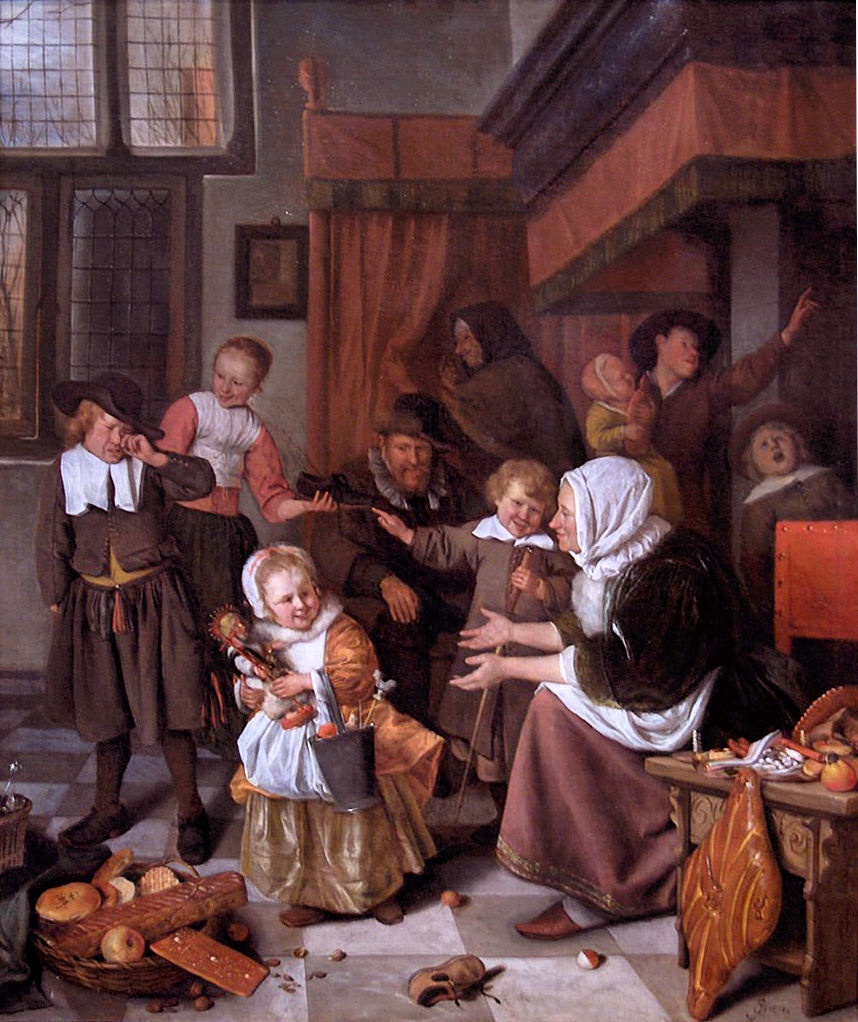
In his lifetime, Jan Steen painted six large, exuberant paintings of The Feast of Saint Nicholaas. Jan Steen, the son of a brewer, was born in Leiden in 1626, twenty years after Rembrandt’s birth. It was the Golden Age of Dutch painting.

Steen was a prolific artist, creating over 800 paintings in his lifetime. Many of his canvases are genre paintings of happy people having a good time. He has been called “the humorist among Dutch painters”.

To supplement his meager income from painting, Jan Steen started a brewery in Delft and opened a tavern in his house. Both ventures failed, but they did provide him with subject matter for his art. Many of his canvases portray people drinking, merrymaking and uninhibited.

The Feast of Saint Nicholaas is a beloved holiday in the Netherlands which is celebrated on December 6th. The traditions today are little changed from Jan Steen’s time. Children set out shoes on Saint Nicholaas Eve, December 5th. In the morning, the shoes are magically filled with pepernoten cookies, gingerbread (speculaas), marzipan and little gifts.

Viewing  Steen’s lively painting, The Feast of Saint Nicholaas, tells the entire story of the celebrating. He used his own children as models…..the crying boy who did not get his shoe filled with treats, the little girl with her new doll and a bucket of treats, the child in the arms of his big brother who is pointing to the rooftop where Sinterklaas has dropped the gifts down the chimney.
St_Nicks
Click image to enlarge

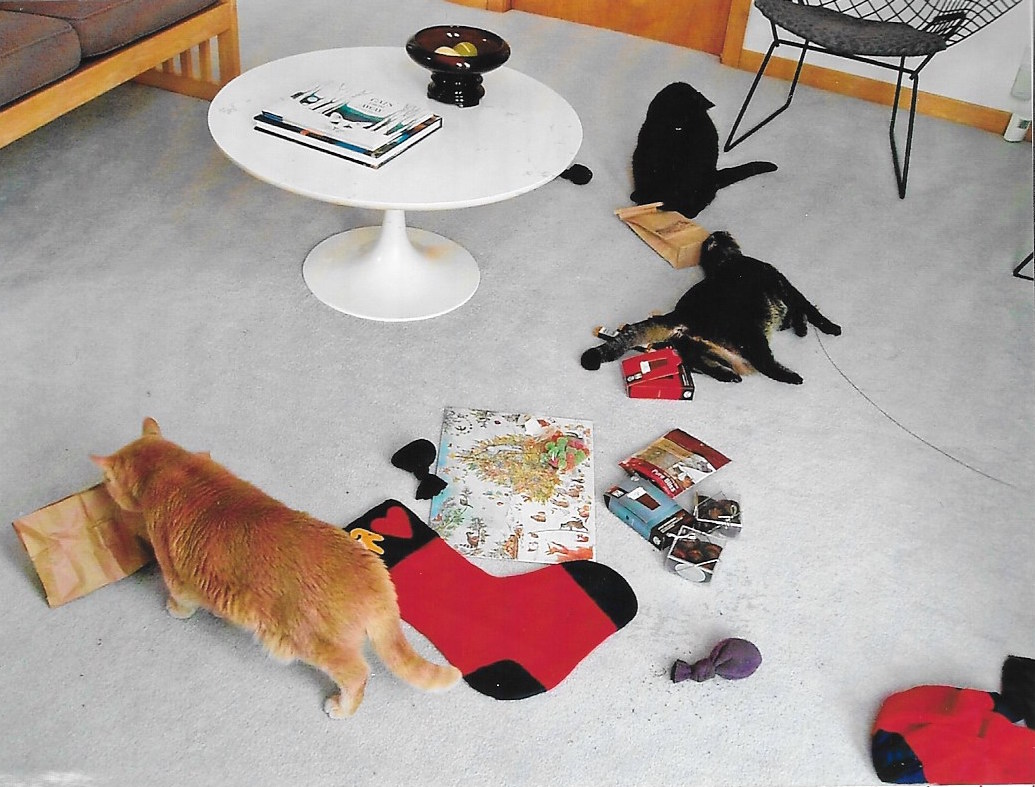
The Dutch have a phrase for a messy, happy, disheveled household, ‘Een huishouden van Jan Steen’……a household by  Jan Steen.

Every year, my husband and I put up our stockings on the night of December 5th. Here  is our version of ‘Een huishouden van Jan Steen’ the next morning.


0
Cookbooks

I love cookbooks. Despite the fact that my iPad gives me access to every recipe in the universe, I prefer my well worn, splashed, stained, penciled, dog-eared and beloved cookbooks.

Michael Perry, the Garrison Keillor of Wisconsin, in his autobiographical book, Truck, A Love Story, veers off from his tale of restoring a pickup truck into the subject of cookbooks. A bachelor at the time, he owned 13 cookbooks with a grand total of 2,320 recipes. He describes his cookbook dilemma as follows:

“Combine a guilt-ridden sense of duty with terminal indecision and you will understand why I resist bringing any more cookbooks into my house. I look at my stack of thirteen and I hear an austere Depression-era voice in my head saying, ‘Hundreds of perfectly good recipes in there, and you haven’t even touched them. There is work to be done, and I am way behind.'”

I immediately headed to my cookbook shelf and counted twenty-one volumes. The task of calculating the total number of recipes was too daunting.

My cookbook collection falls into two main categories: the ones I use to cook and the ones I use to read in bed. I value both equally.

In the utilitarian category are America’s Best Vegetable Recipes and Home-Made Ice Cream and Cake. Both of these recipe collections are from the Farm Journal magazine. They were contributed by farm women long before the phrase “locally sourced” became chic. All the recipes are easy, dependable and full of flavor.

Michael Perry notes that he relies on Let’s Start to Cook by the Farm Journal when he is in need of basic cooking information.

In the second category are the books featuring gorgeous photos, lovely artwork and delightful stories. I will never make a recipe that takes two hours and requires 21 ingredients, most of which aren’t available in the rural area where I live. But I truly can enjoy reading and dreaming about these food fantasies before I drift off to sleep.

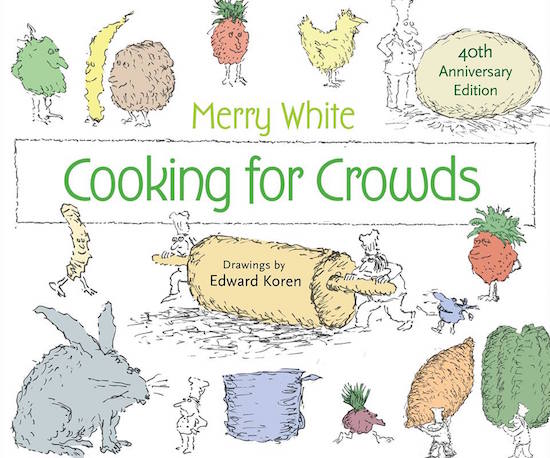
Perhaps I need to add a third category, cookbooks that make me laugh. Cooking for Crowds by Merry White would fit here. I have no need for the 95 recipes in this book that feed hordes of people. I spotted the edition at a thrift store and snapped it up for one reason: the whimsical Edward Koren illustrations. Feel free to borrow it if you are feeding 100.

Merry White


0

Cafes

I recently read that Cat Cafes are a new trend. These are not bistros for cats, but cafes which have many in house cats. People come to have the companionship of a cat as they sip their coffee, snack, relax or work.

The  idea of a working cat in an establishment that serves or houses food is not new. Over 5,000 years ago, the Egyptians probably got tired of rodents raiding their stores of wheat and decided to entice wild little desert cats to try out a domestic lifestyle. More recently, in late night strolls in Amsterdam, I’ve seen cats in darkened restaurants, patrolling under the tables and upturned chairs.

The new breed of Cat Cafe was popularized by the Japanese, although the first establishments were in Taiwan. The Japanese cats (nekos) are not hired as mousers. Like Hello Kitty, their main function is to be adorable. Can’t have a cat in your apartment? Having a bad day? Come to our cafe and cuddle with our kitties.

Some politically correct Americans will be aghast at the feline cafe concept. “I’m allergic, I don’t want cat hair in my food and animals are dirty”, they will loudly exhort.

Europeans, most of whom aren’t animal phobic, are welcoming the Cat Cafes. I love the nonchalance with which Europeans accept animals in their midst. Heads did not turn in the French supermarket where I saw a woman pushing her cart through the aisles with her small dog ensconced in the child seat.

Here are some photos we’ve taken in European restaurants and stores with resident cats. These are cafes with a cat, not Cat Cafes. Regular visitors greet the cat as warmly as they do the proprietors.

Note that my husband and I have no need to visit a Cat Cafe…….we live in one everyday.


0

Dachshund

I recently read a fascinating book, A Solemn Pleasure, The Art of the Essay, by Melissa Pritchard. The writings were on serious and thought provoking topics until I came to the piece called “Doxology”.

I had to look that word up….Doxology, an expression of praise to God. The essay of that name was thirty pages long and was entirely about dachshunds. Since I had enjoyed the first seventy-one pages, I kept on reading despite feeling like a victim of bait and switch.

May I never subject you, dear readers, to thirty-one pages in praise of dachshunds, or anything else for that matter. I only subject you to one minute of reading even when discussing cats.

After having been drowned in dachshunds, I challenged myself to write a few words (emphasis on “few”) on the topic.

Dachshunds were bred to ferret badgers out of their holes. These dogs are best described by H. L. Mencken: “A dachshund is a half dog high and a dog and a half long.”

Dachshunds come in six colors and five sets of markings. The fur can be smooth, long haired or wire haired. Wiener, sausage and hot dog are common nicknames for these low slung creatures.

I have had one memorable experience involving dachshunds. Walking into Washington Square Park in New York City one April day, I spotted several people walking dachshunds. Soon the park was filled with hundreds of dachshunds. I had serendipitously discovered the annual Dachshund Spring Fiesta. In case you need a dachshund fix, the date for 2016 is April 30th.

My favorite dachshund is named Pretzel. He only lives in a children’s book entitled Pretzel and the Puppies. The book was written and illustrated by Margret and H.A. Rey and published in 1946. They are the same couple who created Curious George. As a child, I read my Pretzel book so many times that the illustrations are permanently cemented in my brain.

0

Incinerated

I need to begin by saying that I do know how to cook dinner. Having had 51 years of practice coming up with nightly meals, I’m experienced.

Last week I came home from work, scrubbed up two huge baking potatoes, pricked holes in them and shoved them in my oven which I set for 400 degrees. Then I turned the timer on for an hour and wandered off to do other things.

Coming back when the timer went off, I opened the oven door and a blast of heat dried the mascara off my eyelashes. Instead of two baked potatoes, two coal black rocks were sitting on the oven rack and the temperature in my kitchen was rapidly rising to hellish degrees.

“What have I done?” raced through my mind. We women all are trained to blame ourselves for anything that goes wrong. I immediately checked the temperature setting I had chosen and it was gone. Instead, the temperature screen said F9.

I whipped out my stove’s instruction manual to decode the inscrutable F9. Convoluted instructions were given to reset the temperature sensors. No translation for F9 was given.

Now I was in perfect control of the situation. I knew exactly what to do. I yelled for my husband to come fast. My stove is mainly a giant computer with a few incidental heating components. He is a computer guru.

He quickly arrived in the torrid kitchen, whipped out his computer, brought up the stove’s online repair manual and diagnosed the problem. F9 was the failure code for “a runaway oven”. The temperature was in excess of 650 degrees. As soon as the patient cooled down, my guy could do a computer repair job and I would be back in the baking business.

Dinner, however, was now the immediate problem. I pulled the black rocks out of the oven and was about to toss them in the garbage. And then a story from decades ago popped into my head.

My father was from an extremely poor family. One of his happiest boyhood memories was of going to a vacant lot, setting a big bonfire and roasting potatoes in the red hot coals. He had watched the homeless (who were called hobos then) do this and he was imitating them.

I got out a sharp knife and cut the potatoes in half. The insides were snowy white and steaming. I quickly made a cheese omelette and a big green salad. The baked potatoes were the best we have ever eaten.

0