Lilies

Tomorrow, May 1, would be a lovely day to be in France. The French are celebrating La Fete du Muguet, the festival of the lily of the valley. Pop-up shops will be dotting the streets selling sprigs and bouquets of these sweet scented little bells. The flowers are given to friends, family and neighbors as a gesture of “affection and good luck.” La Fete du Muguet coincides with Labor Day in France. Everyone has the day off to celebrate spring, love and social justice.
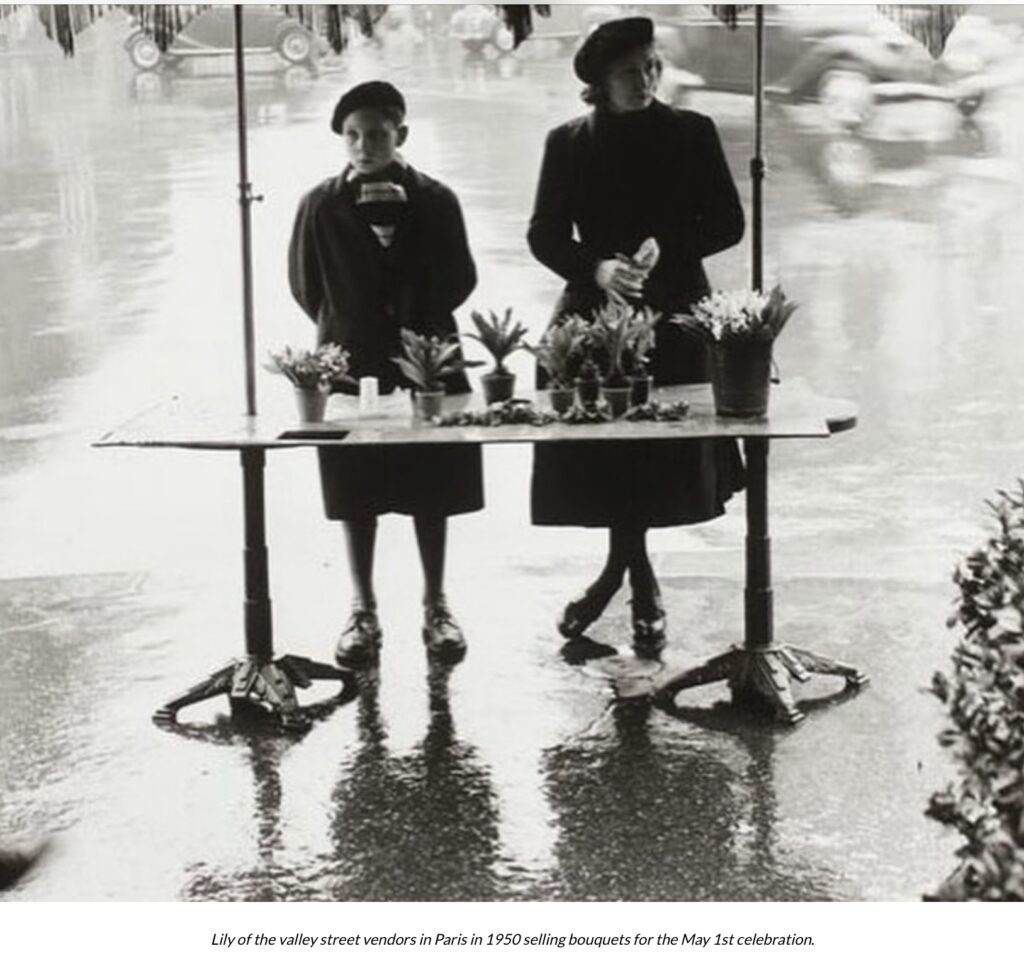
The tradition of giving lilies as a gift goes back to May 1, 1560. King Charles IX and his mother, Catherine de Medici, were walking in the garden of a knight, Louis de Girard de Maisonforte, when the knight picked a bouquet of lily of the valley and presented it to the king. Charmed by the gesture, the king decided to give these flowers to all the ladies in his court on May 1, saying, “Let it be so every year.”

The custom was reinforced in 1900 when the French couturiers gave nosegays of the flowers to their craftspeople (called “little hands”) and customers. Christian Dior so loved the flower that he made it the emblem of his fashion house.

My own love of the flower goes back to my early childhood. For some reason, my mother had given up on gardening and let our backyard run wild. It was a child’s paradise. Gigantic lilac bushes to hide under, enormous wild rose bushes, towering hollyhocks and lily of the valley in profusion. My mother showed me how to pick the lilies to make a bouquet…hold firmly on the stem and pull straight up. Zip! Out they came like a rocket, no roots whatsoever. My mother may not have liked gardening, but she loved fresh flowers in our home. I was free to pull all the lilies I wanted.

All these many decades later, I live surrounded by the native flowers and grasses we have planted. But about ten years ago, I was walking in the far end of our acre and discovered a huge swath of lily of the valley. They found us, and I couldn’t be more delighted.

Note: The lily of the valley is not in the lily family. The plant is a rhizomatous perennial of the Asparagaceae (asparagus) family. It is native to Eurasia.


4

Doorbell

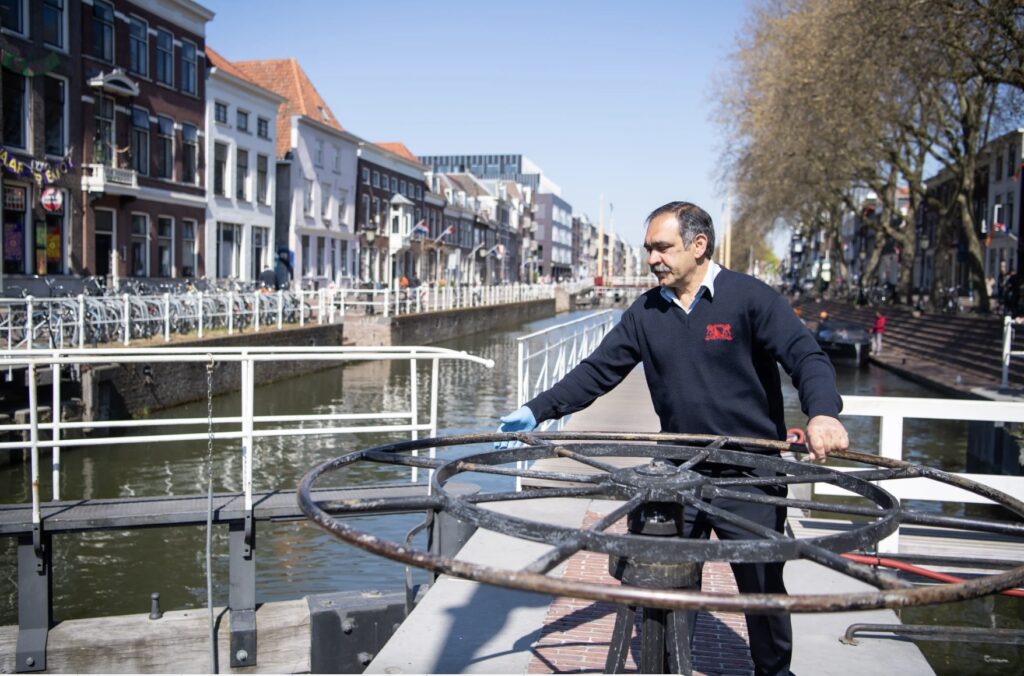
In case you missed this item in the news, some lucky fish now have their own doorbell. Since a doorbell is hard to ring with fins, the fish get assistance from nature loving humans.

The underwater action is in the canals of Utrecht in the Netherlands. Far fewer boats pass through that city’s canals in spring than in summer. As a result, a lock gate on the west side of the city is often closed. Fish gather around the gate waiting to swim upstream for their once-in-a-lifetime chance to spawn.

In 2020, ecologists Anne Nijs and Mark van Heukelum viewed these frustrated, sex-driven fish congregating around the closed dam. They also noted that birds like grebes and cormorants were scooping up lots of those queued up fish for their lunch entrees.

The scientists hatched an ingenious plan to help the fish reach their spawning grounds. They installed an underwater camera at the site. Viewers watching the live stream can push a virtual doorbell which alerts a worker to crank open the barrier.

The call for volunteer fish watchers to the doorbell (De Visdeurbel) was phenomenal. The live feed can accommodate 950 viewers at a time, but over a million citizen scientists wanted to ring the bell. The overflow crowd is directed to a YouTube stream, sans doorbell, and a Fish Doorbell news report. To say the fish have a whale of a fan club is an understatement. Their website has been viewed 8.2 million times.

In this surreal age when many people don’t believe science is real, it is encouraging that so many others are rushing to the aid of pikes, eels, catfish and numerous other species.

4

Faith

I woke up last Sunday to the news that Faith Ringgold had died. A huge wave of sadness washed over me. I love her artwork, have followed her career for decades and have shared her art and stories with hundreds of children. People need heroes, and she is one of mine.

Faith Ringgold was born in Harlem on October 8, 1930. Eighteen months prior, her mother, Willi Posey Jones, had lost a little boy to pneumonia and was hoping for a boy. She had no name picked out for a girl. A nurse who was attending her suggested, “Call her Faith”, and Faith Willi Jones began her 93-year life journey.

As a child, Faith had asthma and was home bound for many days. Her mother, a fashion designer and dressmaker, gave her daughter scraps of cloth, thread, needles and art supplies to occupy her quiet hours. Faith’s love of art was a continuous path from those childhood moments.

In 1948, Faith enrolled at the City College of New York to pursue a degree in fine art, but she was forced to major in art education instead. At that time, City College limited women to only certain majors. Fine art was for men, teaching was for women. Faith taught in the New York Public Schools from the 1950s to the 1970s.

Even while teaching, Faith was constantly creating her own art. Her work is political; she boldly took on white racism, misogyny and other social justice issues. She stated, “I’m always thinking about what can be better. And if you don’t get out there, the situation will never change.”

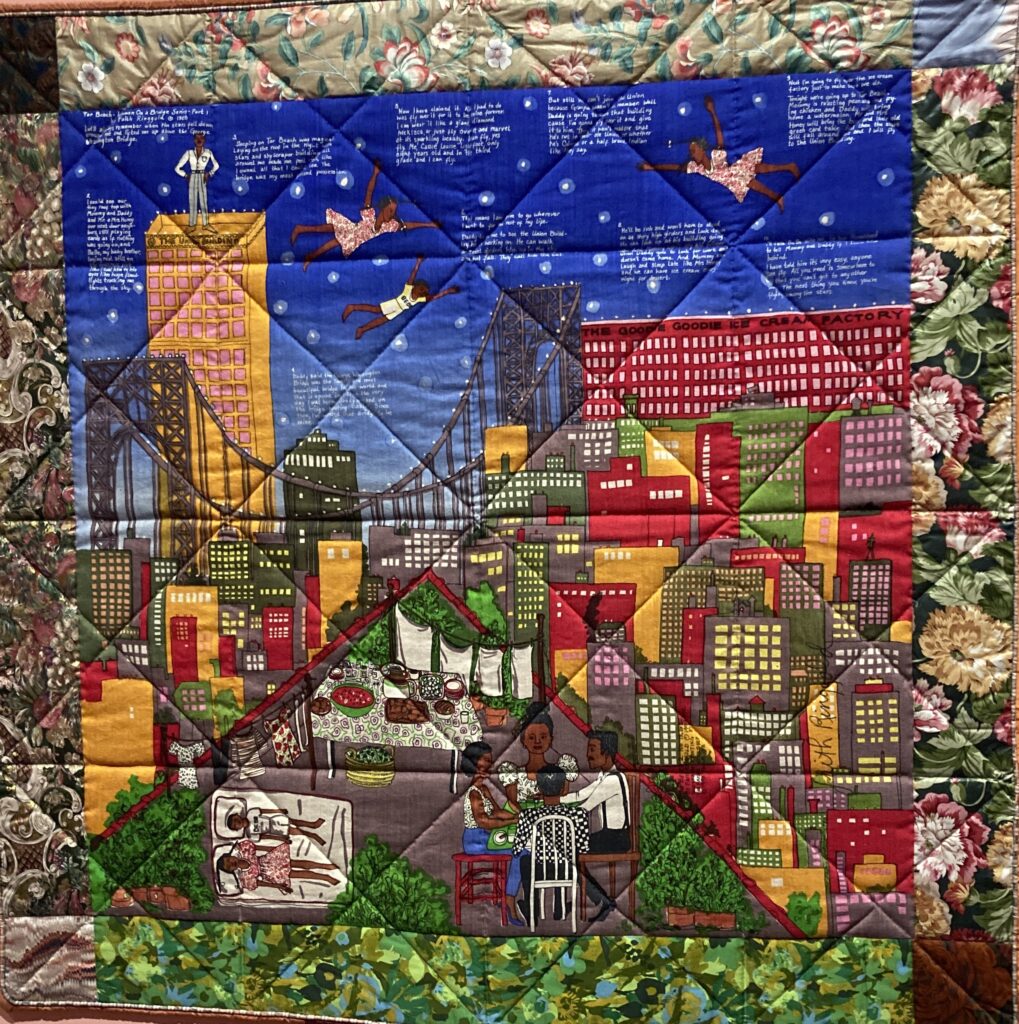
Although she worked in many styles, Faith Ringgold will be most remembered for her unique story quilts. These mural-sized unstretched canvases honor the African traditions of storytelling and quilting. She collaborated with her mother on the construction of the story quilts many of which feature women characters.

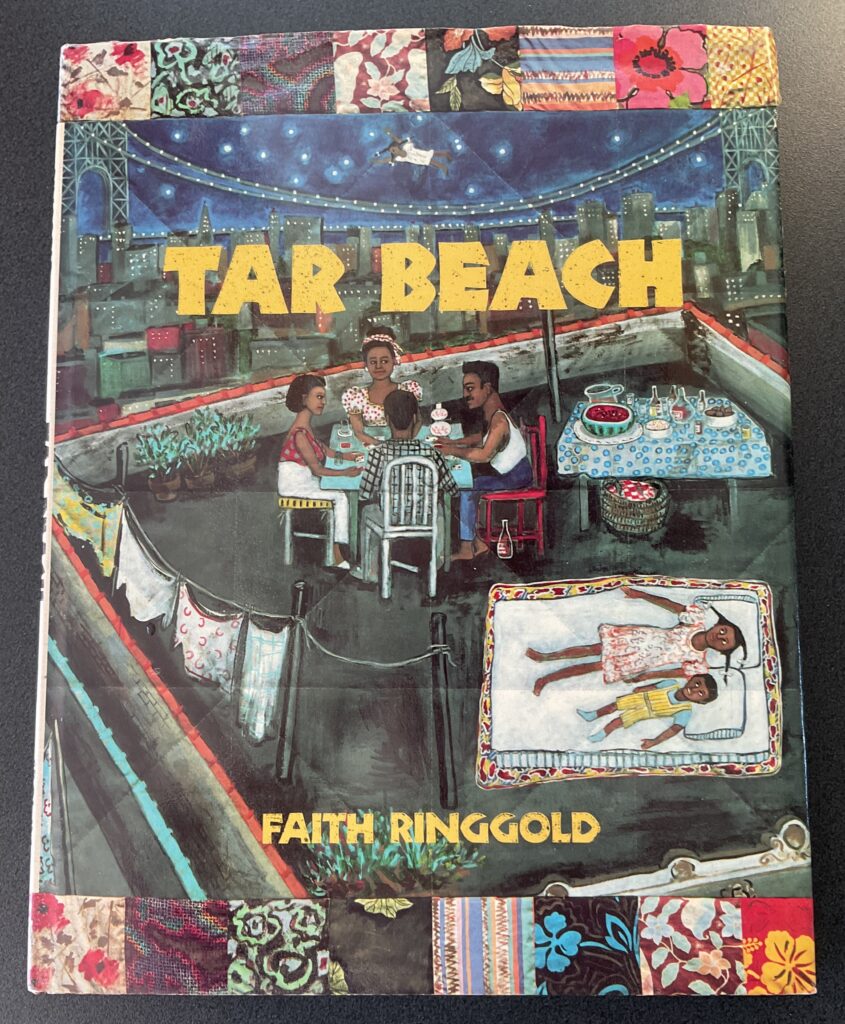
One quilt, “Tar Beach”, is based on her happy childhood memories of summer nights on her tenement’s tar roof. Families would escape the sweltering heat in their apartments by picnicking and sleeping under the stars on the roof. In the quilt story, a little girl can magically fly up into the stars above the city. The Tar Beach quilt became the basis for Faith Ringgold’s first published children’s book. “Tar Beach” was a Caldecott Honor Book in 1992.

Last February, I learned that the Museum of Contemporary Art in Chicago was hosting a retrospective of Faith Ringgold’s work. I said to my husband, “I absolutely have to drive to Chicago to see this exhibit.” I did not know it at the time, but that trip would be a farewell to this powerful, talented woman who never lost a sense of joy despite the hardships she endured.

Tributes to her are pouring in. The words that struck me the most are from Holland Cotter, the New York Times art critic:

“Certain artists manage to leap over walls. Picasso was one. And some tunnel under those walls, hit resistance, tunnel some more and, once inside, open a door to let others in. That’s what Faith Ringgold, artist-activist to the end, did.”

Click below for a video of highlights from the MCA Chicago exhibit. The pictures are in chronological order.

4

Hotels

A great hotel is a small slice of heaven. All have a grand lobby, tasteful rooms, snowy linens, luxurious beds, mountains of pillows, gleaming bathrooms, impeccable housekeeping and pleasant, but not obsequious, staff. I rank staying in one of these soothing, gorgeous environments among life’s greatest pleasures.

Money is the only obstacle to a night in paradise. Fortunately, with patience, luck, flexibility and a computer, spectacular bargains at four and five star hotels occasionally can be had. Happiness is having the computer screen inform you that a $350 a night room is yours for the price of a Comfort Inn.

I am a fan of the Historic Hotels of America website. Compiled by the National Trust for Historic Preservation,  it lists all the restored, grand old hotels that survived hard times and wrecking balls to be reborn for a new generation travelers. Staying one night in any of them is a vacation in itself. America is a nation of intense speed and excessive work. A return, however briefly, to places that evoke more gracious times is restorative.

As much as I appreciate the history and grandeur of America’s old hotels, I am also a lover of midcentury modern and contemporary hotels. A night in a hotel designed by John Portman is exciting. With the exception of those who fear heights, who doesn’t like a ride in a glass elevator up a soaring atrium?

The Portman designed hotel in Atlanta, GA

One of my top favorite hotels from this century is in Holland, Michigan. It is the Haworth Hotel on the campus of  Hope College and was built with funding from Haworth, leaders in commercial furniture design and manufacture. It is a stunning showcase of top of the line modern furniture built in the cities near Holland and around the world.

My taste in architecture is eclectic. Although my husband and I prefer to live surrounded by the clean lines and simplicity of midcentury modern design, we love spending a night surrounded by the best of any architectural style. For example, we can enjoy all the ornateness of a Gilded Age building and never have to dust a thing. Vive la difference!


4

Garçons

What would you do with a croissant, a coffee cup and a glass of water? The first thing that comes to mind would probably not be holding them aloft on a tray while hustling through the streets of Paris.

This, however, is what around 200 garçons, French waiters, did a few Sundays ago when the “course des garçons de cafe” was held after a thirteen year hiatus. The original race was held in 1914 and followed a five mile course. The waiters were attired in white jackets, bow ties, black pants and dress shoes. Their trays held bottles of French wine. In contrast, this year’s race was 1.2 miles, starting at Paris City Hall, going to Centre Pompidou and then back to City Hall. The participants wore aprons, and sneakers were allowed.

Crowds lined the sidewalks, cheering the participants along as they power walked through the twisting streets. No running is allowed in this historic race, and the trays cannot be carried with two hands. Minutes are deducted from the waiters’ race times for spillage and breakage.

Paris’ 15,000 cafes are an important part of the city’s cultural heritage. As the head of the restaurant trade group explains it, “A lot goes on in Paris cafes; love, friendship, business deals and revolutions.” Ann Hidalgo, Paris’ mayor, states, “The bistrot is where we go to meet people, where we go for our little coffee, our little drink, where we also go to argue, to love and embrace each other.” Note that she leaves out the “revolution” part.

The lucky winners of the waiters’ race receive medals, plus some things far more enjoyable…stays in four-star hotels and meals in highly starred restaurants.

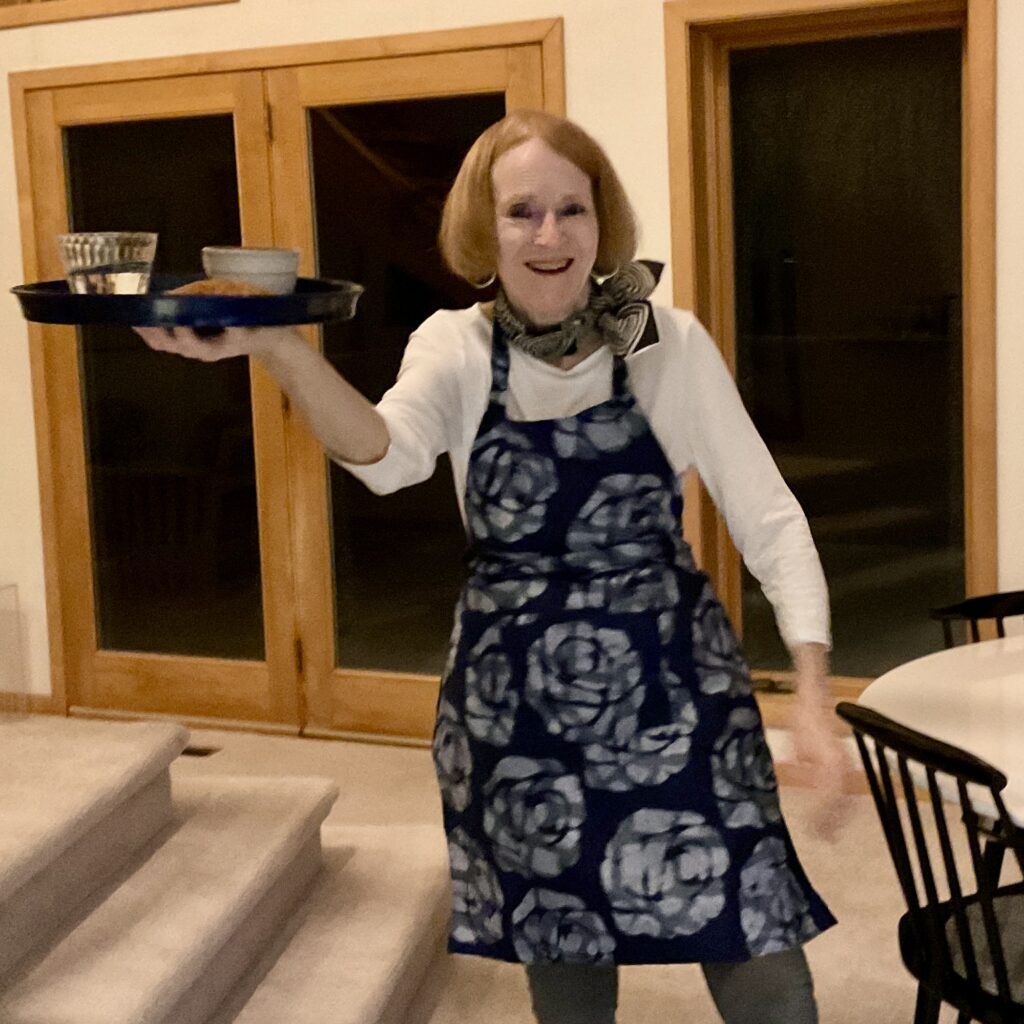
I would love to be a spectator at this delightful event. I have long respected the hard and stressful work that all restaurant workers perform, often for low wages. And I know that I would be a disaster as a server. When I tried to balance a tray with a croissant, a coffee cup and glass of water, I only got a few meters when things got out of my control.

7