Dinnertime

I am a true believer in the value of dinnertime. Sitting down to share food and conversation with members of your household is always a good idea.

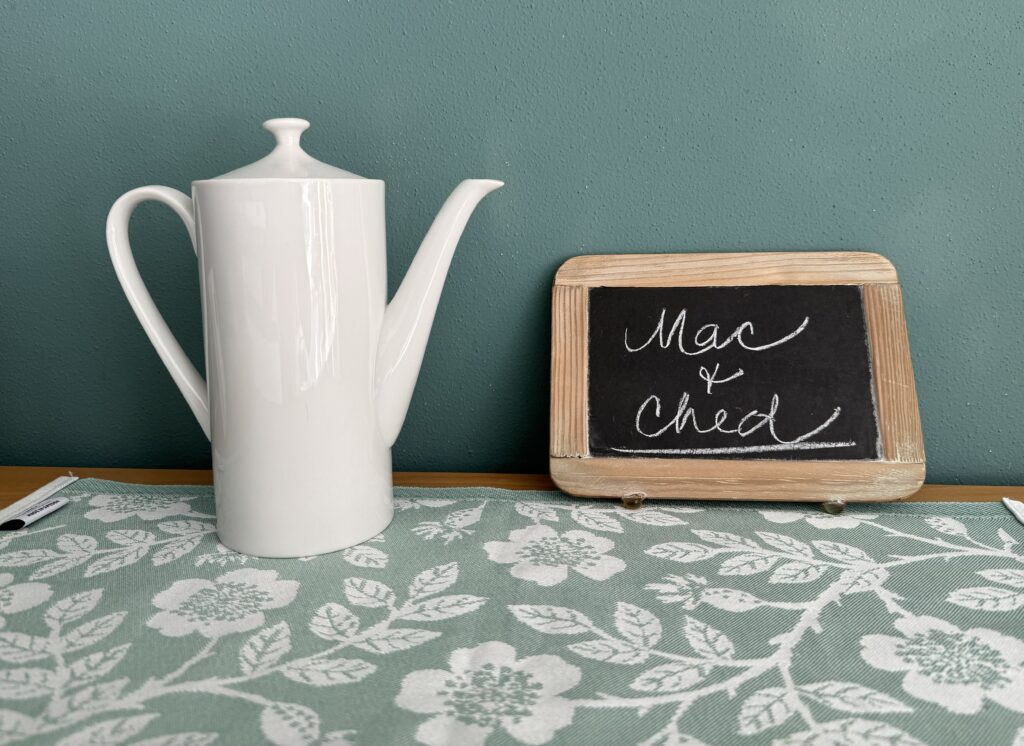
Dinnertime is the highlight of my husband’s and my day. From the earliest years when we were raising our children right up to today, we do not let anything interfere with our daily shared meal. When our kids were in grade school, I started posting the night’s entree on a small blackboard in our kitchen. I wanted them to look forward to dinnertime together and what I was cooking up for all of us. That same little board is still in our kitchen. Now it is keeping my husband, who is not the cook, informed on what I, still the chef, am concocting for our nightly meal.
I am not alone in appreciating regular family dinnertimes. Studies show that 84% of parents surveyed agreed that family meals are important. However, only about 50% said they could make this happen. Longer work hours, two jobs, irregular work schedules and multiple outside activities are all culprits responsible for making family dinnertimes in America an anachronism.

Anne Fishel, the head of Harvard’s Family Dinner Project, states, ”I’m a family therapist, and I sort of half-joke that I could be out of business if more families had regular family dinners because so many of the things I try to do in family therapy actually get accomplished by regular dinners.” She explains that more than 20 years of studies document that family dinners improve physical health, brain functions and mental health. She further says the meals don’t have to be perfect, “The secret sauce is, ‘Is it enjoyable?’. Do kids feel when they speak, someone wants to listen to what they have to say.”

I would like to give the last word to Judith Martin, a.k.a., Miss Manners.

“The dinner table is the center for teaching and practicing not just table manners but conversation, consideration, tolerance, family feeling and just about all other accomplishments of polite society except the minuet.”

Bon Appetit, let’s eat…together!
8

Eyes

Last week I was in my Art in a Suitcase room giving my folk art collection a good dusting and washing. In the midst of this mundane job, a funny thought popped into my head…A LOT OF EYEBALLS ARE WATCHING ME! I looked around and realized that the number of eyes in this room was more than I would care to count.

The folk artists who created the art in my collection did not have the opportunity for formal training. The materials they use are basic; paint, paper, fabric and clay. But the work they craft is wildly creative and a constant source of joy. I love having all these eyes watching over me.

I could not resist getting out my camera and clicking away at the eyes. Nobody blinked. Here is the resulting video. Hope it makes your eyes happy, too.


6

Perception

Living surrounded by animals, I often wish I could see what the world looks like through their eyes. I’m aware that human eyes excel at clarity of vision compared to hundreds of other species. But how do we compare in other areas such as color perception, night vision and field of vision?

To start, it must be noted that “we cannot actually see through another life form’s eyes but…we can make a close approximation.” Recent advances in science and technology are providing a better look into animal vision than previously possible.

Humans are trichromats, meaning we have three types of cones in our eyes which perceive red, green and blue, the primary colors on the light spectrum. Dogs are dichromats, having two types of cones which are tuned to yellow and green. Through a dog’s eyes, A red ball tossed on green grass would look like a yellow ball on a white or gray field.

Humans’ View (left) and Dogs’ View (Right)

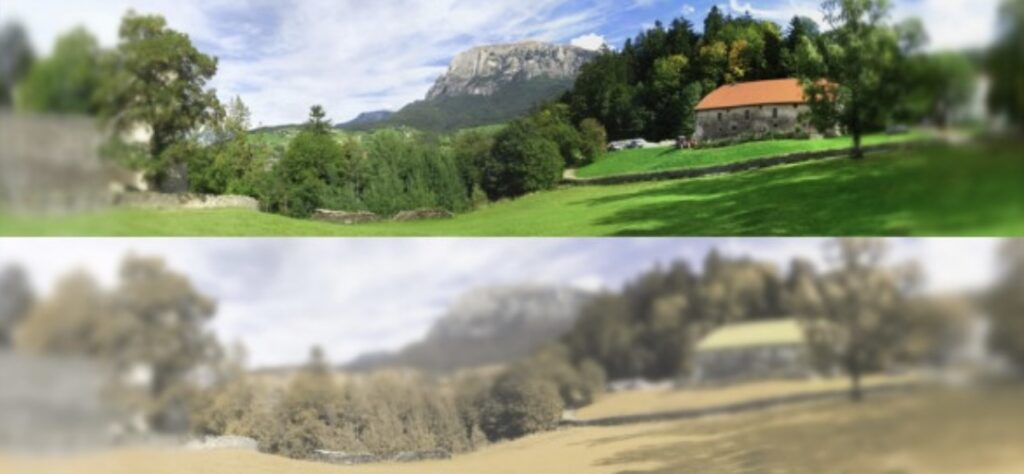
According to researchers at McGill University, cats’ eyes are “a bit of a mystery”. Think of them as trichromats who are red-green color blind. Colors are also more muted to a cat. Their distance vision is blurry, but their peripheral vision is wider than ours. Plus, they are champions at detecting motion, even in darkness.

Humans’s View (top) and Cats’ View (bottom)

The most important sense of birds is sight, and avians perceive the world in ways we cannot. Classified as tetrachromats, they see ultraviolet light plus subtle differences between shades of color that the human eye cannot distinguish. Being able to see UV light enables birds to zero in on plants, hunt prey (the prey’s urine trail lights up), eject parasitic eggs from their nests and find mates.

Humans’ View (left) and Birds’ View (right)

Daytime (diurnal) birds have the best color sense. Nocturnal birds are endowed with more rod cells which capture the maximum amount of available light. In addition, many night birds such as owls have large eyes for taking in more light.

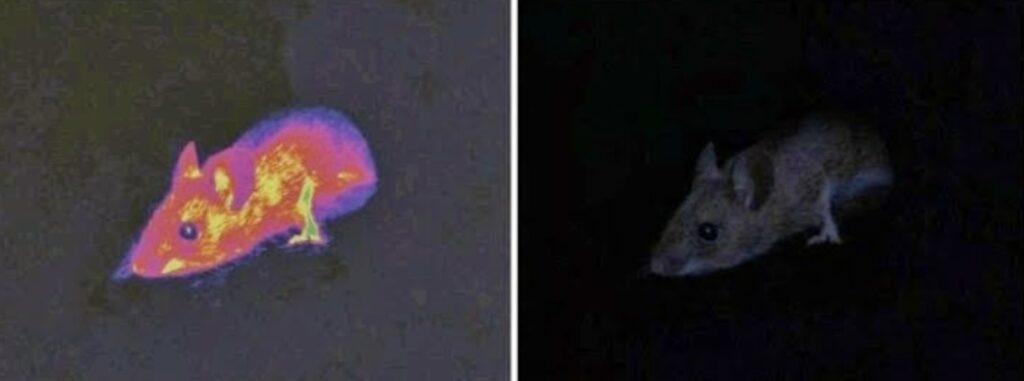
Over millions of years, the eyes of snakes have evolved in unique ways. Some are dichromats seeing two primary colors. Others such as boas, pythons and pit vipers can “see” the infrared spectrum. The heat given off by warm blooded prey such as a mouse, glows. Their meal literally lights up.

Snakes’ View (left) and Humans’ View (right)

And, finally, a quick look at insect eyes. Insects have compound eyes made out of hundreds of six-sided lenses. However, they DO NOT see hundreds of images. They see one image as we do, but would be legally blind by human standards. Their resolution is 100 times worse than ours. However, their field of vision is much wider than ours. Dragonflies, for example, have almost a 360 degree field of vision. Insects also possess superior motion detection.

Many insects also see ultraviolet light which is given off by flower petals. This enables the “legally blind” butterflies and bees to hone right in for that lunch of nectar or pollen.

Wouldn’t it be amazing to be able to spend a few minutes seeing the world through each of these different creatures’ eyes?


5

Disasters

Some days, you just have to give up and laugh. We had one of those days recently. I was in the kitchen about to make breakfast when all our power went out for no apparent reason. Then my husband looked out the window and saw lots of flashing red lights down the road from us. A car had run off the road and crashed into an electric pole. The driver survived, but the pole didn’t.

We both decided to make the most of the situation and go out for a hot breakfast, something our electric stove and coffeemaker couldn’t produce at the moment. We don’t have many restaurant options other than fast food in our area, but we decided that a nearby Perkins Pancake House could probably deliver a decent pancake or waffle. We hadn’t been in a Perkins in over a decade, but what could go wrong?

The answer to that turned out to be almost everything. The first problem was sticker shock. How could a lone, unadorned waffle cost eleven dollars? We ended up ordering two short stacks and coffee. After taking our order, the waitress looked at us and said, “Is that all that you’re eating?”

A short while later, the server deposited a plastic, thermal coffee pot on our table. The brew turned out to be lukewarm, a real trick when it’s in a thermos. We figured that sending it back would be futile, so started drinking and waiting for our order to arrive … and waiting and waiting. Just as we were beginning to think that the chef must have walked out the door, the pancakes and a small jug of maple syrup arrived.

My husband picked up the jug and his hand stuck to the handle. He unstuck his hand, wiped off sticky stuff from himself and the handle, put a clean napkin around the handle and tried again. In the meantime, I was unwrapping the napkin that was around my silverware. This revealed two spoons and a knife. Fortunately, I was able to flag down a busboy and request a fork, a most handy tool when eating pancakes.

Finally, we are able to eat. My husband takes his first bite and says, “This syrup tastes like absolutely nothing.” I try mine and concur. Without a doubt, the syrup was cane sugar mixed with water and brown food coloring. In a state known for maple syrup production, these folks could not even give us artificially flavored maple syrup.

In fairness, I must say that the pancakes were good. I try to look on the bright side of things.

While we were having our dismal breakfast, the electric company crew was working on getting a new pole delivered and installed. Shortly after 7:00 PM, our lights popped back on. I was able to make a hot dinner in the oven. And when I set the table, I gave each of us a fork.

P.S. Although our breakfast did not go well, our electric company did an excellent job of restoring our power in a timely fashion. It’s comforting to know that some things still work.

6

Redbuds

For many years, in early April, my husband and I would drive to Atlanta, Georgia, to attend the Carter Center annual meeting. The roadsides from Indiana down would be fabulous panoramas of blossoming trees and bushes. And my favorites of all the gorgeous foliage were the redbud trees.

During the Covid years, the meetings were canceled, and we stuck close to home. Now the meetings have been resumed, but are held in October. Missing the redbud drive, I did a computer search to learn more about the trees. To my great surprise, I discovered I could get my redbud fix right here in Wisconsin.

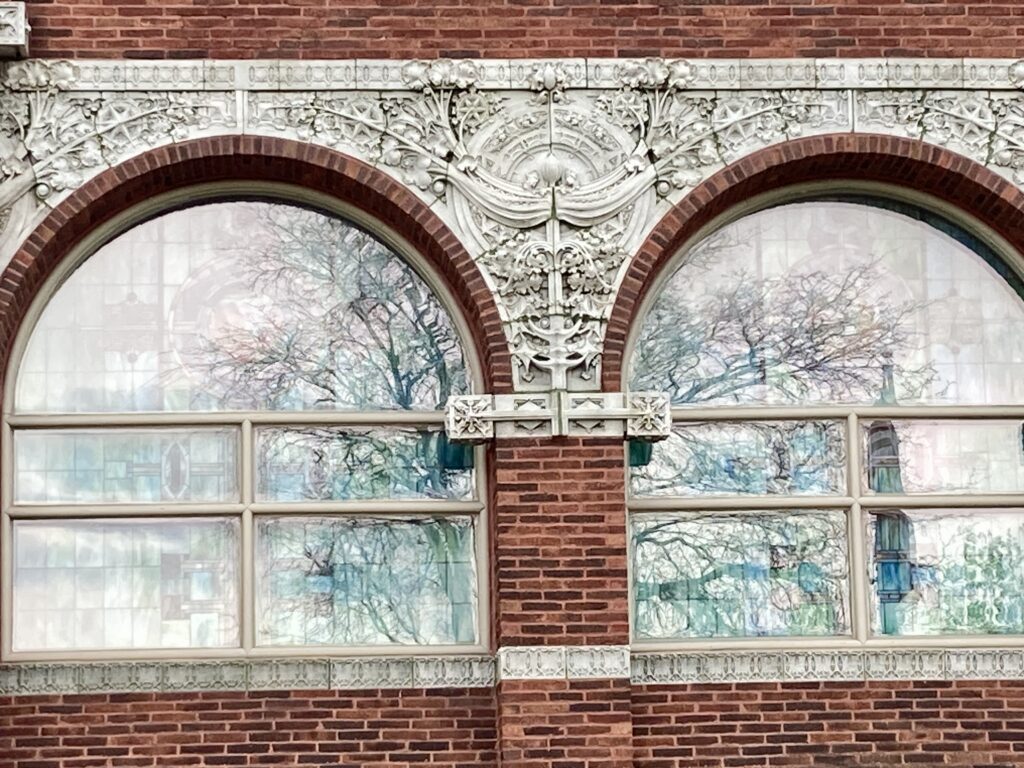
While redbuds are not native to my state, a hardier variety of the tree has been developed by a nursery in Columbus, Wisconsin, a small city 30 miles east of our state capital in Madison. I have been in Columbus several times to see one of their architectural treasures, but had no idea they call their burg, “Redbud City”.

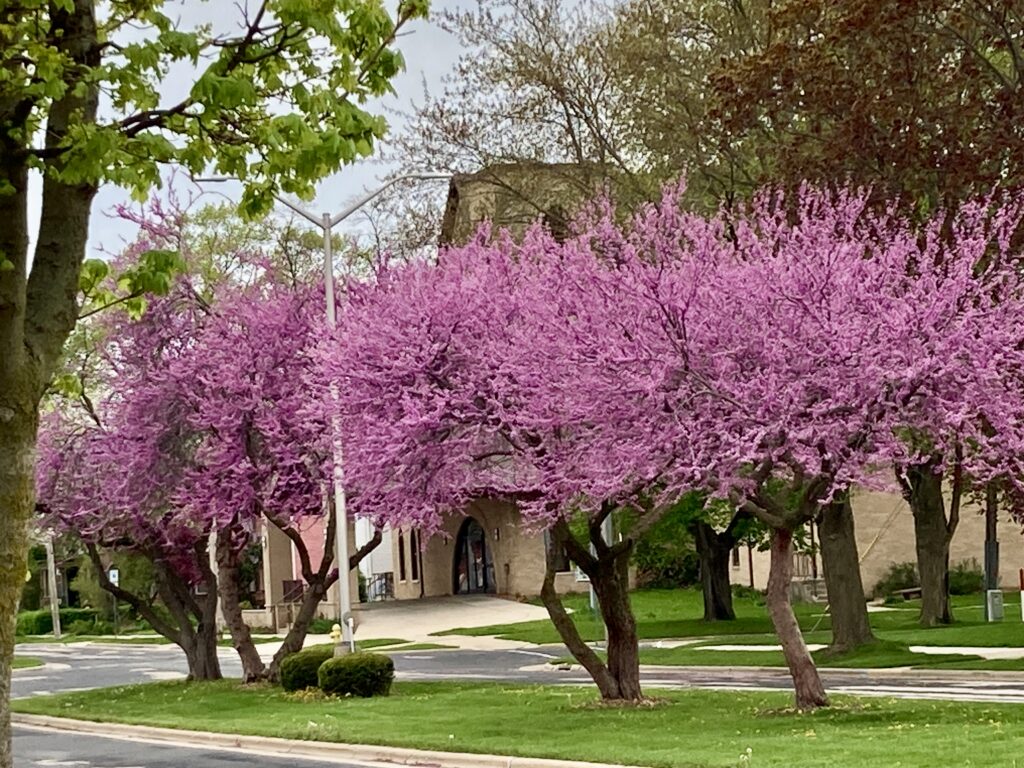
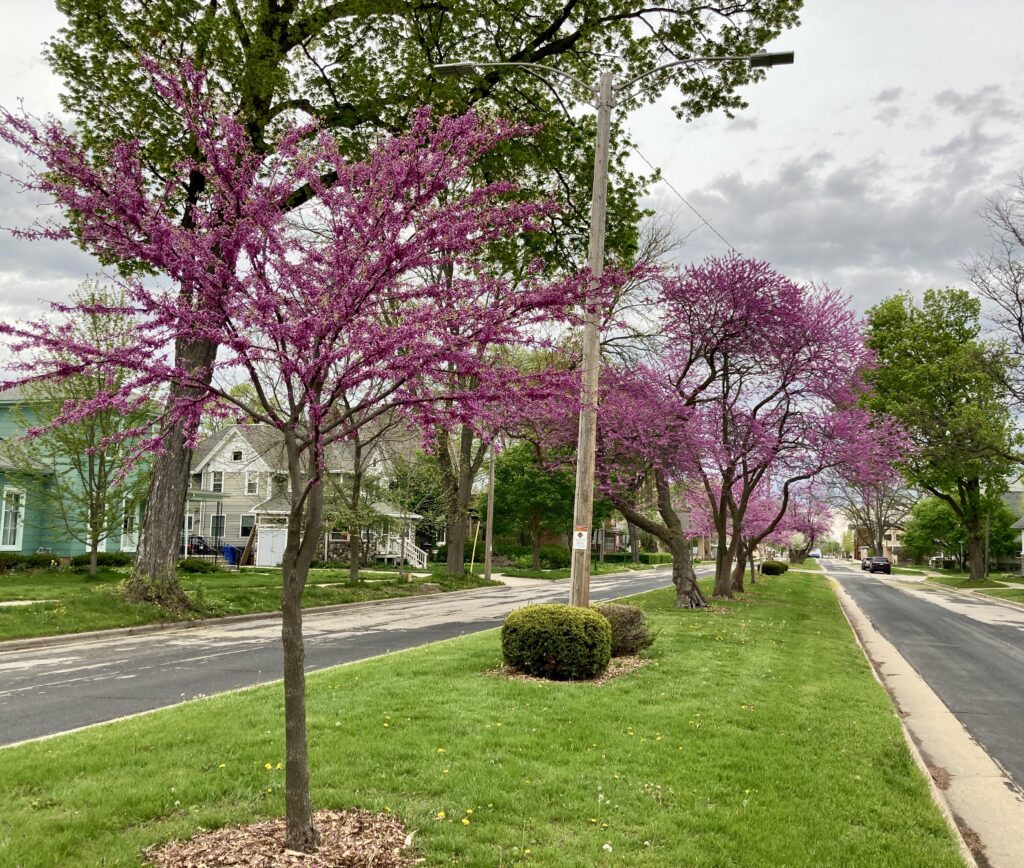
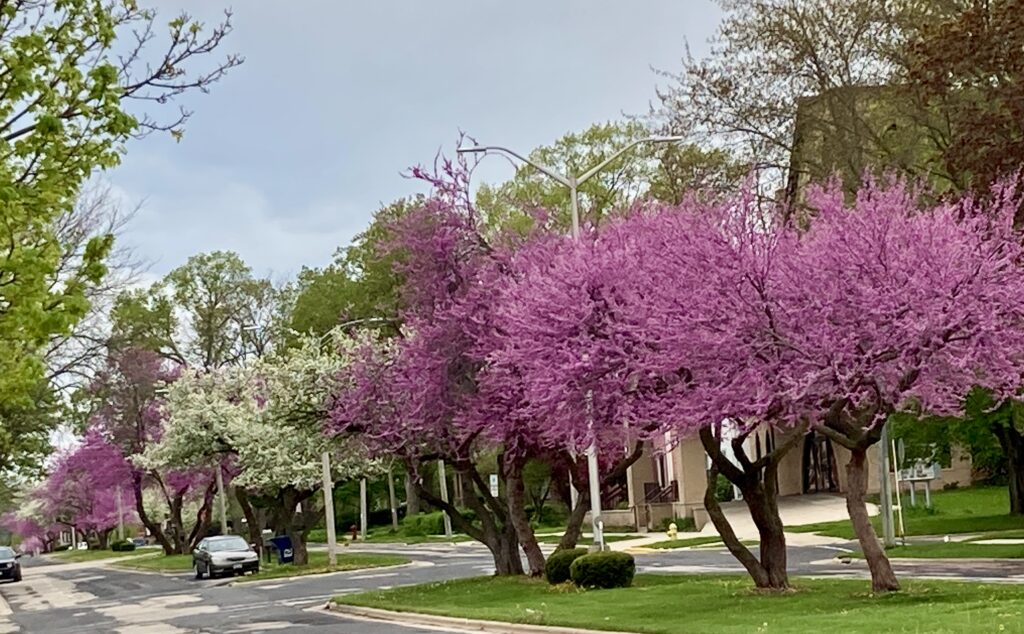
Each May, they host a Redbud Festival to celebrate the redbuds that grace the downtown boulevard and dot many of their yards. Last week, on our way home from Madison, we decided to pop in and see if the trees were putting on a show. Jackpot! It was a southern spring spectacle in southeastern Wisconsin.

Here are some photos of the Columbus trees in bloom, plus some photos of the town’s architectural star.

Eastern Redbud Facts

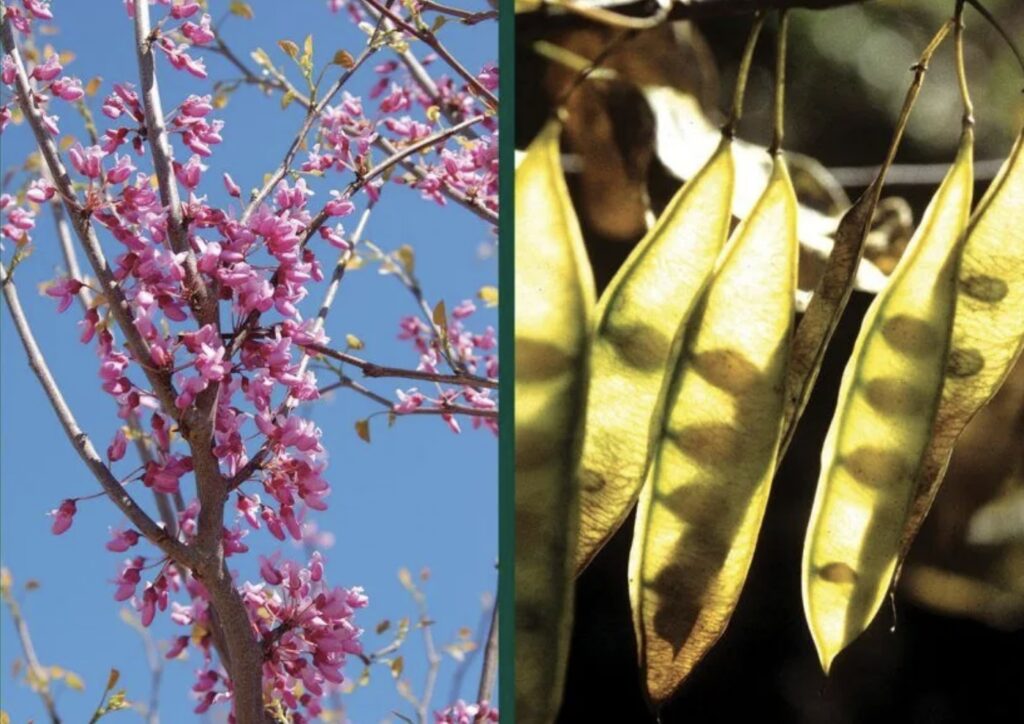
Redbuds are related to the pea family of plants. Flowers appear before any leaves open and last about three weeks. Only a half inch across, the tiny blossoms are a delicate reddish-purple color. Leaves are heart-shaped, and seeds are in pea-like pods. The trees can reach heights of 20 to 30 feet. Average lifespan is 50 to 70 years. The Columbus strain of Eastern Redbuds is famous in the American nursery industry “as being the hardiest source for plant production.” Some of Columbus’ redbuds are close to 100 years old.

6