Bridges

I am a lover of bridges, both the mighty and the minute. Going up and over and getting a lovely view gives much pleasure.

As a historic preservation Commissioner, I quickly learned that bridges, unlike buildings, get beaten up all the time and have finite lives. Even die hard preservationists can’t save aging, albeit beautiful, bridges.

Luckily, my husband shares my fondness for fine bridges, and we frequently drive miles out of our way to cross one. The tip of  Illinois at Cairo is bridge heaven. We happily drove back and forth several times over the Mississippi and Ohio River bridges only stopping to change drivers so the other person could enjoy the views.

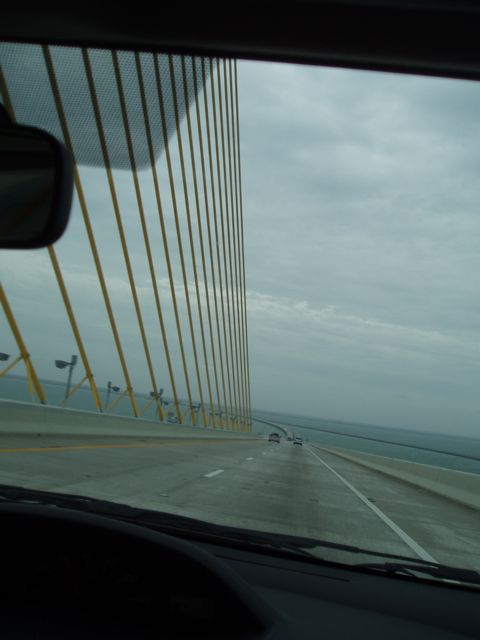
An efficient bypass around Tampa saves drivers from going over Tampa on the Sunshine Skyway Bridge. We definitely turned that option down and were rewarded with spectacular vistas of both the bridge and the bay.

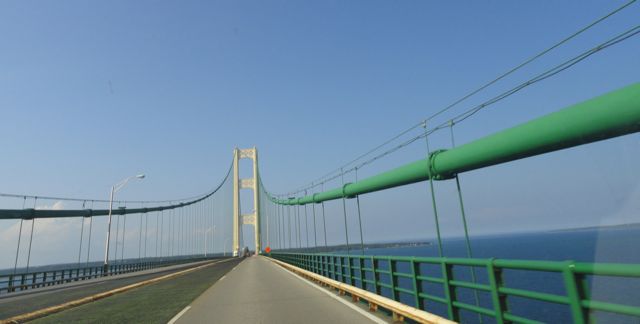
Five hours from our house is the Mackinac Bridge, the longest suspension bridge in the western hemisphere. It joins the upper and lower parts of Michigan in fact, if not in culture. Like the denizens of the Conch Republic, a.k.a. Key West, Yuppers seem to enjoy being a breed apart. Bridges can do that to you.

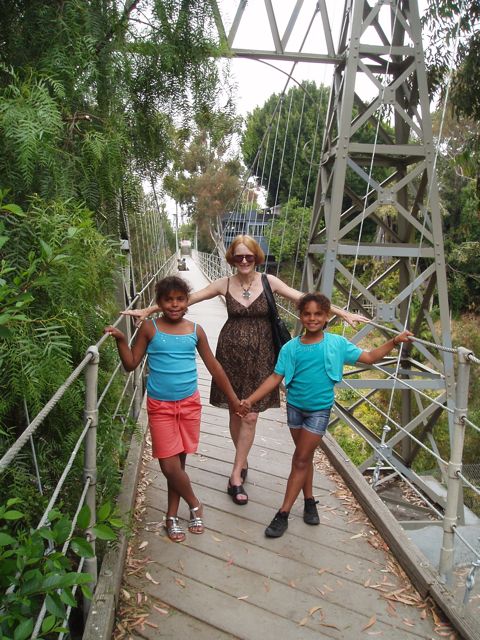
Small bridges have charm as well. My favorite is the 98 year old Spruce Street pedestrian suspension bridge in San Diego. It was originally built to allow disembarking streetcar passengers access to their homes on the far side of the ravine. If no one else is on it, we love to go out to the middle and get it swinging. This activity is not for the faint of stomach.

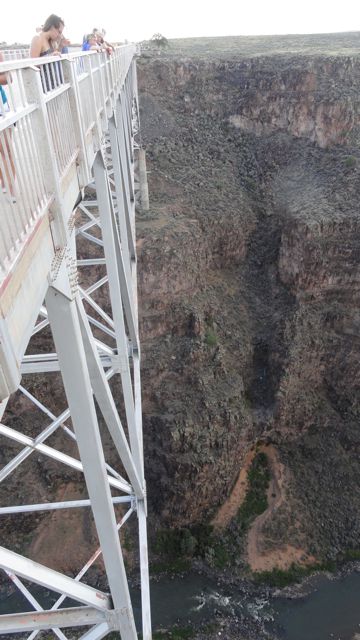
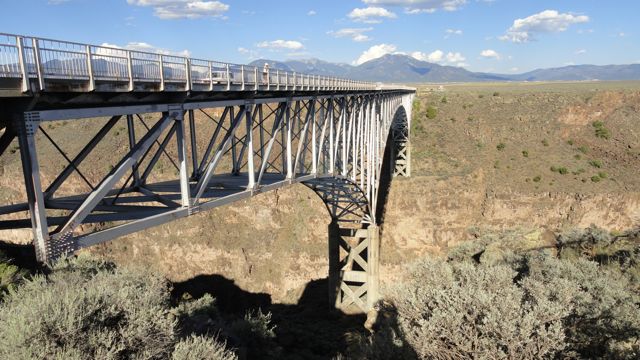
The Rio Grande Gorge Bridge just north of Taos, New Mexico, is an absolutely flat bridge which doesn’t give away its secret until you are on it. Look down, and down is forever which proves that rivers are the best stone carvers of all time.

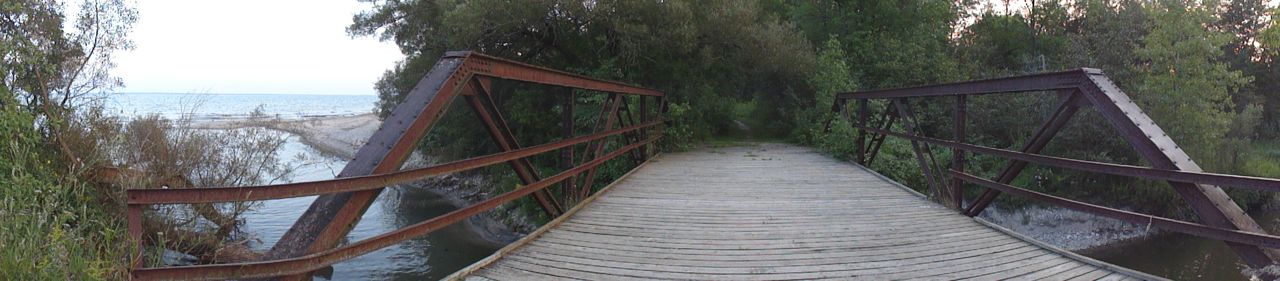
The bridge nearest our home is the Fischer Creek Bridge beside Lake Michigan. Like many bridges, it is a homage to the triangle, that tough shape that puts the strength into our buildings and bridges. Rectangles aren’t up to the job: they squish too easily.

I’ll cast my vote for bridges anytime. They are infinitely better than walls.

To view a delightful and surprising adaptive reuse of an old trolley bridge, click here.
0

Stoned

Sometimes you have to leave home to discover what’s in your own front yard. In our case, we had to go all the way to Tucson to learn what’s in Lake Michigan.

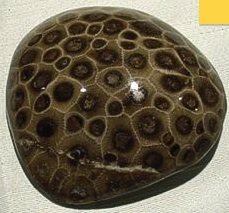
Several years ago, we were at the gigantic Tucson Gem and Mineral show when we spotted a booth proclaiming the wonders of “Petoskey Stones”. We drifted over to discover that these amazing and lovely rocks are found  in our own Lake Michigan… but on the opposite shore near Petoskey, Michigan.

The charming, elderly couple who ran the booth had come from Northport, Michigan, to display their polished rocks as well as jewelry, paperweights and other items made from the stones.

The geology of Petoskey Stones, Michigan’s State Stone, is fascinating. The rocks are fossilized coral from the Devonian Period. The land we call Michigan now was covered by a shallow sea 360 million years ago, and  a species of coral called Hexagonaria Percarinata grew in the reefs. Glaciers subsequently moved, rounded and smoothed the stones.

On a trip to the eastern shore last year we did not find a Petoskey Stone. The city of Petoskey, however, was a delight to visit. This year we went back and hit the jackpot. Walking on the beach at Charlevoix, a stone’s throw from Petoskey, we struck up a conversation with a fellow beach walker. We inquired about Petoskey Stones, and she reached down in the water and came up with one. “It’s easier to spot one in the water than on the beach,” she helpfully said.

She was right. Here I am with my treasure.


0

Libraries

I exist because of a library… the elegant Milwaukee Central Library to be exact.

More than a decade before I was born, the woman who would become my mother worked at the circulation desk of Milwaukee Central. A young man came in every week and checked out large piles of books. He was also checking out my mother. Eventually, he got courageous enough to ask her out on a date, and, lucky for me, she accepted.

Of course, if I wished to be more precise, I could thank Benjamin Franklin for my tenure on the planet. In 1871 he started the first free, public lending library in America. Up to this time, libraries were only for the royal, the rich or the church. Peasants did not have library cards. That would have been too dangerous.

My connection with libraries did not end at birth.I have visited some library almost every week of my life since I was four years old. For five years I had my dream job as the “Children’s Programmer” for the Greenfield Public Library. I was paid to read new children’s books, create programs for young people and present them. And for the last 24 summers I have had the pleasure of traveling the state of Wisconsin to present summer reading programs in libraries large and small.

Currently, debates rage on the need for libraries in a computer age. Who needs libraries when all knowledge is as close as your keyboard? Might I suggest that life (real not virtual) will always be found at the library. I should know.

0

Dragons

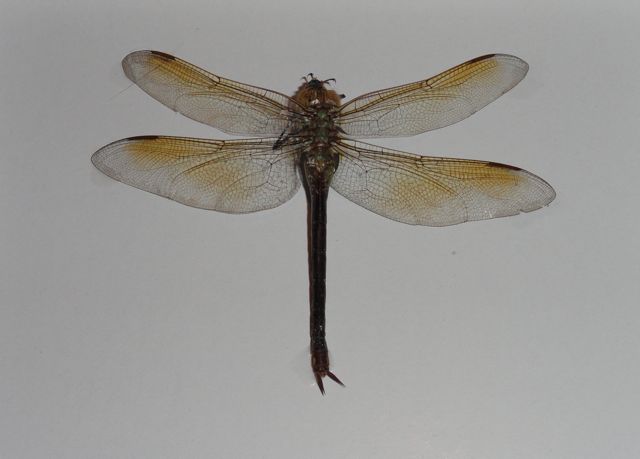
I hurry home from work on summer days eager to see what’s going on in my yard. Every summer evening is special, but last Wednesday at dusk was spectacular. As we sat having dinner on the front deck, the sky directly overhead was peppered with giant dragonflies. They were zigging, zagging, dropping straight down, zooming vertically and, in general, putting helicopters to shame with their aerial stunts. I know that as they were performing these feats, the dragonflies were simultaneously grabbing bugs with their front legs and stuffing the insects into their mouths. The only show more sensational would have taken place in prehistoric times when dragonflies had wingspans of 2.5 feet.

In the airspace above the dragonflies, about forty of our purple martins were swooping around, chattering and gobbling insects for bedtime snacks. We observed that no dragonflies got picked off by the martins. I’m guessing the dragons were too big a mouthful.

As the last rays of the sun were fading, the highest layer of the sky was filled with silent streams of gulls winging home for bedtime in the lake.

In less than an hour, we witnessed hundreds and hundreds of flight paths. Unlike O’Hare, no control tower  filled with air traffic controllers was needed. And we are happy to report that, despite the congestion, no mid-air collisions occurred. Nature certainly has her act together.

0

Lobsters

Understanding the big picture is more important than knowing the details. Delightful as they may be, details should be the dessert.

That sums up my teaching philosophy of the last forty-nine years. Whether I am teaching art or natural science, I stick to the creed of large to small.

“Plan the entire picture first,” I remind the kids in my art classes. Or, “learn about the animal’s habitat, then see how that animal adapts to its environment”. In other words, make the connections.

Which brings us to lobsters and their friends. I loved biology and lapped up information on scores of species. But throughout grade school, high school and college, no teacher ever taught me the word “arthropod”. Many years later I was in a big Canadian natural history museum which had a banner extolling “The Wonderful World of Arthropods”.

“What’s an arthropod?” I asked my husband. But his teachers had not answered that question either. To this day, grade schools mostly ignore the large arthropod group and zoom in on the insect class.

The museum clearly presented us with the big picture in brilliant ways. Arthropods are a large phylum of animals with many jointed legs, segmented bodies, an outer shell and no backbone. Then the exhibits introduced the classes of animals with these features.

All of a sudden I saw lobsters in a whole new way. The curtain had fallen from my eyes. Lobsters look just like gigantic bugs or bugs just look like itty-bitty lobsters. These guys are all cousins along with other crustaceans, centipedes, millipedes, spiders and insects.

Arthropods are a big deal. They are the most numerous animals on earth. When we mammals mess up the planet beyond repair for our survival, the arthropods will probably continue on their merry way as they have for eons. Kids should definitely learn the big picture.

0