Installations

Public art can bring joy or dismay. Either way, I wouldn’t want public money not to be spent on it. People need art because the arts humanize us. Art is never without controversy, and even controversial art serves a purpose: it gets us thinking.

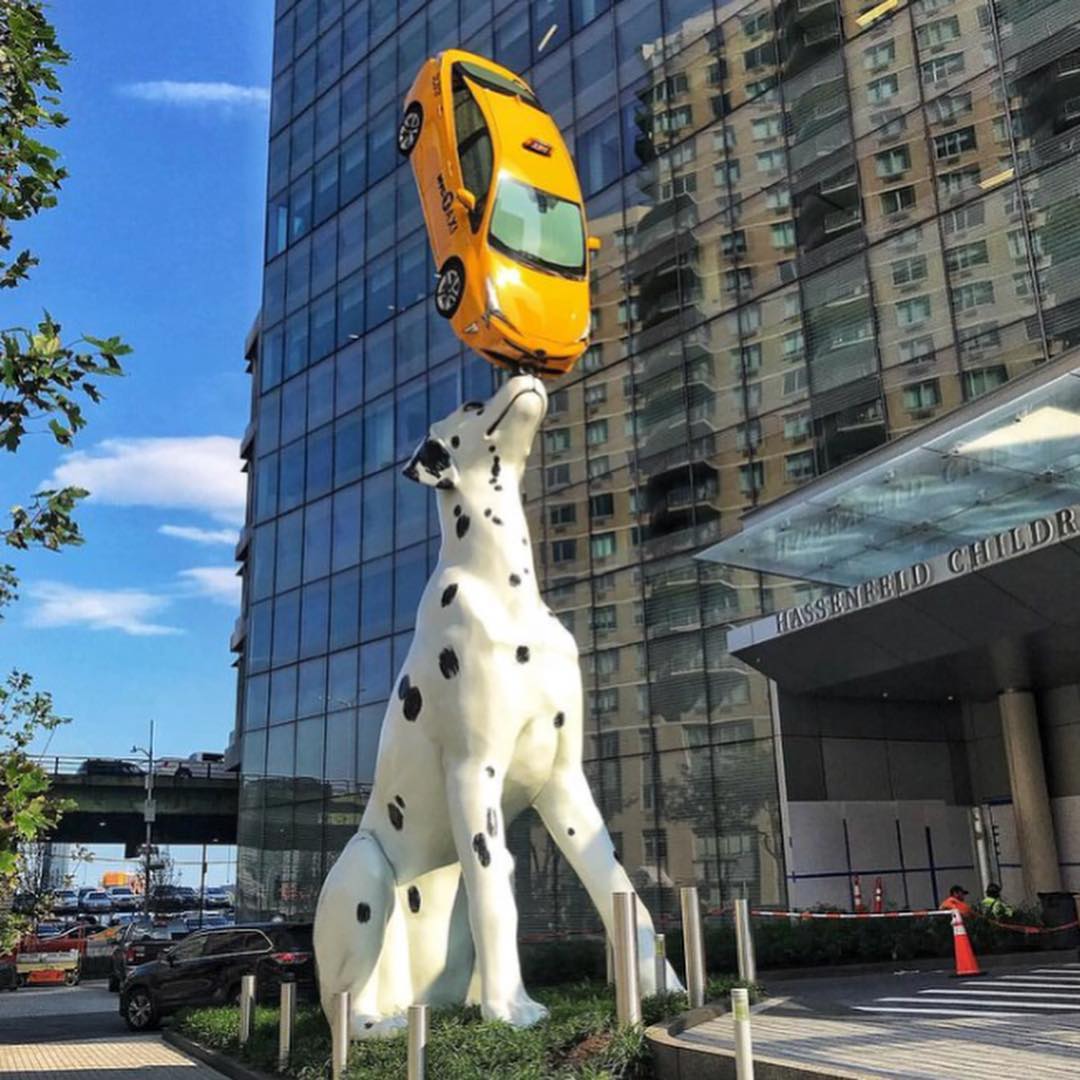
New York City has recently gone on a big binge of public sculptures. One new piece is particularly delightful to me, and I can’t wait to see it in person, preferably on a rainy day. Entitled “SPOT”,  Donald Lipski’s sculpture stands in front of Hassenfeld Children’s Hospital in Manhattan. The work consists of a 24 foot tall, spotted Dalmatian which is balancing a real New York City taxi on its nose. The cab is sans engine and other guts, but when it starts to rain, the windshield wipers turn on.

Explaining his creation, Mr. Lipski says he wanted the big dog/taxi combo “to have assets we hope to find in our doctors: focus, confidence, patience and sweetness.”
This child-friendly sculpture aroused my curiosity about Donald Lipski’s other installations. I quickly learned that he is one of America’s most prolific creators of art in public places. Scanning through numerous photos of his large scale works, I loved the wit, diversity of materials and imagination he employs. But then came the big surprise: he is also the designer of a sculpture I see frequently and loathe.

The sculpture was commissioned by the University of Wisconsin and stands outside our big football stadium in Madison. A UW graduate, Mr. Lipski named the sculpture Nails’ Tales, after his roommate Eric “Nails” Nathan. The sculpture is a lone limestone column from which dozens of footballs are emerging like some malignant growths.

When asked if the University gave him any guidelines, the artist said the University’s facilities manager and athletic director both asked for “something that projects power and strength. Something that is tall and vertical and holds its space…something virile.”

Lipski adds, “They were without saying, saying they wanted something phallic.”

And that is exactly what Donald Lipski gave them. It is probably a fitting tribute to football, a sport where guys bash each other’s brains out.

 

0
Pantry

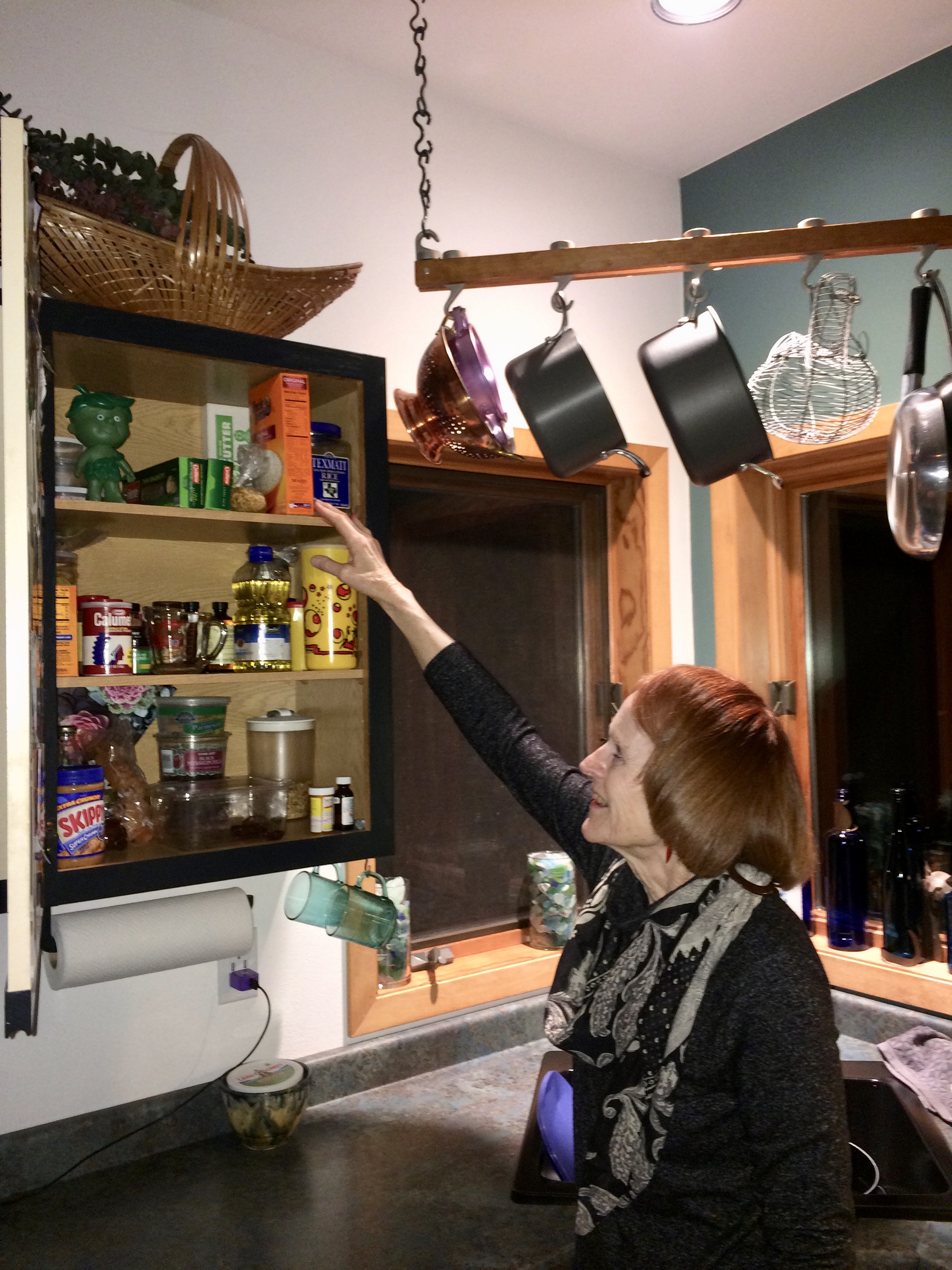
Last week, the New York Times’ food section ran a feature on the well-stocked pantry. The writers offered three lists of must-have items for the essential, expanded and expert levels of home cooking. Even before reading the article, I feared I would miss the mark on every level. And I also knew it would be my father’s fault.

Deeply embedded in my psyche is the belief that wasting food in a world where so many go hungry is very, very wrong. My father always asked my mother to cook only what our family needed for dinner, not extra food “in case someone drops over at dinner time”.

We never stockpiled food, either. Our cupboards and fridge were never crammed to overflowing. Tons of food was wasted in the 1950’s, however, as it was piled into bomb shelters so that nuclear families could survive a nuclear holocaust. (Our species does love magical thinking.)

Reading the foodstuffs required for “perfect pantries”, I was surprised that I had most of the items deemed necessary for the essential level of cooking. In fact, I excelled in the essential baking ingredients. But I will never have the right stuff on hand to reach the exalted levels of expanded or expert cook.

Here are but a few of the many items I am lacking:

  • red curry paste
  • harissa
  • verjus
  • olio santo
  • verjus
  • mirin
  • caperberries
  • dukkah
  • shichimi
  • gochujan
  • thai bird chilies
  • makrut lime leaves

I would bet a big pile of money that these items sold out last week at upscale urban markets such as Whole Paycheck.

Acknowledging that the pantry items won’t be the same for every cook, the article did provide some solid advice on managing the food we buy. My favorite was F.I.F.O. , or first in, first out. In other words, “cook in order of freshness”.

Other wise words were, “If you haven’t used it in a year, get rid of it. Then restock with an eye to the things you are confident using and what you love to eat.

Now those are words I will be happy to cook by.

My cupboards aren’t bare.
0

Glasses

Years ago, my husband had a friend with a watermelon problem. The guy was red green colorblind and could not tell when he was eating into the green part of the melon before the rind. My husband would alert him when it was time to stop eating.

How sad it would be not to see every color of the spectrum at full hue and intensity. From as far back as I can remember, I have been in love with color. Every color in the rainbow is a source of daily joy, and I can’t imagine living in a personal world lacking such constant beauty.

However, color blindness, or color visual deficiency, is a common affliction, affecting about 1 in 12 men worldwide and 1 in 200 women. Several different variations of color blindness exist with the red green type being the most common.

Last Saturday, I chanced on a program on NPR and heard some amazing news. An “accidental invention” has led to the production of glasses that enable people with red green color blindness to see vivid colors for the first time.

The breakthrough came on a frisbee field. Don McPherson, the inventor of tinted glasses that protect surgeons’ eyes from laser lights, was wearing his invention while playing in an extreme frisbee game. His friend asked if he could try on the sharp looking glasses. When he put the glasses on, he saw bright colors for the first time in his life.

Here is a YouTube on how this chance discovery turned into Chroma Glasses which have given rainbows back to over 30,000 people. Bravo to science, scientists and serendipity.


0

Avocado

I received the news from a friend of mine, a former children’s librarian and soon-to-be-published children’s book author, that John Burningham has died in London at the age of 88.

An award-winning author and illustrator of books for children, Mr. Burningham’s books brim with gentle wit and kindness. He and his wife, Helen Oxenbury, also an author, have been bringing delightful tales to young and old alike for over six decades.

Mr. Gumpy’s Outing is undoubtedly John Burningham’s most famous book. However, when I heard of his passing, the first thing I thought of was avocados.

I stumbled upon his book, Avocado Baby, when I was the children’s storyteller for my local library. All these years later, that book stands out in my mind as one of the funniest books I ever used in my storytimes.

Mr. Burningham’s editor, Kate Fletcher, says, … “he never speaks down to his audience, yet captures the spirit of imagination and inquisitiveness in children so well. In his own words for describing his approach to book-making: ‘There is no demarcation in my work for children and for adults.’ ”

I invite you to see for yourself. Click here for a short YouTube video of a British storyteller reading Avocado Baby.

With the condition that America is in now, we could use an Avocado Baby in our midst.

0

Will

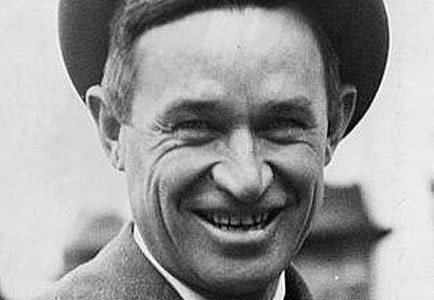
I was driving down the Will Rogers Turnpike in northeast Oklahoma last week when my thoughts turned to the road’s namesake. My favorite quote of his popped into my head: “I am not a member of any organized political party. I am a Democrat.” Having been a card-carrying Democrat all my life, I can attest to the truth of his words.

The drive motivated me to know more about this witty man who H.L. Mencken called, “the most dangerous writer alive.”

William Penn Adair Rogers was born on November 4, 1879, in the Cherokee Nation in Indian Territory. (Oklahoma would not become a state until 1907). His parents were Cherokee and white but identified most closely with their Indian ancestors. In addition to being a prosperous rancher, his father was an attorney and a Cherokee judge.

Will’s wit and intelligence often got him in trouble at home and in various schools when he was growing up. Reaching adulthood, he left the ranch to see the world where he found work in Wild West shows doing rope tricks while telling jokes. This led to the vaudeville circuit and then to the Ziegfeld Follies on Broadway. Will Rogers was a success on Broadway and an even bigger celebrity when he went to Hollywood and appeared in dozens of silent films.

America couldn’t get enough of Will Rogers, and soon he was writing regularly for The Saturday Evening Post and newspapers all over America. By the 1930’s he also had a number of best-selling books including one with the improbable title, “There’s Not A Bathing Suit in Russia”. All the while he continued making films, now talkies, three of which were directed by John Ford.

Will Rogers had a life long love of airplanes and traveled around the world three times making friends wherever he went. In 1935, he and aviator Wiley Post died when their small plane crashed in Barrow, Alaska. All of America mourned the man whose political humor never offended any of its targets. His words remain with us today and are more timely and needed than ever. Here is a sampling:

  • I hope there are some sane people who will appreciate dignity and not showmanship in their choice for the presidency.
  • I don’t make jokes, I just watch the government and report facts.
  • Everything is changing. People are taking their comedians seriously and the politicians as a joke.
  • Why don’t they pass a constitutional amendment prohibiting anybody from learning anything. If it works as well as prohibition did, in five years Americans would be the smartest race of people on Earth.
  • Democrats never agree on anything, that’s why they are Democrats. If they agreed with each other, they would be Republicans.
  • The country has come to feel when Congress is in session as when the baby gets hold of a hammer.

Amen!

0