Our planet is geologically active. Or, as I explain to kids, it rocks and rolls. Earthquakes and volcanic eruptions remind us that the rocks under our feet are constantly on the move.
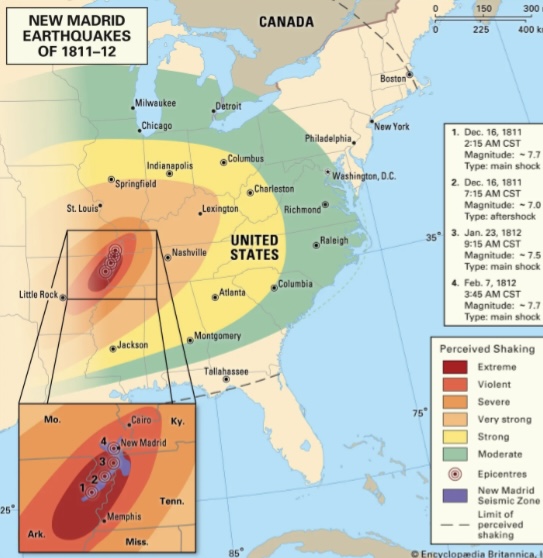
Here’s an interesting question. Where did the largest and most powerful series of earthquakes occur in America? The answer may surprise you…it was smack dab in the middle of the country and it started 211 years ago this week. During the winter of 1811-1812, three gigantic earthquakes occurred in the New Madrid seismic zone in the mid-Mississippi River Valley. Damage was reported from over 300 miles away.
The first struck on December 16, 1811, and the epicenter was in northeast Arkansas. At an estimated 8.6 magnitude, the quake was felt over the entire eastern United States and parts of Canada. President James Madison and Dolly Madison felt it in the White House. Tremors caused church bells to ring in Charleston and Boston. In Annapolis, the cupola of the statehouse swayed by several feet.
On January 23, 1812, the second quake of 8.4 magnitude began, causing damage over 232,000 square miles. The epicenter was near New Madrid, Missouri. But it was the third on February 7, 1812, at 8.7 that was the largest of the quakes. It entirely wiped out the town of New Madrid, caused the Mississippi River to flood and formed Reelfoot Lake in Tennessee. Boatsmen reported that the Mississippi River flowed backwards for several hours and waterfalls popped up in the river.
Ironically, the first steamboat ever to ply the Mississippi was caught in the quakes. The passengers woke one morning to find the island they were moored to had disappeared. But somehow the boat miraculously did complete its harrowing journey to New Orleans.
In addition to the three major quakes, about 2,000 aftershocks rocked the area. They created large fissures in the land, caused river banks to collapse, felled massive numbers of trees and toppled or tilted dwellings.
Other phenomena of the quakes were sand boils or vast patches of sand that suddenly appeared in the middle of fields and lights flashing up from the ground from quartz being squeezed. The sky turned dark, the air was hard to breathe and smelled foul. Understandably, many people thought the world was ending. Some even blamed the disaster on the steamboat.
Fortunately, in 1811, the population in the central United States was sparse. Only about 5,700 people were in the St. Louis area. Today the St. Louis-Memphis region is home to around 12 million people.
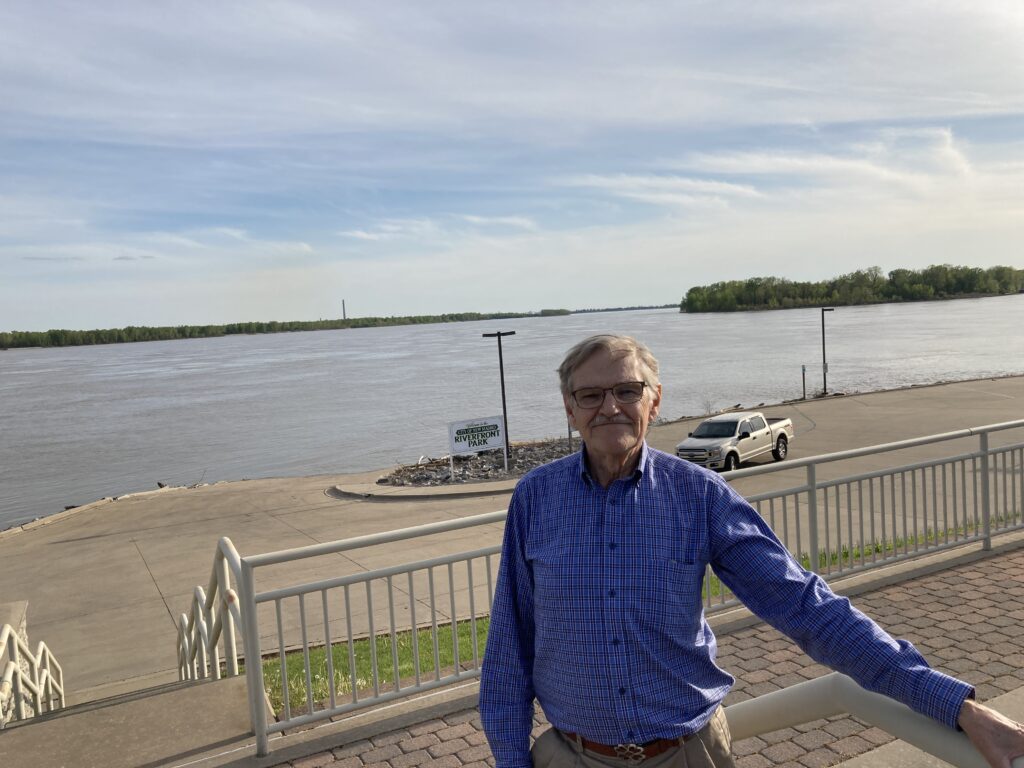
The New Madrid seismic zone remains the most active in America east of the Rockies registering about 200 earthquakes every year. Luckily, most are too small to be felt and all is peaceful in downtown New Madrid.
Whole ‘Lotta Shakin’ Goin’ On – Jerry Lee Lewis. Fayetteville, Mississippi
Now we know where that came from, thanks.