Living surrounded by animals, I often wish I could see what the world looks like through their eyes. I’m aware that human eyes excel at clarity of vision compared to hundreds of other species. But how do we compare in other areas such as color perception, night vision and field of vision?
To start, it must be noted that “we cannot actually see through another life form’s eyes but…we can make a close approximation.” Recent advances in science and technology are providing a better look into animal vision than previously possible.
Humans are trichromats, meaning we have three types of cones in our eyes which perceive red, green and blue, the primary colors on the light spectrum. Dogs are dichromats, having two types of cones which are tuned to yellow and green. Through a dog’s eyes, A red ball tossed on green grass would look like a yellow ball on a white or gray field.

According to researchers at McGill University, cats’ eyes are “a bit of a mystery”. Think of them as trichromats who are red-green color blind. Colors are also more muted to a cat. Their distance vision is blurry, but their peripheral vision is wider than ours. Plus, they are champions at detecting motion, even in darkness.

The most important sense of birds is sight, and avians perceive the world in ways we cannot. Classified as tetrachromats, they see ultraviolet light plus subtle differences between shades of color that the human eye cannot distinguish. Being able to see UV light enables birds to zero in on plants, hunt prey (the prey’s urine trail lights up), eject parasitic eggs from their nests and find mates.

Daytime (diurnal) birds have the best color sense. Nocturnal birds are endowed with more rod cells which capture the maximum amount of available light. In addition, many night birds such as owls have large eyes for taking in more light.
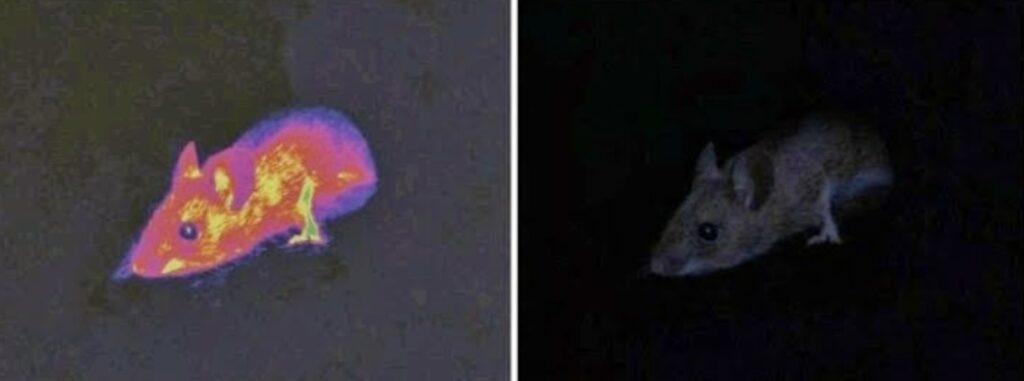
Over millions of years, the eyes of snakes have evolved in unique ways. Some are dichromats seeing two primary colors. Others such as boas, pythons and pit vipers can “see” the infrared spectrum. The heat given off by warm blooded prey such as a mouse, glows. Their meal literally lights up.
And, finally, a quick look at insect eyes. Insects have compound eyes made out of hundreds of six-sided lenses. However, they DO NOT see hundreds of images. They see one image as we do, but would be legally blind by human standards. Their resolution is 100 times worse than ours. However, their field of vision is much wider than ours. Dragonflies, for example, have almost a 360 degree field of vision. Insects also possess superior motion detection.
Many insects also see ultraviolet light which is given off by flower petals. This enables the “legally blind” butterflies and bees to hone right in for that lunch of nectar or pollen.
Wouldn’t it be amazing to be able to spend a few minutes seeing the world through each of these different creatures’ eyes?

I’d like the ultraviolet light given off by flower petals . . .
sigh . . .