Pandemonium

I’ve constructed a little wordplay to start 2022. It’s archaic.

As the New Year begins, let’s leave behind panic, pandemonium, chaos and fury. Lethargy, narcissism and phobias will be things of the past.

Instead, we will pack an atlas and head to Europe where we’ll listen to music while dining on nectar, ambrosia and cereal. For our mental hygiene, we can be mentored in psychology, succumb to hypnosis and entertain erotic fantasies. 

Good fortune will reign and the world will be brighter. Even the flora and fauna will be iridescent. How jovial it will be!

A New Year may be about to start, but the past lives on in the present. This story is brought to you by the Greek and Roman gods and goddesses and their entourage. Here’s the complete cast of characters and references.

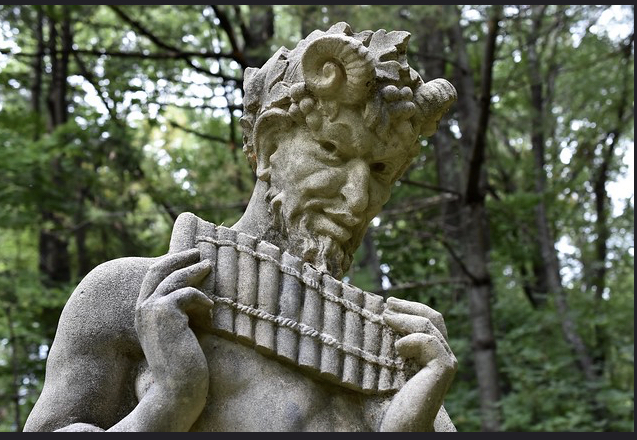
  • Panic and pandemonium – Pan was the god who stirred up confusion and fear.
  • Chaos – Comes from the Greek myth of Khaos, the void from which all life sprang.
  • Fury – The furies were the goddesses of vengeance.
  • Lethargy – In Greek mythology, the River Lethe in the underworld was “the river of forgetfulness”.
  • Narcissism – Narcissus fell in love with his own reflection.
  • Phobia – The Greek god of fear.
  • Atlas – Atlas was a Titan who carried the world on his shoulders.
  • Europe – Europa was a beautiful princess who Zeus fell in love with.
  • Music – Named for the Muses, the goddesses of art and science.
  • Nectar and Ambrosia – The food and drink of the gods.
  • Cereal – Ceres was the Roman goddess of agriculture.
  • Hygiene – The Greek goddess of health and cleanliness was Hygieia.
  • Mentor – Odysseus entrusted his son’s education to a man named Mentor.
  • Psychology – Psyche was the Greek goddess of the soul.
  • Hypnosis – Derived from Hypnos, the Greek god of sleep.
  • Erotic – Eros was the Greek god of love and desire.
  • Fortune – The Roman goddess of chance was Fortuna.
  • Flora and Fauna – The Roman goddess of flowers was Flora. Fauna was a minor Roman goddess whose brother Faunus was the Roman equivalent of Pan.
  • Iridescent – Comes from Iris, the Greek goddess of the rainbow.
  • Jovial – From Jove, the chief Roman God also known as Jupiter.

May your New Year echo* with love and laughter.

*Echo, the Greek mountain nymph who was deprived of her speech, except to repeat the last words of another.

5

Donald

Every December for over 30 years, I have done a program called “Festival of Lights” which highlights beautiful holiday traditions worldwide. All people seem to crave lights and the brightness of smiles to break through the winter gloom.

Many individuals and families have shared their unique traditions with me, plus I have done extensive research. My files are overflowing. But the latest tradition I recently discovered is so bizarre it made me laugh out loud when I read about it. So what is this extremely popular Christmas tradition? It’s none other than Donald Duck.

In Sweden at 3:00 PM on December 24, half of the entire population will be glued to their televisions for one hour. They all will be watching the same program, a 1958 Christmas special from Walt Disney, “From All of Us to All of You”. In Sweden it is called, “Kalle Anka och hans vänner önskar God Jul”. That translates to “Donald Duck and His Friends Wish You a Merry Christmas”.

It all started in 1959 when TV was new and Sweden only had one channel. No other American cartoons were aired at that time. The Swedish population was enchanted by Disney and has remained so every year since. This mass viewing is thoroughly ingrained in Swedish culture and is honored with a display in Stockholm”s Nordic Museum.

“Kalle Anka” consists of Jiminy Cricket presenting “Silly Symphony” shorts and clips from Disney classics like Snow White, Cinderella, Bambi and the Jungle Book. Each year, one new snippet from a current Disney movie is aired, but the show is essentially a nostalgia trip on steroids.

The Swedish people take “Kalle Anka” seriously. Several attempts by the network to cancel the show (mostly because of excessive violence in the cartoons) have been met with public outrage. The viewing time is so sacred that a curator at the Nordic Museum states, “at 3:00 in the afternoon, you can’t do anything else, because Sweden is closed”.

I am a believer in traditions, even crazy ones such as this. Whenever a nation comes together for one happy event, that’s a good thing. The man who gives Jiminy Cricket his Swedish voice says, “like a fairytale when we were kids, there’s something familiar. Kalle Anka offers security in a confusing world”.

Who doesn’t need that at this moment?

The Swedish version of this would be more fun, but Disney blocks the copyrighted rebroadcasts of Kalle Anka on Christmas Eve to American viewers… as far as I and my computer guru can determine. If you can find the Swedish version that can be shared, let me know.

0

Nothing

The New York Times recently ran an editorial piece entitled “The Joy of Buying Nothing New for the Holidays”. In it, Vermont journalist, Annelies Griffins, presents numerous ways to get gifts from thrift and resale shops, used book and antique stores, plus swap tables and white elephant exchanges. She is careful to note that, “this is not about being a Grinch, canceling Christmas or trying to pass a minimalist purity test.” Rather, it is about being kind to the planet by moving recycled consumer goods around in one city as opposed to transporting new, manufactured items around the globe.

As my family and friends know, I heartily concur with this sentiment. Gifts do not have to be new. But they should be filled with thought.

Ever since I was a child, I have loved giving presents. Going to the dime store with my small allowance, I perused the crowded aisles trying to find the perfect purchase for everyone in my family. When my funds were depleted, I made presents such as a clay “snowball” candle holder for my mother. In retrospect, I’m sure my mom liked that lopsided snowball better than the tiny bottles of Blue Waltz dime store perfume that I often bought her.

As an adult, I am still thrilled when I spot the ultimate present in a thrift store and cannot wait to see the recipient open it. Has my guess been correct?

I am not able, however, to give only recycled items. Two categories of new gifts are high on my radar screen. The first is the beautiful work created by artists and craftspeople. Many of my friends are creators and they need to make a living. I am delighted to be their customer.

The second group of new gifts is FOOD, the gift that doesn’t have to be dusted, just enjoyed. I love baking Christmas cookies to give away as gifts and I equally enjoy getting homemade soups and other edible treats as presents. One of my favorites was the homemade caramel corn I received as a teacher gift every year from one of the kid’s mothers. That was 36 years ago and I still remember awaiting and eating it with pure bliss. No caramel corn will ever match hers.

It’s not the Black Friday or mall crawl merchandise that makes memories. It’s the gifts that are the result of careful thought, work or both that resonate. May you get many of these insightful gifts.

A great Christmas gift of homemade broccoli cheese soup. For some reason, it came in two parts!

1

Cowed

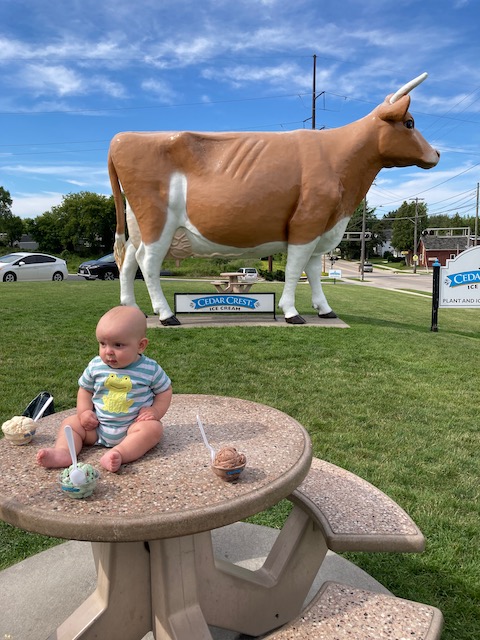
My husband and I are ardent fans of giant fiberglass cows. We are fortunate to live just down the road from Bernice, a beautiful big girl who stands in front of our local ice cream factory. Affectionately referred to as “the Big Cow” by almost everyone in Manitowoc, her hometown, she has been known to don special attire for events such as Sputnikfest.

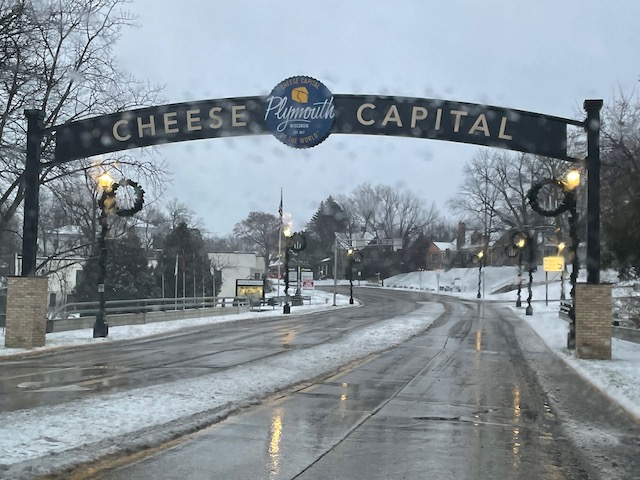
In the nearby town of Plymouth stands another supersized bovine named Antoinette. This lady’s a Holstein and a tribute to Plymouth which bills itself as “The Cheese Capital of the World”. That might be a bit of hyperbole, but the city’s cheese statistics are impressive. Four major cheese factories operate in the town and they produce 15% of Wisconsin’s cheese. (Wisconsin makes 27% of America’s cheese.) If Plymouth were a country, it would be the 4th largest cheese producer.

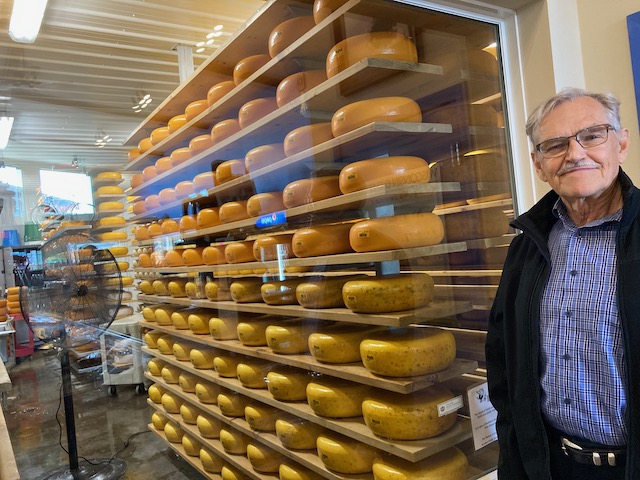
On a recent road trip, we serendipitously discovered two more humongous, Wisconsin girls. The first welcomed us to the delightful Marieka Gouda Cheese facility in Thorp. The owners are from the Netherlands so they know a thing or two about making award-winning Gouda cheese. A visit to their store and cafe is like a mini trip to Holland.

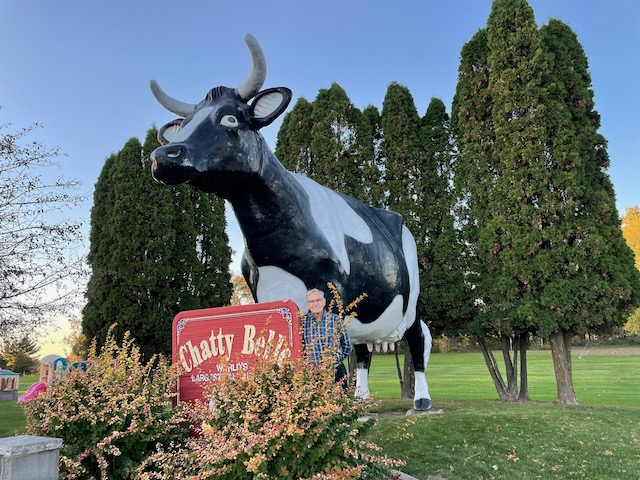
The second cow, Chatty Belle, lives in Neillsville and is “the World’s Largest Talking Cow”… if you put a quarter in her voice box. She was named by a first grader who received 100 pounds of butter for coming up with the winning name. Chatty Belle’s a traveler, her first appearance was at the 1964 World’s Fair in New York. When she came home to Wisconsin, she brought the Wisconsin Pavilion at that Fair back with her. This whimsical piece of Atomic Age architecture stands beside her and is used as the headquarters for a local radio station. Chatty Belle will tell you all about it.

2

Margherita

Almost everyone loves pizza. A generous combination of grease, salt, carbs and seasonings is hard to resist. Plus, no utensils need be involved to eat it.

My husband and I are firmly in the camp of pizza-lovers. So much so, that we reserve pizza eating as a treat, a dinner out at a carefully chosen pizzeria. Lacking a wood-fired oven, we don’t ever attempt to make them at home.

Like all pizza aficionados, we do have preferences. We both agree that the crust should be paper-thin and crisp; we don’t want a mouthful of dough to overwhelm the toppings. We also have a favorite pizza, the Margherita.

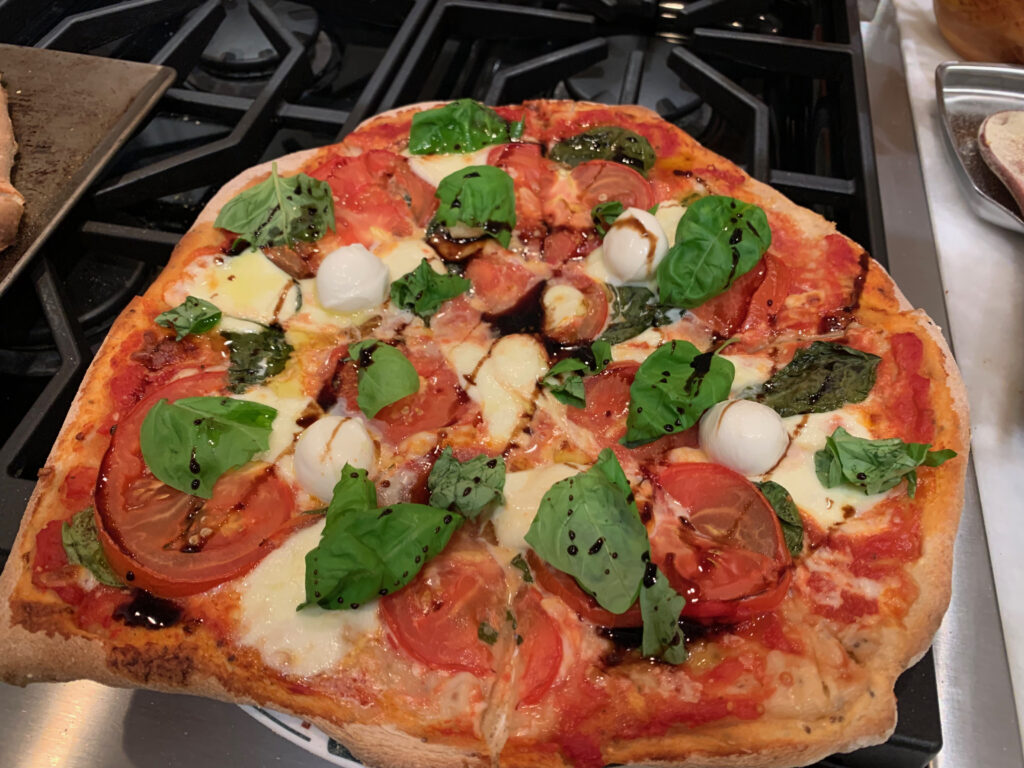
A story accompanies the Margherita pizza, and, though not completely verifiable, it’s a great origin tale nonetheless. According to legend, Italian Queen Margherita and King Umberto I were visiting Naples, the pizza Mecca of Italy, in 1889. She had become bored with the elaborate French dishes that were popular with royalty at that time and asked Naples most famous pizza maker, Raffaele Esposito, to create three different pizzas for her. She ruled against the marinara with garlic and the anchovy ones. Her royal seal of approval was bestowed on the one with red tomato sauce, white mozzarella cheese and fresh, green basil leaves. The colors neatly coincided with those of the Italian flag.

Pizza, including the Margherita, came to America in the late 19th century when waves of Italian immigrants arrived. It was sold for 2 cents a slice from peddlers’ carts in Italian- American enclaves. However, it took World War II to make pizza a staple of American life. Soldiers returning from the fighting in Italy missed the pizza they had eaten there. Pizza consumption subsequently exploded all over the U.S.A., and its popularity has not waned in 80 years.

The Margherita may be named for a queen, but it is traditionally a peasant food…cheap, filling and loaded with taste. Buon Appetito!

4