Birthday

The other day, a clerk noted my husband’s July birth date on his driver’s license and asked, “What are you doing on your birthday?”

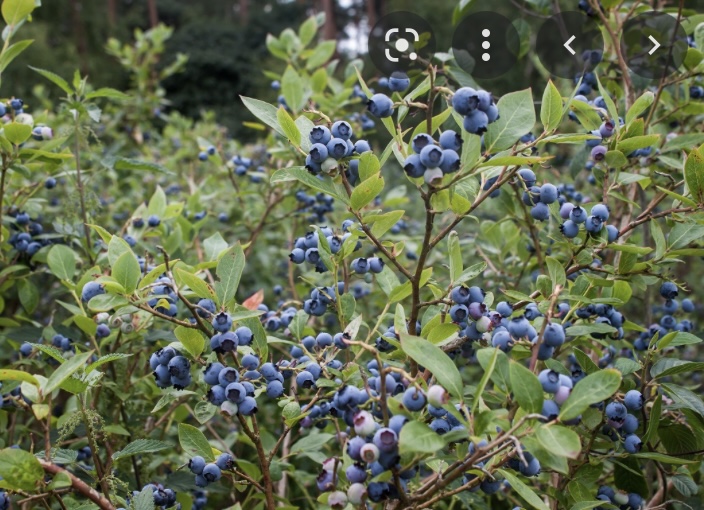
His answer was immediate and succinct…”blueberries”. She looked perplexed, and I nudged him to add a bit more. He explained, “They’re my favorite fruit and I want to eat lots of them on my birthday.”

My guy is lucky on three counts. First, he has a summer birthday, a good thing if you live in a northern clime. Second, July is National Blueberry Month. And third, we are only a five hour drive from one of America’s largest blueberry growing regions, southwest Michigan. This year we will be going there to get his berries fresh from the fields.

There are many good reasons to be a fan of this interesting fruit. Here’s the scoop on blueberries.

Blueberries and cranberries are the only two commercial fruit crops that are native to North America.

America is the world’s largest blueberry producer with Canada coming in second.

In America, blueberries are the second largest berry crop. Strawberries are number one.

People have been eating blueberries for over 13,000 years.

Native Americans called blueberries “starfruit” because of the perfect star shape at the blossom end of the berry. They would smoke the berries to preserve them for winter.

Early colonists would make gray paint by boiling blueberries in milk.

Five major types of blueberries are grown in America. The northern highbush variety is most common.

A single bush can produce as many as 6,000 berries a year.

A cup of blueberries is 80 calories. Compared to 40 other fruits and vegetables, blueberries have the highest level of antioxidants. They are an extremely healthy fruit, but not a miracle cure for everything that ails you.

Hammonton, New Jersey, claims to be the blueberry capital of the United States, but Washington State and Michigan are the top producers.

Blueberry muffins are the official state muffin of Minnesota.

New Jersey proclaims blueberries as their official state fruit.

4

Cones

Ice cream is always the star of the show with the cone being the supporting actor. But the cone comes with an interesting history filled with mystery and myth. The precise origin or inventor of the cone can not be targeted. But it is known that the cone’s invention resulted from multiple attempts to create an edible treat that did away with dishes and spoons.

Ice cream gained popularity in the 19th century. Street vendors in London sold “penny-licks”, small stemmed glasses filled with ice cream. The glasses were reused with no washing between customers, a frightfully unsanitary practice. It’s possible the edible cone was invented to avoid breakage and sanitation problems.

An alternative to the penny-lick was the hokey-pokey, a square of ice milk thickened with cornstarch and wrapped in paper. Italian immigrants introduced the hokey-pokey to America. Sold by peddlers off carts, it was a success, as was the next Italian innovation, an ice cream square between two sweetened wafers. The ice cream sandwich was born.

The next innovation came in 1901 when Antonia Valvona invented the biscuit (cookie) cups for ice cream. He and his American partner, Frank Marchiony, soon had factories churning out these edible dishes.

The World’s Fair of 1904 in St. Louis saw the ice cream cone come into its full glory. The new “cornucopias” were wildly popular and soon became staples of fairs and gatherings all across America. Historical researchers have combed the Fair’s archives, but have been unable to pinpoint who made and sold the cones. The invention story that comes closest to the event was published in 1916 in The New York Produce Review and American Creamery.

“A certain young lady had a fairground concession selling a sweet cake which she baked flat on a waffle iron-like device. Her brother sold ice cream at a nearby stand. One customer who had bought some cakes from the sister asked the brother to put a scoop of ice cream inside of them. The brother made it work by rolling up the cakes while they were still hot in the shape of a cornucopia and pinching over the end…. He then joined forces with his sister, putting the two concessions together, and they soon did a rushing business in ice cream cones, as they were very promptly dubbed.”

All this cone history brings us to 2022 and Joy. That’s the Joy Baking Group, a third-generation business that produces 60% to 70% of all the cones sold in America. They only stick to three basic classics; the cup cone, the sugar cone and the waffle cone. Their flagship factory in Hermitage, Pennsylvania, turns out between 15 to 20 million cones a day. That’s a whole lot of joy.

3

Judith

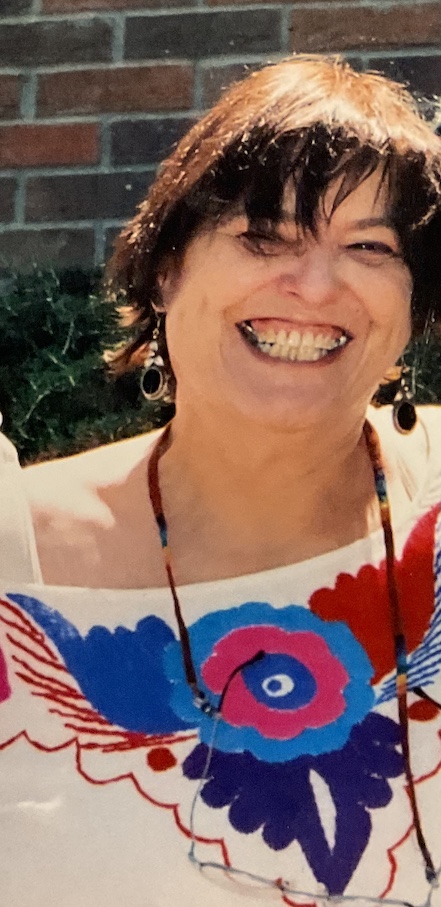
A year ago this July, one of my best friends died. I am finally able to write about her with joy that is not consumed by the sadness that comes from losing a remarkable person.

Judith L.A. Hayes was a full-throttle western gal. Her personality was huge, her laughter was raucous and her smile was like she’d just eaten all the cookies in the cookie jar and gotten away with it. She dove into life headfirst, never second guessing herself. Her heart was huge, her mantra was kindness, and, in her words, “Patience is not one of my virtues.”

Born in Chickasha, Oklahoma, Judith was one-quarter Cherokee and three-quarters European ancestry. Her family moved to Los Angeles when she was a youngster, and she loved the California lifestyle. That life ended when her father walked out of the family. Judith and her mother ended up in Alamagordo, New Mexico, the state that became her life-long and beloved home.

As a young woman in Alamagordo, Judith met many members of the local Soka Gakkai Japanese Buddhist community. Their message and work for world peace soon led her to become a practicing Buddhist. Her desire to help others also led her to become a social worker.

Our paths crossed at an assisted living facility in Albuquerque where I visited each month to care for my aunt. Judith’s apartment was across the hall. It soon became apparent to me that Judith was giving my aunt more care and love than the staff at the home.

One day I ramped up my courage, ditched my manners and asked her, “Why are you here?” I could not fathom why this highly intelligent, witty and caring fifty-year-old needed assisted living.

“I’m recovering from brain damage,” was her reply. While pruning her grape arbor, she had been bitten by a black widow spider. The venom traveled to her brain causing a stroke. Coming out of a coma, she had to learn how to walk, talk, read and get dressed. Judith was a Mensa, and her intellect was not affected, but every coordination function was impaired.

When I met Judith, she was remarkably far along in her courageous recovery. Soon after we became friends, she was able to move into her own apartment with only one hour of help a day from a caregiver.

For over twenty years we shared fun, laughter and adventures. Before we would go to the Santa Fe Opera, she would fill me in on the storylines. “Turandot’s about this evil queen who had her prospective suitors killed if she did not like them. She was really something else, you’ll love it.”

Judith was a born storyteller with an acute understanding of the human condition. She would tell me how she would ride her motorcycle up to remote places in the mountains to visit her social work cases. Some of her clients tried to con her, but they never got away with it. She did, however, on rare occasions, look the other way.

We could sit for hours discussing Shakespeare’s plays, books, Aboriginal art, history, poetry or politics. Judith had a brilliant mind, and, because of a spider, found herself trapped in a body that struggled to button her buttons, get into her bra, find her keys or drink her beer without tipping over the glass.

I can sum up my love for her with one short story. I drive her to see her brain doctor and wait in the car. She comes out and relates to me that he shows her a scan of her brain, points out a dark spot on it and morosely tells her that it will never come back. To which she replies, “Well it looks like there’s a lot left around it.”

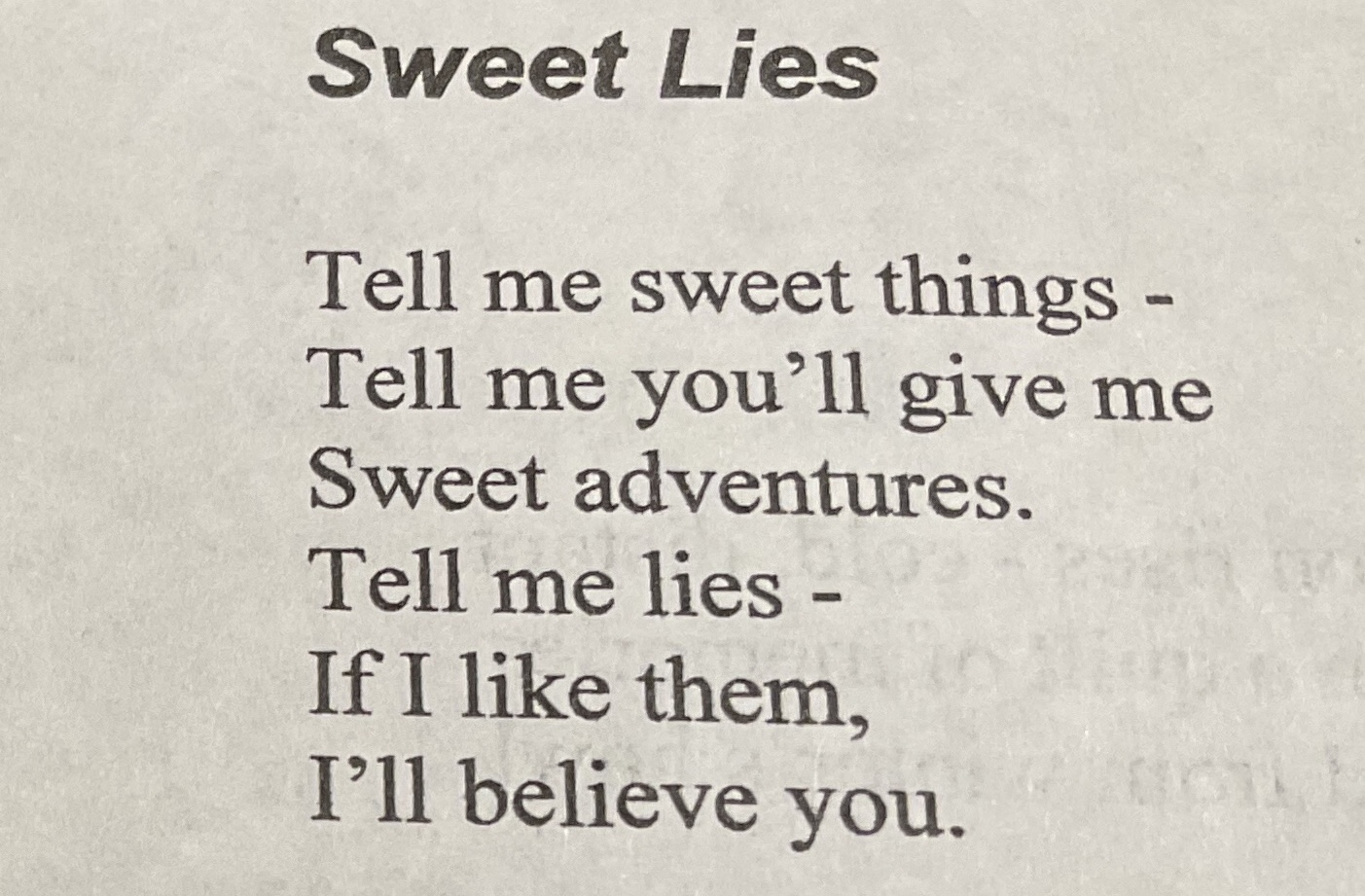
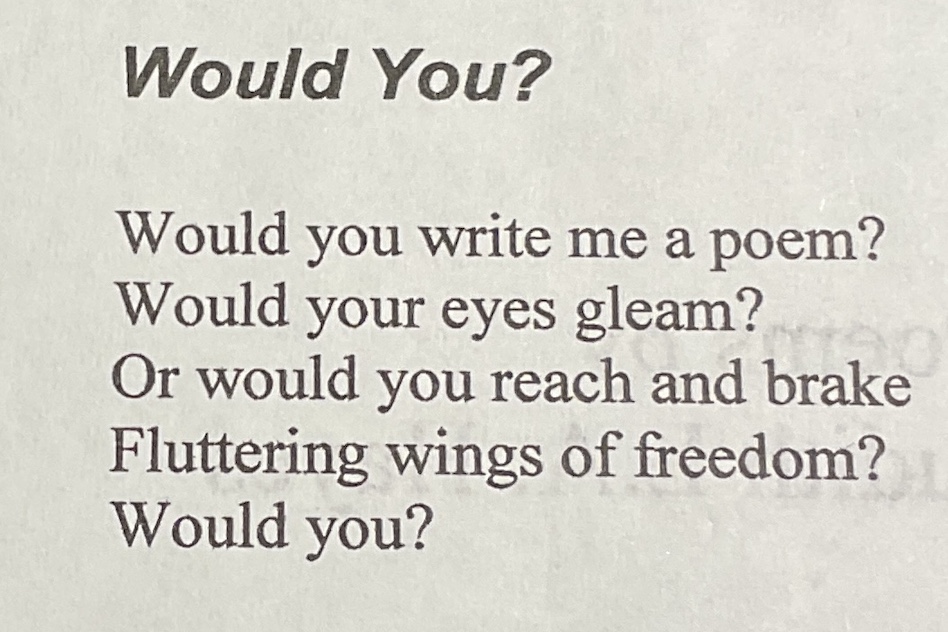
Judith wrote lovely poetry. Here are two of my favorites.

4

Castles

July has arrived, the peak of vacation time. How would you like to hang out in a castle? No problem, and you won’t even have to go to Europe. We have a castle a few miles down the road from our house.

Our neighborhood is a crazy mix of small homes like ours (1,200 square feet), moderately larger size homes, farm houses and super-sized luxury properties.

If our local castle is not your style, you might wish to stay in the lion house, named for the two stone lions that guard the long driveway that leads up to this gigantic villa. It has everything you need for a relaxing stay; tennis courts, multiple swimming pools, a full-size gym, a bar room, a media room and, almost as an afterthought, Lake Michigan in the front yard.

There’s only one possible hindrance to a stay at the castle or lion house and that is the price for one night’s rental. Both were originally built as single family homes. The 1% spare no expense when it comes to family comforts. Now both are upscale B&Bs without the second B. The castle goes for $1,450 a night. The lions command a heftier price, $4,500 for a one night stay.

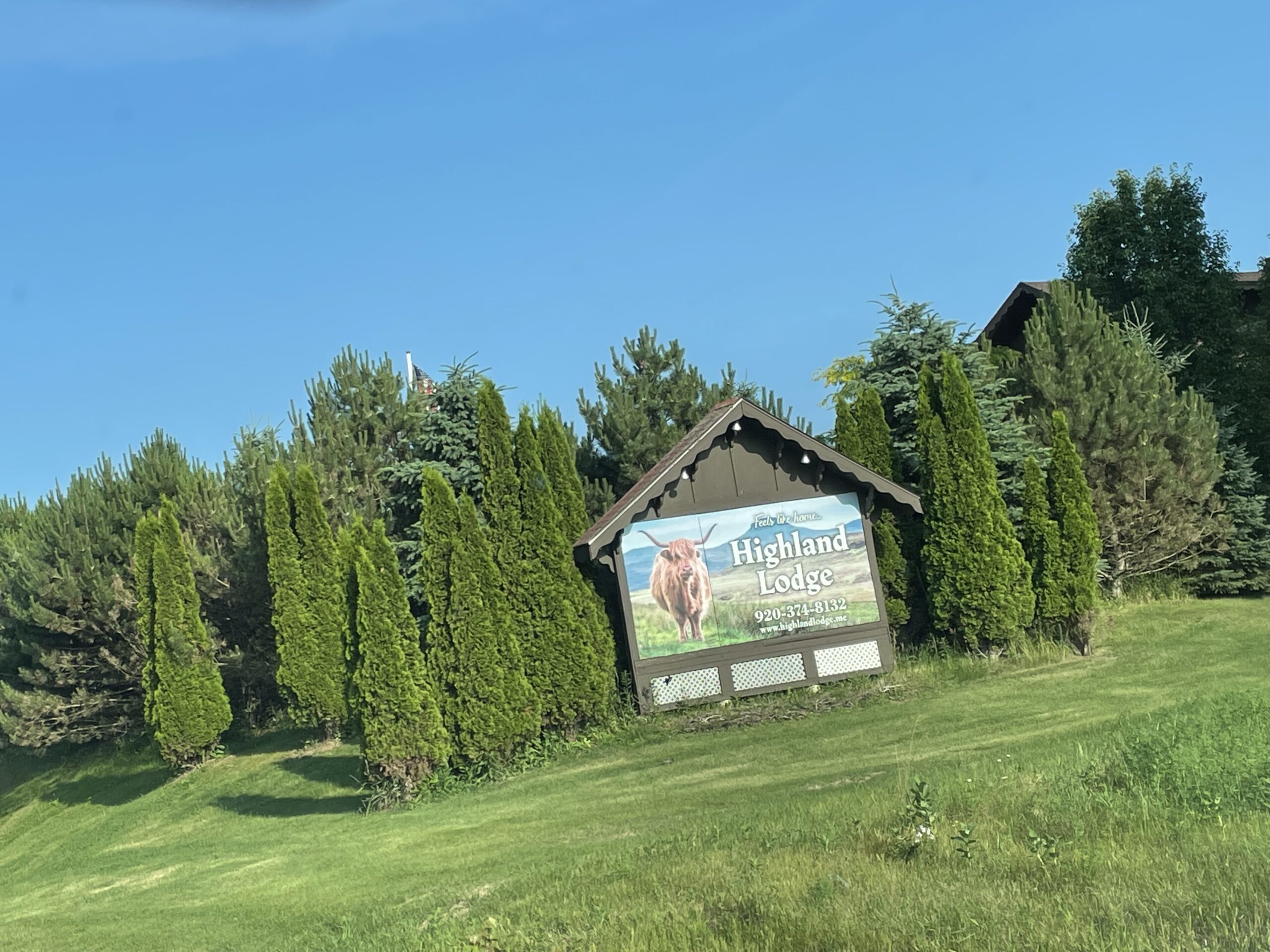
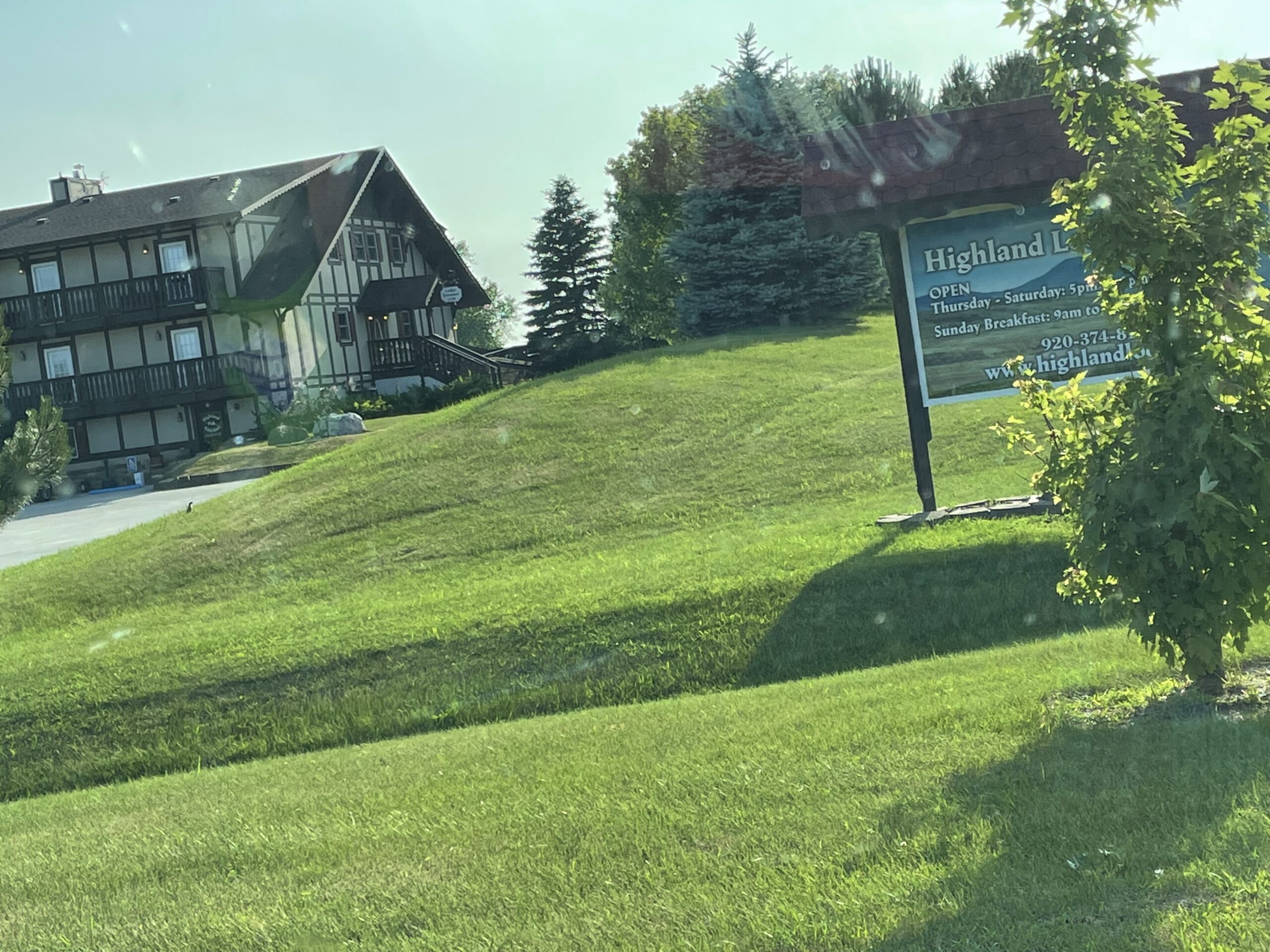
If you are not in this economic league, you can vacation in another local attraction, an authentic replica of a German guest house. One man’s dream, it was built by him and his family over a period of five years. The owners were not wealthy and put every cent they had into the project with nothing left for advertising. Sadly, their Gasthaus went bankrupt. Another local family purchased it and now it is called Highland Lodge and Pub, a bit of a misnomer. But it’s still a delightful place to stay and only $120 dollars a night…breakfast included.

5

Fourth

I made four attempts to write this blog. All failed.

For the past fourteen years, on the week of July 4th, I have abandoned the stated mission of my blog to stay out of politics. But this year everything I attempted to write sounded more like an obituary rather than joy about living in a Democracy. And rather than subject you, valued readers, to my angst and gloom, I have decided to turn this week’s words over to Molly Ivins.

A Texas institution and a brilliant political journalist, Molly used witty satire to lampoon “the self-seeking, the corrupt and the incompetent in positions of public trust.” May her words put a bit of hope, cheer and laughter into this once wonderful holiday.


“The thing is this: You got to have fun while you’re fightin’ for freedom, ’cause you don’t always win.”

“On the whole, I prefer not to be lectured on patriotism by those who keep offshore mailboxes in order to avoid paying taxes.”

“Politics is not a picture on a wall or a television sitcom that you can decide you don’t care much for. “

“Many a time freedom has been rolled back – and always for the same sorry reason: fear.”

“Whenever you hear a politician carry on about what a mess the schools are, be aware that you are looking at the culprit.”

“Americans are not being screwed by the Republican Party. They’re getting screwed by the large corporations that bought and own the Republican Party.”

“It’s all very well saying regulation is bad, get government off our backs, etc. Of course our lives are regulated. When you come to a stop sign, you stop; if you want to go fishing, you get a license; if you want to shoot ducks, you can only shoot three ducks. The alternative is dead bodies at the intersection, no fish and no ducks. O.K.?

“Cheer up, it could always be worse. You could be living in Texas.”


Molly Ivins died in 2007 of breast cancer. Her words continue to be very much alive. And needed.

4