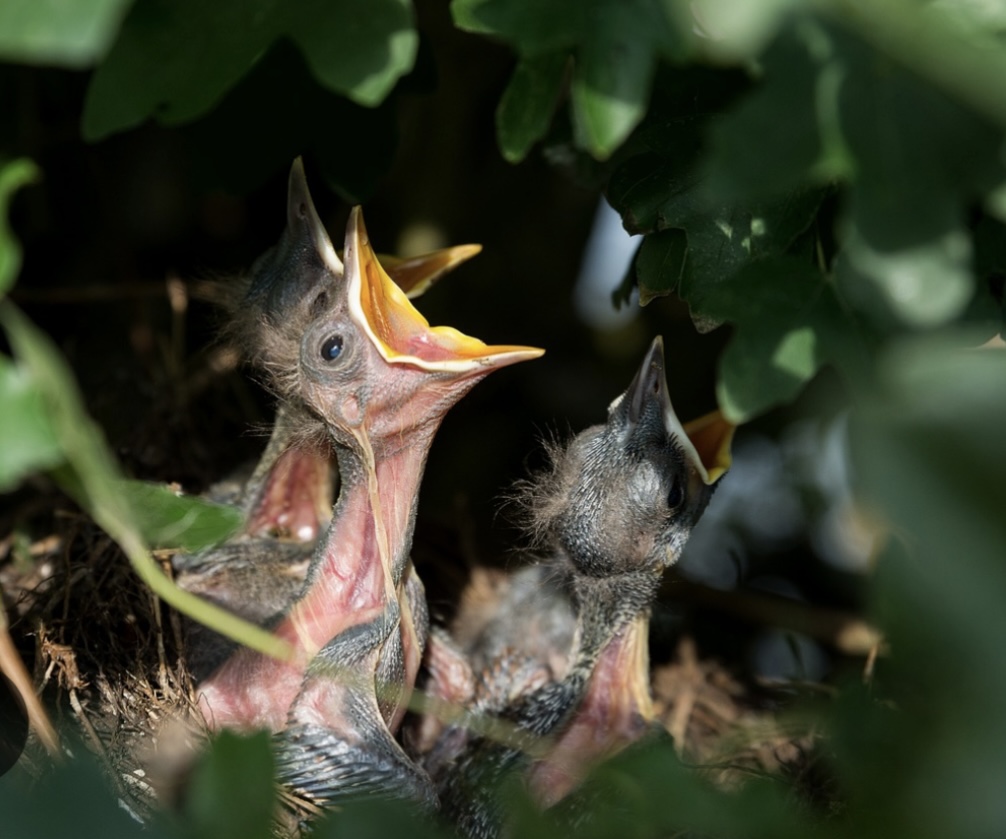
Most of us have been lucky enough to have had this experience. A bird finds its perfect nesting site somewhere on our home. We are able to be voyeurs on the entire parenting process; preparation, parenting, nurturing and fledging.
I recently finished an inspiring book, Nature’s Last Hope, by Douglas W. Tallamy, and have acquired a new understanding and appreciation of birds’ parenting skills. Before reading the book, I would have guessed that most birds (excluding raptors) were feeding their chicks insects or worms. Wrong. According to Tallamy, “Caterpillars are the mainstay of most bird diets in North America, particularly when birds are raising their young.” He whimsically but accurately describes caterpillars as “soft bags filled with food.”
Birds quickly stuff food down their young babies’ throats. Insects have hard outer exoskeletons which could damage the chicks. In contrast, caterpillars are squishy, digestible packages of proteins and fats. It would take 200 aphids to equal the balanced food value of one juicy caterpillar.
The nesting period is the most dangerous time in a bird’s life. The young birds must grow fast and learn to fly quickly to avoid becoming an easy meal for numerous predators. Most baby birds fledge after only 16 days in the nest. This means the parents will be worn ragged keeping their offspring fueled to grow at exponential speed.
A typical baby bird will eat a full meal 30 or 40 times a day. Thanks to the hard work of field scientists, numbers are available on how hard these parents are working. For 10 days in a row, downy woodpeckers brought food to their nest 4,095 times. Hairy woodpeckers delivered food 2,325 times. In a 16 day nesting period, chickadee parents delivered between 6,000 to 9,000 caterpillars to one nest of tiny birds. And then they couldn’t slack off but continued to feed the fledglings for 21 more days.
Not even the fussiest human baby or teenage boy makes these demands. Bird parents need to be inducted into a Parent Hall of Fame.
Wow! and what a cool photo!